Football is Racist

High school, college, and professional football are racist. I’m not the first to express this unpopular opinion and certainly will not be the last. Hopefully, the number of people who recognize how problematic football is will only increase. I have been wanting to and have been asked to do this post for some time. Please read with an especially open mind. Thank you. 

From roughly 1880-1930 instead of watching and participating in football (depending on the season) on a Sunday afternoon after church or lunch, White people lynched Black men and women and watched and participated in their torture.

Of course this parallel between football and lynching has a few eyebrows raised. As it should. The parallel is not perfect by any means, but, nonetheless, it is an important and relevant parallel when we consider the long history of sanctioned violence and discrimination directed at Black United Statesians. Football is also one very important aspect of civil religion in the United States.

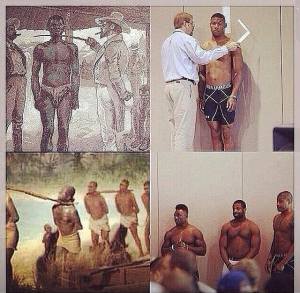
Football is racist because predominately rich White people pay to watch impoverished (I’m not just talking about money) men really hurt each other for entertainment. Most of these men are Black. For example, in 2011, 67 percent of NFL players were Black. Players “are owned” by rich White people. Black football players have little-to-no autonomy and control over what they do and little-to-no free speech. Many Black football players were forced or channeled into playing football as “the only option to avoid prison.” Football is extremely disastrous for one’s health.  

These thoughts, and others, are partially illustrated in the image below. This image was designed by a History professor I met on twitter who has since deleted his account, @darrengrem – since that time another use has taken this handle. His website is here.

racism and football copy 2

With the exception of conversations with my dissertation adviser and three or four colleagues/friends and a few family members, the reaction I get when discussing how football is racist is very negative.

Comments I have received in the past include: 

people do not choose to be lynched……but they choose to play football… [sic]

Hello black athletes have the same choice that any other athlete has play the game and make millions or work like the rest of non athletes hmmm let me see that’s a difficult choice NOT

I’m sorry, but your argument is completely ridiculous!

Black people have always been about money. 

They are too rich for me to feel bad. Millions of dollars

wow i really think you need to get out into the world and stop reading. ya know there are millions of blacks that dont play sports and the ones that do choose to, they are not forced they practice and practice just like their hispanic and white counterparts and they have to try out just like everyone else. the single biggest reason for racism today is because people wont let it die. not saying it doesnt exist but its like a scab, keep picking and it keeps getting more sore. how bout just treating people the same, the past is past, move forward

Why are you hating on football? For someone who thinks we should be tolerant and respectful, you are being the total opposite. I like football, and I always have, but it is far from my religion, and I’m really offended by that remark.

These reactions help speak to the blindness and to the inability to have exercises in thinking when it comes to football, and in some cases, these comments speak to racism, pure and simple.

Money does not really matter if you are unable to live happily and healthily.

We must have broader, more abstract concepts of wealth and choice and responsibly.

We cannot use football as an excuse to avoid important conversations about present-day systemic and institutional discrimination.

Black men need to be allowed to go to school and achieve all the greatness they want to achieve.

Black athletes have also spoken out plenty but we have to look for and listen to their voices. 

White people need to face their stereotypes and consider what en masse enjoyment of football suggests about their hopes and fears.

High school, college, and professional football need serious reconsidering.     

I guarantee in 20-40 years, football will be looked at as one of the nation’s all-too-many tragedies. The news is growing daily, if we listen closely. More and more discontent is being raised about football’s racialized and discriminatory nature. Sports were indeed helpful for advancing equality at one point, but today they function as a new kind of plantation, as termed by historians and sociologist. 


Please consult the following sources as starting points for more information: 

Youtube:
“40 Million Dollar Slaves,” with Bomani Jones — Race Scholars at Rice
LWS William C. Rhoden /40 Million Dollar Slaves
Forty Million Dollar Slaves
 (part 1 of 3)

Books:
The New Plantation: Black Athletes, College Sports, and Predominantly White NCAA Institutions
Forty Million Dollar Slaves: The Rise, Fall, and Redemption of the Black Athlete

Articles:
Lawmakers, Obama butt heads on football
The Superbowl, Bob Dylan, and American Civil Religion
HEAD TRAUMA IN FOOTBALL: A SPECIAL REPORT
Whites See Blacks as Superhuman 
10320566_10154146332315187_2676984778231100094_n

How much do we miss without even knowing it?

A lot.

Working memory (or short-term memory, using now-dated terminology) last a matter of seconds and can hold 7±2 chunks of information before it is gone forever, unless we make special efforts to transfer that information into long-term memory. 

But what about all the information that does not even make it into short-term memory? What about all of the endless bits of information we never even see that is right in front of us? I’m talking about seeing in terms of both information intake and in terms of understanding said information. Because, if we don’t see, really see information–even if we disagree with it–we have no chance of learning and progressing.

As a result of my cultural studies work and how it informs my teaching and research, I regularly am labeled as one who thinks too much, is thinking too hard, is spoiling the fun for others. (For previous discussions of this on my blog see this, this, and this.) I am always working on a way to effectively answer this criticism reaction. My latest thought is to simply say this is an exercise in thinking, creating, and exploring the limits of such. 

And recently as I was going through books planning materials I want to use when teaching Mexican American History, I realized that I too was once guilty of reacting with “reading in too much” instead of “I don’t fully understand what the author is saying” or “I understand…but still think the author is reaching because of…”

Image from The Buried Mirror: Reflections on Spain and the New World one of the books I’ll be assigning that I was assigned as an undergraduate: 

2015-07-11 17.19.50

Sometimes, we don’t yet know enough to really see. (Similar to how I carefully explain to students that sometimes you don’t really know enough to disagree per se.) Now, when I read this, the author’s analysis makes perfect sense. I also feel a bit embarrassed that I reacted with “the author is thinking too hard.”  

I find similar things when I re-read articles I first read years ago (or sometimes even months ago). As I learn more, I actually see–both intake and understanding–more information and more ideas each time because I am always learning, and in this process, the ideas make more and more sense and connect to larger and larger edifices of thought. This especially applies to theory-heavy articles, which I like more and more, as I understand the full picture more and more. 

We would all do well to remember that we miss something like 99% of what is in front of us 99% of the time. Additionally, we all, in every way possible, literally, see, hear, and experience the world and information directly in front of us in unique ways. We constantly misunderstand each other and misunderstand texts. So while we miss a bunch, we experience everything in an individual way!

Always be open to learning and thinking. 

A Few Important Defenses of Sarah Palin

The Sarah Palin presented in the media certainly has problematic ideas, but a few, and very important, words need to be said in her defense.

For some time now, I have been deeply disturbed by the images and stills used in articles about Palin. (Photos below as evidence-not to perpetuate such photos.) They are all deliberately “bad photos.” No one enjoys seeing bad photos of themselves, especially deliberately bad photos. So-called liberal news sites are particularly guilty of using bad photos. These clearly off-putting photos add–psychologically speaking–to the degree to which we’re automatically not supposed to like and/or trust her and even “have permission” to dismiss her ideas and laugh at her. Words and actions, not digital constructions of light supposedly representing a person, should form our perception. The media should use nice, reasonable photos and stills to give her a more equal chance (male privilege already limits her possible platform). 

Such photos harm all women and all men. Women and men, boys and girls need positive, realistic images of women in the media. Having such “bad photos” available and everywhere en masse is distinctively a phoneme of the Internet. Before, such photos had no audience, per se. So-called liberal-leaning websites that seemingly promote the best for women in other circumstances need to remember Sarah Palin deserved/deserves a fair chance and the consequences of such for all women.

I also wonder if the degree to which the media and the status quo gives Palin the attention it does to distract from other issues and/or to make all women look bad or questionable: And this is problematic. (Added July 8, 2015, 10:52 PM – we need to ask why Palin and not other women get such media attention. It’s not in the power structure’s best interests, per se, to give fair, frequently attention to women calling for en masse equality, for example.) 

Additionally, we must remember that Palin is a daughter, mother, grandmother, friend, and so on.

We shouldn’t so throughly dehumanize Palin (her ideas are products of society, after all) and by extension, if we apply semiotics to these Palin texts and rhetoric, all women.      

Important Conversations: What Does it Mean to Come to Terms With the History of Slavery?

This blog is intended as a reply to my friend and fellow historian Nick Sacco and his blog, “What Does it Mean to Come to Terms With the History of American Slavery?” I encourage others to reply, too! 

As Nick said, with this question “the tenuous intersections between past, present, objectivity, and activism all came to a head in one very complex question.”

First, in order to come to terms, we must fully, without exception, accept that enslavement existed in the United States and was interwoven throughout the nation, South and North. As a slave society, laws, religious practices, educational systems and mores, celebrations, and economic practices, to name just a few examples, were all developed with enslavement a cornerstone the cornerstone.

The United States as a modern nation state was born at a time when enslavement was thriving and considered perfectly normal. At this same time, racialized (and sexualized) science supported notions that Africans were inferior beings. Johann Blumenbach and his students were among the forerunners of codifying such ideas that are now considered pseudoscience.    

People and institutions have got to accept that the United States is forever scarred by all of its actions.

As a very imperfect parallel but hopefully illustrative, I have had four surgeries. Brain surgery was the first one at age four. In ways that are still present every day, this surgery (and the others) have forever changed things in dramatic ways.

No one would deny the longterm effects of such surgeries. Why then do we deny legacies of enslavement?

Coming to terms with this history (and enslavement) means, very simply, accepting that it happened and that it can never be erased from the cultural, economic, and political DNA and artifacts of the United States. 

And accepting that enslavement existed means coming to full terms with where, when, and how it existed. While 1619 is the widely-agreed upon date for the beginnings of enslavement in the British Colonial North American colonies, recent studies have suggested it existed earlier than that. Additionally, enslavement in Colonial Spain, present day areas of Texas and Florida for example, had enslavement a century before 1619 – although by no means fully established until much later. As I always enjoy doing, we must challenge the typical geographical and chronological boundaries of United States History. Recognizing the middle passage and DNA are important, too.  Coming to terms also means having a public aware that History evolves in good and bad ways (consider Birth of a Nation and Gone with the Wind phenomenons).

Coming to terms with enslavement means placing the United States’s institution into larger World trajectories. Slavery has existed for thousands of years and continues to exist. One difficulty with studying enslavement then or now is that we’re not supposed to see it, so to speak, and few first-hand accounts exist because enslavers see “property,” not humans, and said property can have no feelings or thoughts. Because of this difficulty, it is frequently all too easy for deniers to deny. But, before we move forward, we must emphasize that slavery in places such as the United States was very different than enslavement as it existed before the 1500s in the New World or even before the late 1700s when the United States was more a “society with slaves,” not a “slave society.” 

Additionally in order to come to terms with slavery, comprehensive stories need to be told where possible. Some people I hypothesize are turned off by only hearing about enslavement because it is such a tragic chapter. While enslavement is absolutely most tragic and these stories need to be told, we all need wider conversations and celebrations about those not individuals racialized as Black who were not enslaved or who accomplished documented, awesome things -without exaggerating. Black individuals had and used their agency! At the same time, too often historical memories jump from enslavement to the 50s and 60s. The time in-between–the Culture of Segregation and its practices of re-enslavement, re-disenfranchisement, lynching, and rape–are too often neglected or highly abridged. These narratives, along with what is widely-known as the New Jim Crow today, are important so that people have an opportunity to realize that enslavement is just one of several periods of tragedy in the United States’s past and treatment of Blacks. And, sadly, I don’t really think that many United Statesians know anything about all of this. 

Coming to terms with enslavement also means recognizing the United States’s attempts to enslave Indians and its mistreatment of every group outside of the status quo. And this is where it gets especially, even more difficult and frustrating. People are very resistant to accepting their nation, their body (to use the surgery example — which considering notions of civil religion might be really applicable) is guilty of so many wrong-doings. Like with surgery, of course, no one alive today is in any way responsible or caused actions in the past, but, nonetheless, we are forced to live with the resulting changes.

Coming to terms with enslavement means talking about racism and systems of privilege. People drive me nuts, and they are very misguided when espousing “if-you-stopped-talking-about-racism-it-would-go-away” rhetoric. Talking about tumors does not cause tumors to grow, to once again use our surgery rough, very imperfect parallel. Productive conversations always, only help.                   

Nick asks:

But what are the future implications for society’s coming to terms with slavery?
If society started sincerely coming to terms with enslavement, the future implications would only be positive. In addition to the above, such coming to terms would by necessity require society en masse to commit to meaningful and long-term individual, social, cultural, and institutional reform. And I don’t know if society is prepared for or even can take such a long-term commitment. Our
governments cannot even plan ahead when it comes to schools or roads.     

“Does it matter whether or not we acknowledge the past so that we can ensure a more just future?”
I don’t think it’s a matter of whether or not it matters, we are able to live only because we acknowledge the past. To take a mundane example, I read Nick’s blog last night and planned to reply today. The same thing with memory and historical memory. Our lives are completely full of the past – it’s what allows us to exist. These same basic notions apply on larger scales, including when examining enslavement. Acknowledging the past, then, is not automatically connected to a more just or unjust future. Arguably, most people use a certain kind of acknowledgment about the past to perpetuate their own interests–although without fully realizing what they are doing and how they are hurting themselves.
Evidence matters.    

“Does coming to terms with slavery mean historians should be advocating for policy reforms and other collective actions like peaceful protests?”
Absolutely! As “guardians” of historical literacy,
historical evidence, and the like, historians should establish and use their voices to try and make the world better. Historians, and other scholars, have ethical obligations to try and make the world a better place and  to “talk” to large audiences. Activism, guided by evidence and sincerity, is always good. Such efforts and interactions with publics, even if not directly about enslavement and coming to terms, would probably have the consequence of helping there, too. Maybe that is part of the solution….solutions that work toward equity for Blacks by somewhat/occasionally having past racism and enslavement somewhat foregrounded, per se. 

“What can I say and not say as a professional historian in uniform speaking on behalf of the federal government to the public?”
Legally, I guess, this depends on official policies. But, we all know there is a gap between the de facto and the de jure. A balancing act is in place for sure, and this applies to anyone in any kind of teaching position, especially when feelings are especially up in the air. Ethically, we should, of course, only say what is best known based on evidence. But again, feelings come into play. Discussions around enslavement are always difficult, and there is not always time to allow people, White or Black or of other racializations, to get their emotions out in order to then possibly move to content. In order to come to terms with enslavement, people have to be able to talk about the past in reasonable, coherent ways.  

◊◊◊

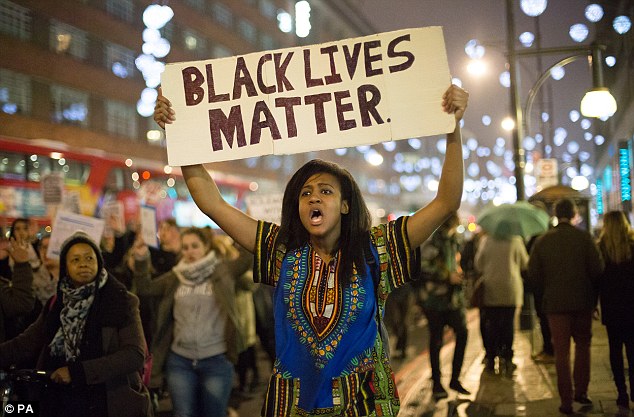
So, concluding and going back to the original question – there is no one, no easy, no easily stated answer to the very important question about coming to terms with enslavement. Enslavement is forever part of the tapestry that makes the United States. By not coming to terms with enslavement, which is possibly impossible or an effort that would take a few generations, we will only have more national tragedies like what just happened in South Carolina prompting important #BlackLivesMatter movements.

Slave-ship

The Racialization of Clothing

As we move through our world, because such movement is so everyday, we seldom stop to consider the obvious. I frequently think about what clothing signifies to others, specifically the ways in which clothing is racialized. What follows are working thoughts. Please add your own to the comments. 🙂 

As we move around at school, work, or while shopping, we are always “performing” – most people perform gender, voluntarily and involuntarily, in ways that are immediately classified as either male or female. But, we don’t think about the process of race as much in this case. 

For one thing, the idea is that, for example, black pants, a white shirt, tie, and sport coat tends to be, historically and culturally, racialized as White. This type of clothing was the stereotypical dress code for (White) men of the 40s/50s/60s who had professional jobs or went to college. These opportunities were not available to individuals racialized as Black. In cases, because of the culture of segregation, such clothes were not always even available to non-Whites. 

Think of how the clothing Black maids wear in The Help is clearly racialized as Black and gendered as female. Such a uniform automatically results in assumptions about social class, education, and thus race and the lack of Whiteness. Whiteness=power and opportunity. 

Clothing is far more than what we wear to “be decent” in public and keep our bodies clean and warm, it communicates many, many nonverbal messages that our brains automatically process. 

Another example would be a “performance” or “uniform” consisting of a backward hat, baggie shirt, and baggie and low-sitting pants. Such clothing is classified as “trashy.” And the people wearing such clothing might be racialized, per se, as Mexican, Black, or perhaps “White trash.” “Pull your pants up” signs embody code-racism and occasionally, perpetuate problematic notions of politics of respectability. 

For wealthy/privileged folks, our clothing, including makeup for those who use it, indicates conscious and unconscious rhetorical choices about the kind of messages we want to send to others. These messages have cultural connotations related to wealth, authority, safety, status; and thus racialization, given historical and on-going significance of racialization and vastly differing economic opportunities.

For example, some studies show those who are dressed formally are less likely to be robbed or attack. Being “dressed up,” a culturally constructed notion made by the status quo, indicates real or unreal wealth and thus Whiteness or access to Whiteness, per se. 

One problem develops because not everyone can afford the cost and upkeep of “nice clothing.” Looking at issues beyond clothing and racialization per se but connected when considering intersectionality, not everyone is comfortable wearing such clothing or being required to conform to cisnormative cultures. (See, (I Hate) Professional Boy Drag“)

In another example, think of a Woman with skin that is a light brown color (phenotype) at Chick-fil-A. If she is behind the counter working the register in the regular uniform, she is more likely to be racialized as non-White (Black, Hispanic, Middle Eastern, etc.). If she is on the other side of the counter with her two kids and family wearing jeans and a shirt, more likely to be racialized as non-White and perhaps a stay-at-home mom or unemployed individual. If she is behind the counter dressed in ways we deem very formal, she is more likely to be assumed as the owner or manager and racialized as White. A tall, cis-male with the same skin would be racialized as White quicker and by more people. (See, “Race is a Relationship and Not a Thing”).  

Different clothes not only make a person look very different–usually my preferred outfit is black jeans and a long sleeve gray shirt, not dress pants and a dress shirt–they communicate a variety of messages. So, as you get dressed and move around the world, please consider the ways in which your clothing is racialized and more importantly, the consequences of this for others. Try to avoid “looking nice” as simply a perpetuation of Whiteness and White Privilege. Be conscious of what such clothing signifies when life requires it. 

None of this is to say we should stop “seeing” racialization–such is an impossibility, we see it, and we need to see it to have any hope of making continued progress.      

Clothing, of course, is also sexualized, genderized, etc., etc and influenced by such mores. Height and weight and body shape also influence these factors and racialization–all of which are related to clothing, too.

And much of our clothing is made by individuals in horrible working conditions.  

Thoughts? I know these ideas need further development. It’s all very complex! 🙂 

vintage-clothing

Toward an Explanation of Fundamentalism and Freaking Out over Equality

marriage-equality-red-3

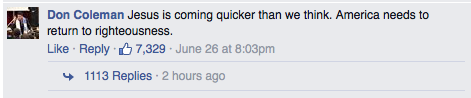
Religious fundamentalism was born, as was the contemporary Republican Party (although not conservatism – we can’t mix the two), in opposition to reforms during the Liberal Consensus. Most, if not all, of this opposition was directed at opposing equality for those racialized as Black.

The contemporary church and its leaders, with at least some important exceptions and the number of exceptions has been growing (see Mark Sandlin’s blog, for example), has long opposed various notions of equality, science and intellectualism, various points of view, and true adherence to separation of church and state.

I saw one comment where someone said, it was never about getting religion out of the government, only government out of religion. Meaning that Fundamentalist Christianity should influence the State, but not the other way around. Separating the two is, for sure, hard.

Regarding marriage equality in particular, at least a handful of vocal Fundamentalist Christians are being very vocal about so-named “religious liberty laws.” Texas has just today decreed that clerks or judges who “sincerely disagree” with equality, can break the law. This line of thinking doesn’t make sense, of course. People cannot use their religion and beliefs to prohibit women or not pay their taxes, for example. And it ignores the rights, the sincerely held rights, of those who wish to marry, to be treated equally. Once again, the “religious liberty laws” only apply if you are in the status quo.

What about my sincerely held belief that equality should be the law and people who oppose it have to dance in the street until they are happy?? 🙂 

So why the hate? Why the opposition to equality and freedom, again and again and again when it enters the national spotlight? 

While it is easy to analyze such opposition in terms of willful ignorance or aggressive ignorance, it’s much more complex. People are largely products of their society, even parts of their biology and DNA are products of society. 

Perhaps a few reasons help explain the hate. 

Some are that Fundamentalist Christians are raised in a culture, in a church where:

1) “every” action they take will determine whether they go to Heaven or Hell forever;

2) “every” action they take or their society takes (etc) could affect whether their children and grandchildren go to Heaven or Hell forever;

3) they live in a “dangerous” world where they have to look out for themselves and their family far before anyone else;

4) as “saved” individuals they are told they are part of an elite group of humans among all the billions who have lived;

5) that they can be punished for the “sins” of others, “sins” that could bring about the destruction of the Universe (I mean “Earth”);

Screen Shot 2015-06-28 at 7.45.26 PM

6) “eating” from the the tree of the knowledge of good and evil (read: learning, thinking, questioning) is what brought about the worst punishment on humanity ever; 

7) almost everything is a “sin,” especially human nature; 

8) LGBT people were deliberately painted as the lowest of low for much of the mid-to-late 1900s, see, e.g., Boys Beware and CBS Reports The Homosexuals. In most cases, this was done by churches and the media and the government knowing they were only promoting unfounded fear. Thus, some of today’s adults were brainwashed as children. (Is religion child abuse?)

In sum, learning, changing, accepting difference, accepting that you’ve been lied to makes it hard, if not impossible, to internalize and overcome hate. 

Thoughts? 

 (Added 6/28/15, 9:57 pm, for a somewhat parallel perspective, see, “The Supreme Court Just Gave American Evangelicals a Gift“)  

9 Different Textual Readings of a Makeup Advertisement

2015-06-25 14.52.01

Approaching Dillards at Baybrook Mall the other day my eyes immediately came across the above advertisement before I could even walk in the store.

There are several possible ways to interpret this advertisement. As a thought exercise (H/T to Aaron and Andrés for the challenge to look for and articulate more POVs occasionally), I am going to offer a variety of interpretations of this advertisement, all based on different perspectives of the same social constructions. Please comment with other possible readings of this text! My own personal opinion, informed by feminism, history, sociology, psychology, critical race theory, etc., revolves around the possible damage it does and how it perpetuates the status quo, but there are, naturally and of course, other readings possible. Which one is most valid, per se? Depends a lot on your perspective and place in the world.   

  • This ad is offensive with its suggestion that (White) Women do not look “amazing” and do not have agency and need said product to look “amazing” and that they can only look “amazing” with the help of said product. Said ad suggests that aging, dark circles, and fatigue–all natural biological occurrences–are wrong and to be avoided. This is one example of countless in our world today that promotes particular and rigid rules for how women (and men) should look. 
  • This ad offers encouragement to (White) Women. What woman wouldn’t want to look “amazing,” especially if said product is free (initially!!) and only takes five minutes? Given the pressures in today’s world, a new look or some product can do a great deal to give women a psychological boost. 
  • This is one of many such ads in a capitalistic world. Women can select to use this product or not based on experience, trial and error, cost, and availability. No harm is done by a sign alone. 
  • The authors’ intent, of course, is to sell products. They use what works to make a living, given our world requires money to eat and live, and to make a profit. Given these factors and the ad, obviously such factors work, are needed, and serve to make a productive economy. 
  • People have long, long been concerned about how they look. The world is still moving along. A poster such is this will not do any harm and will actually do good. 
  • This ad is exclusionary. From a Queer reading, this advertisement assumes and suggests we live in a world where all “females” identify as “women” and all of them use makeup, and it assumes we live in a world where are “males” identify as “men” and do not use (and shouldn’t use) makeup. The world, social contractions of sex and gender, and who desires to use makeup or not is far more complex and diverse. 
  • This ad is exclusionary. Only a White woman, “the ideal of beauty” in US cultural history, is featured, as is so often the case. This also relates to that makeup and film and photography were designed to project and emphasize White people as beautiful.
  • This ad is exclusionary. Similar to most such ads, this ad assumes that every one can see (and see in a color-normative way -colorblind people exist, too).
  • This ad is exclusionary. Only women who already have enough time and enough money will have the chance to “look amazing.” Classism and racism have no place in public places. 

Again, please comment with other possible interpretations of this text and which one most resonates with you. Doing this exercise was fun, for sure. While I do not think all of these readings are equally valid, e.g., we know from studies that makeup and sexualized/genderized mores causes hard, I came up with interesting readings and ideas that I would not have thought of if I had just posted a critique about the ad’s sexism, as originally planned. 

Thank you for reading. 

Black Lives Matter: 13 Things I Would Rather See Happen Than Confederate Flags Removed

Of coursewhat people consider (and thus what is) the Confederate Flag is racist (as are almost all things associated with the South at that time)–symbolizing hatred by 2015-mores to its core. Any examination of political and cultural rhetoric in the South during the 1850s and 1860s and 1870s shows this, as well as uses of this flag since the 1920s. The speed and force with which people have come out en masse; articles such as this one, this one, and this one; Walmart pulling the flag; and the governor of South Carolina speaking all speak to the power of social media (as Dr. Yaba Blay says) and contemporary mores associated with modern liberalism.

My concern, however, is that the current attention around the flag is and will continue to distract from much more serious, much much internalized, much more systemic, much more institutionalized issues. Yes, the flag being removed from public, official “memorials” is a great thing and is much needed, but it just a tiny, tiny, tiny step toward what should have been done centuries ago.  

  1. Non-White fictional characters featured in legitimate, seriously-considered roles such that POC of all ages are represented in positive ways. Representations matter because they create the impressions people have.
  2. A complete halt on Black Men being singled-out for “crimes” and given much harsher sentences. An end of Black Men being killed and beaten up by White people.
  3. Serious coverage and respect given to Black History and culture and listening to Black people.
  4. Required high school and/or college courses in African American Studies taught by experts.
  5. Serious affirmative action-like and reparations-like programs, as well as understandings of equity vs. equality. Equity is what we need. (See Ta-Nehisi Coates’s article.)
  6. The end of “voter IDs” and life-long disenfranchisement for people imprisoned and other tactics that function as Neo-Literacy Tests/Poll Taxes.
  7. The end of Republican and Tea Party racism toward President Obama.
  8. The end of pushing Black Men into dangerous sports in high school. Yes, football is racist.
  9. The end of accusing Black Women of being “welfare queens.”
  10. The true end of de facto and de jure discrimination, including segregation and pay inequalities.
  11. A recognition of the legacies of enslavement.
  12. The end of you-are-suffering-from-white-guilt attacks on White people who care.
  13. A sincere recognition that racism and White Privilege are alive.

black-lives-matter-lol1