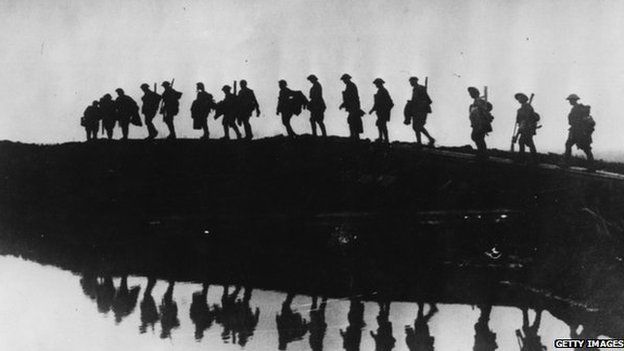
Now, of course, I know that World War I took place from 1914 to 1918 at the beginning of the 20th century.
However, historians and non-historians alike rely too much on dates and how we group these into clusters like “decades.” As critic and philosopher Susan Sontag argues, decades are mere social constructions. Going by how we think, it’s almost as if there is a complete and total disconnect between December 31, 1899, 11:59 PM and January 1, 1900, 12:01 AM – a time when the day, month, year, decade, and century changed!
Indeed, how we study and how we learn about World War I, for instance, is artificially very deeply rooted in characteristics of what we call the 20th Century. Imagine, if you will, that our system of numbering years started twenty years later–with nothing else changing. This would put the American Revolution in 1756 and World War I in 1894-1898. How would this effect how we think about World War I? How we think about the 18th and 19th Centuries?
Such re-thinking when it comes to timelines and unquestioned methodologies is important.
Thinking about World War I and values and ideologies we attribute to the so-called 19th Century, World War I does fit – in some ways maybe even more so than with the so-called 20th Century – given that World War I was about technology and nationalism.
And continuing this line of thought, shifting the years would place the great depression as the historical grand entry into the 20th Century. How does this alter how we think about the following 100 years? (And then again here too we quickly fall into the trap of artificial boundaries.)
How would our conceptualizations of the “revolutionary” “1960s” be different if we shifted the decade by five years? Whereby what occurred in 1960 would be said to have occurred in 1955 and so on. So the “60s” would be what actually happened from 1965-1975?
Consider the “disconnect” too between 12/31/2003 and 1/1/2004. People talk about events in 2003 or in 2004 but not from July 13, 2003 to July 12, 2004. Why? Both are equally artificial and useful and unuseful.
As humans, we need groupings. It’s an important part of the psychology of how we learn. But, when we let such groupings (overly?) guide our thinking, the consequences result in overly arbitrary understandings based on arbitrary measurements.
As an exercise of thinking, take time to think about how your understandings of eras are weakened and then maybe strengthened by concepts of months, years, decades, and centuries and shifting these around. Conceptually play with such notions and see what new understandings emerge.
Andrew Joseph Pegoda
Is the start of a new decade, for example, really the cause of such major change?
People either love or hate Full House (1987-1995) and now Fuller House (2016-). One of many reasons to love these shows is that they provide a Queer outlook on family life, which has been almost completely ignored by the blogosphere. A “queered” analysis examines the ways in which a text relates or does not relate to what society has labeled as “normal” masculinity, femininity, and heteronormative structures of family, relationships, and sexuality.
Pause for a minute to recognize the conservative environment of the late 1980s and early 1990s (read more about the Conservative Consensus) in which Full House emerged – a show where, in the true spirit of the sociological concept of “fictive kin networks,” a group of non-related people fully function as a happy, healthy, and “normal” immediate family.
Full House features three dads–the biological father, Danny; Danny’s best friend, Joey; and Danny’s brother-in-law, Jesse–and three daughters. When Jesse and Rebecca marry and have kids the household has three dads, one mom, and five kids. Throughout all of the shows, the adults are equally engaged with all of the children and various household responsibilities. Danny and Joey never marry and seldom date, which provides a strong message that marriage and constant romantic love is not required for happiness.
As a result, Full House is anything but a “typical family”–although there is no such thing–and this television family does not come close to fully subscribing to or endorsing so-called “masculinity,” as happens far too often in popular culture. And this is without even talking about their neighbor Kimmy, who might as well be a daughter, and other reoccurring characters.
Now Fuller House features a household of moms and kids.
Full House and Fuller House are only simplistic portrayals of life (an often repeated criticism) when we fail to consider that one of its biggest and most important messages is that good, important, and meaningful families and relationships AND identities come in all shapes and sizes, and as Melissa Harris-Perry recently said, raising children is the responsibility of each person in society. By Queering this unique television show we can appreciate it in an entirely new set of ways.
I spoke with my friend Trevor Boffone, an expert in Latin@ Theatre and Literature and a professor of Spanish, about his latest exciting adventures. Please check out our conversation below and be sure to visit his websites, linked below.
AJP: For people who don’t know, who are you, and what is your experience?
TJB: I just finished my Ph.D. in Latin@ Theatre and Literature from the University of Houston in December 2015. Although I’ve always loved theatre and grew up in a theatergoing environment (and donned a Hungarian accent as Professor Fodorski in All American my junior year of high school), I never formally studied theatre or made theatre beyond high school. My BA and MA are both in Spanish with a heavy emphasis on Latin American Studies. Most departments are traditional and largely exclude U.S Latin@s from the conversation. So I never really had any formal (classroom) exposure to Latinidad for the majority of my life. I simply didn’t know it was something I could study.
Midway through my MA in Hispanic Studies at Villanova University, I “discovered” Latin@ theatre. I was taking a Latin American Theatre course and my partner Kayla suggested I read a play called Anna in the Tropics by Nilo Cruz. I read the play, published an article on it, and was hooked. In many ways, I began to decolonize my brain and realize the tremendous work of Latin@s in the United States.
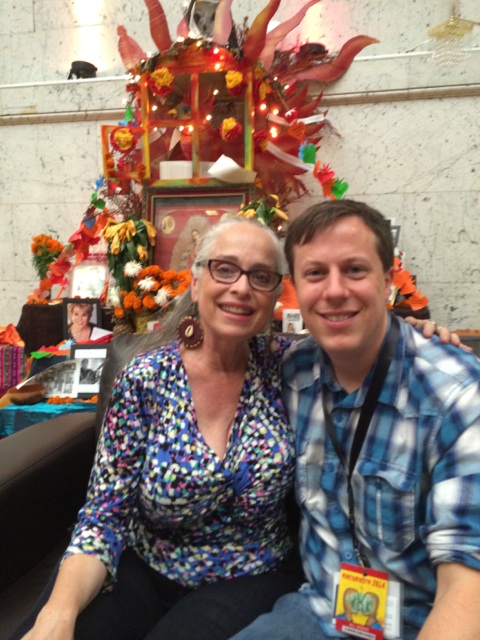
Pictured, Josefina López and Trevor Boffone
My interest in theatre remained largely academic for a few years until I met Josefina López in 2012. As I tell everyone, she changed my life. She made me see myself as an artist (perhaps for the first time in my adult life). She made me feel like I belonged. She made me feel like I could make a difference through my work. She made me feel like my work could go beyond the university and truly engage with the community.
Long story short—my relationship with Josefina set me on a path that led me to becoming a member of the Steering Committee for the Latina/o Theatre Commons (which has also changed my life!), to championing the Café Onda Editorial Board, and to starting the50 Playwrights Project.
I am here now, doing this work, because of many people, but several deserve a special shout out—Magdalena Gómez (pictured with Trevor in the featured image for this blog), Mercedes Floresislas, Abigail Vega, Marci McMahon, Jorge Huerta, Teresa Marrero, Tiffany Ana López, and Mariana Alegría.
AJP: And then so what is the 50 Playwrights Project?
TJB: The 50 Playwrights Project (#50PP) is a digital resource dedicated to contemporary Latin@ playwrights and other teatro allies.
The 50 Playwrights Project is engaged in filling the gaps about contemporary Latin@ theatre artists. This project serves as a dramaturgical and pedagogical database for artists, educators, scholars, and students who are looking for more online information about playwrights: where are they from, how do they identify, what are they working on, what advice would they give to aspiring artists, links to relevant online resources, and so on and so forth.
The first iteration of the project will feature 50 short, to-the-point interviews with contemporary playwrights working in the Latin@ theatre movement
AJP: What drew you to starting this exciting project?
TJB: This is the resource that I wanted as a graduate student. For years, I’ve followed Adam Szymkowicz’s “I Interview Playwrights” series which, while a fantastic resource, doesn’t include many Latin@ playwrights. For years I went back and forth about making the leap and starting the project, but always found an excuse not to—mostly as a result of the “publish or perish” mentality of academia.
By chance, I crossed paths with playwright Josh Inocéncio in early 2016. We had just missed each other for years, but finally connected once he moved back to Houston after finishing his MA from Florida State. I randomly ran the idea by him one Wednesday afternoon and by Monday I launched the project.
AJP: I know you’ve already published a number of these interviews. What kind of response have you gotten so far?
TJB: The response has been so positive and supportive, especially from the playwrights. At first I reached out to my network of playwrights, but soon received emails from playwrights I had never heard of and from writers that I didn’t think would be interested.
Luckily, I’ve had the support of several key organizations (and their members) to help promote the project: the Latina/o Theatre Commons, Café Onda, and Nuestra Palabra: Latino Writers Having Their Say. Additionally, the playwrights have done a phenomenal job of supporting the work and sharing the interviews with their networks.
AJP: That’s really exciting. I’m glad people are discovering 50 Playwrights Project so quickly.So, the big question, what happens after fifty people have been interviewed?
TJB: This is something people keep asking me and, at the moment, I don’t have a definitive answer. I have created an advisory board of sorts—Kayla Boffone, Claire M. Massey, Andrew Joseph Pegoda, Josh Inocéncio, Jasminne Méndez, and Lupe Méndez—that I bounce ideas off of (and these are the six people who have been instrumental to starting this project). I’m currently brainstorming ideas for the second 50PP series: an alternative interview format, 50 monologues, 50 testimonios, 50 guest posts, 50 lo que sea.
AJP: So often our projects evolve in sudden, last-minute ways. I know the next forms will be just as exciting. And I’m so honored to be able to help out. In its current form, who all do you hope to interview, and what do you want readers to learn?
TJB: I am committed to featuring the full spectrum of Latin@ playwriting and the Latin@ experience. I want #50PP to be a space that everyone views as welcoming and a safe space to express ideas. The 50 Playwrights Project will not just feature established veteran@s such as Migdalia Cruz, Josefina López, and Caridad Svich, but will boldly feature new, emerging playwrights such as Josh Inocéncio, Krysta Gonzales, and Wilfedo Ramos, Jr. To me, part of the beauty of the project is having a playwright who has never received a professional production (por ejemplo, Josh Inocéncio) next to a playwright who has won the Obie Award for Lifetime Achievement (Caridad Svich).
I hope readers will use 50PP as a starting point to learn about playwrights: ones they already know and new ones. I hope artistic directors and literary managers read about one of these playwrights and decide to produce them. I hope a graduate student does a google search for “Latina/o playwrights,” finds 50playwrights.org, and writes a seminar paper on Mercedes Floresislas. I hope that seminar paper becomes a dissertation and that dissertation becomes a book.
AJP: What can people do to support your project specifically and the arts generally?
TJB: My main goal has and always will be for 50PP to make it into the college classroom. I want professors to share this resource with their students and encourage them to learn more about playwrights they might have never heard of before.
I can say my journey has been richer for working with emerging playwrights such as Mercedes Floresislas. What started as an email introducing myself and asking to read Tamales de Puerco has grown into something so much more and something that continues to nurture my work as a scholar as well as my relationship with Floresislas.
People always ask me how they can support Latin@ theatre. And I believe the answer is simple. Be open minded and willing to try new things. Go to the theatre. Go see a play by a writer you’ve never heard of. Buy published plays. Read content on Café Onda. Share with your networks. Tweet it. Talk about it. Donate to the Latina/o Theatre Commons. Donate to your local Latin@ theatre company (CASA 0101 Theater, for example).
AJP: You said the 50 Playwrights Project is new and fills a gap in available knowledge. What else is waiting for a scholar to study?
TJB: The possibilities are endless.
I would love to see similar projects that feature the work of designers, directors, actors, etc. There are so many possibilities and so much work to be done.
For instance, there are terrific designers out there such as Regina García, Courtney Flores, and Christopher Acebo who are doing important work, but don’t always have the platform to profile the work. García and Flores have created La Esquinita series on Café Onda to do this work, but text can only go so far to showcase work that is visual.
AJP: What else would you like to tell us?
TJB: In addition to my work with the Latina/o Theatre Commons, Café Onda, and the 50 Playwrights Project, I am also working on two book projects—one based on my dissertation research and an anthology of new Latin@ plays.
My first book project, Eastside Latinidad: Josefina López, Community, and Social Change in Boyle Heights, is a study of theater and performance in East Los Angeles, focusing primarily on Josefina López’s role as a playwright, mentor, and community leader in Boyle Heights. Eastside Latinidad explores the mutual relationship between theater and community, and analyzes how theater and performance can be used as a critical framework to promote positive social change and new subjectivities on the Eastside. Eastside Latinidad examines the textual and performative strategies of contemporary Latin@ theatermakers based in Boyle Heights that use performance as a tool to expand notions of Latinidad and (re)build a community that reflects this diverse and fluid identity.
For my second book project, I am co-editing (with Teresa Marrero and Chantal Rodriguez) an anthology of plays from the Los Angeles Theatre Center Encuentro 2014 featuring the work of Quiara Alegría Hudes, Karen Zacarías, Magdalena Gómez, and other playwrights.
AJP: Wow. Thanks so much for your time, Trevor. I hope we can do another interview sometime to see all of the great things that have happen with 50 Playwrights Project.
When discussing problems related to racism, sexism, heterosexism, classism, anti-intellectualism, or Donald Trump, for example, you may often renounce these forces as non-existent and/or things that do no real harm, will not actually matter. You might go further and say people make things worse by discussing these things even where they “did” exist in the “distant, distant” past.
This kind of thinking can potentially be easy for you and I to accept given the everydayness of our world. For instance, as I was walking the mall after lunch today I was looking around, mentally taking my “field notes.” Today I was particularly struck by how “simple” things around me were.
This slideshow requires JavaScript.
Walking around the mall there are no overt signs that there are any problems at all in the World. There are no tangible indicators that a “Donald Trump” could be a truly dangerous president. No visible consequences of global warming/climate change. No visible indicators of what was there before the mall. No visible indicators of how peoples and products came together in the building, no signs of how the mall is connected to other cities, states, countries, and the universe.
The rhetoric of the mall, then, tends to suggest that everything is always the same and nothing really changes and that we are self-dependent. And that no one is in pain, no one is hungry, no one is unemployed or underemployed, no one is being sexually harassed, no one is struggling to pay their bills, no one is busy studying for their midterm exam, no one lacks transportation, no one is afraid of being wrongly arrested. Nothing is wrong. The rhetoric of the mall is something of a micro-utopian society that exist in a bubble and that aims to preserve the myth of thesmall town.
The inescapable rhetoric of the mall–by design–condones the worldview that firmly believes everything is perfectly fine and that events beyond the mall have no influence for the mall. The rhetoric of the mall aims to live outside, above, and around History – it does not actually want to be remembered.
And these problems are not limited to the mall. Throughout everyday life–outside of institutions truly devoted to education–we seldom actually see what is going on and hardly ever see the intertextuality of events. We go throughout our day and simply cannot easily see cause and effect. And too for many of us–especially those with various forms of privilege–world and national events seldom change what we can or cannot do and if they do, it is usually temporary. Only education–knowledge based on studies that go beyond personal experience, looking for diverse voices, and keen awareness–can help remove our blinders because if we “look” close enough, we can easily begin to see how the world and universe are incredibly interconnected and that things are from being as utopian as casual strolls though life suggest.
In one of many expected ironies of life: the more real something actually is, the less people see it and the more they deny it – the less real something actually is, the firmer people cling.
Angry hands shaping pottery Pottery forcefully replicated Replicated with maker’s fears Fears that misunderstand Misunderstand and forget Forget the purpose of pottery
Pottery never dedicated Dedicated woefully and forced to bend Bend and break Break and bend and And heal itself from being Being forgotten and throwaway Throwaway Throwaway yet unearthed anew
Anew but maybe aware Aware of its ever changing shapes Shapes that steadily shape other shapes Shapes filled with dust and cracks and scrapes Scrapes hidden except from the quiet lights Quiet lights that come and go without notice Without notice to all the scrapes and cracks and dust
Dust from a life of use Use that grew without real use Use that began with abusive hands Hands that bury monsters in pottery Pottery amazed by the power of hands Hands creating and neglecting pottery Pottery unaware of its permanence Permanence glued to every crack in every scrape of dusty pottery Pottery seared with monsters
Many things capture my awe as an academic…one of the top things is the seemingly very deep will to life.
While not at all to discount those who suffer from depression and those who have (or have attempted to) kill themselves because of depression or those who are ultimately not able to survive due to pressures placed upon them (including sickness and diseases), humans seemingly frequently have a very deep desire to live and that really, really fascinates me.
We can find manifestations of the will to live in those who:
were born enslaved or kidnapped and then enslaved;
survived the Holocaust;
servegovernments–mandated decades-long sentences when they are deemed guilty (and sometimes later innocent – even at times after they have died);
are women pressured into being a mother and wife against their will;
have chronic physical and/or psychological pain;
live in countries (and a world) with plenty of help and resources yet live with nothing;
and in many, many others
who, nonetheless, live comparatively long lives, frequently filled with subtle and not-so-subtle acts of rebellion and creativity in this cruel world.
People, again and again, throughout World History don’t “give up” when no one would blame them for doing so. Think how very different history would be if people in such situations just gave up and decided to die.
Think how different the world would be, for example, if enslaved peoples hadn’t started the long Civil Rights Movement? The Civil Rights Revolution of the 1950s, 60s, and 70s is made possible by the will to live of those who came before. As Vincent Harding says, the will to live began the Civil Rights Movement.
As a thought exercise, I have been thinking about this question for some time but especially the last day or two. I’d like to share a few working thoughts. (I’m saving a few for later.) Let me know what you think! Thanks!
To begin this exercise, we must first recognize that Indians were here first. We’re somewhat imperialistic as we write History from present-ish points-of-view thereby “forcing” the label of Texas retroactively on a collection of lands, peoples, and events. Our boundaries between Mexico and the United States or Oklahoma and Texas were meaningless before we subjectively created them — geopolitical forces control everything! 😉
Additionally, similar to the United States, Mexico (including Mexican Texas) promoted itself as a unique land of opportunity, partly in hopes of increasing its population and also partly in hopes of having some kind of control over illegal immigration. People from the United States flooded into Mexico en masse, legally and illegally. Those who came legally–became Mexican citizens–and promised to become Catholic, master Spanish, and develop their land, for example.
Due to political revolutions in New Spain and then Mexico and elsewhere around the world, as well as deeply-rooted notions of race and White superiority, White people in Spanish Texas/Mexican Texas continued to see themselves as part of the United States and did not follow Mexican laws they promised to follow. Indeed since at least the United States acquired Louisiana, the United States really wanted Texas (and at times thought it already belonged to them) – wanted it for slavery, to “civilize” the lands, and to show off their power, for example.
Those who came from the United States to Mexico, had no real intention of becoming true Mexicans. Likewise, they had no true intention of becoming “Texans.” They brought with them and transplanted their cultural practices from the United States with no real goal to create another place or real plan to change national (and religious) loyalties.
From 1836-1846, the Republic of Texas “prospered” in mores related to enslavement, race, religion, and sex, for example, that existed in essentially the same way throughout the United States, especially in the South. After the Texas Revolution, for example, Hispanic women in Texas lost rights.
It takes times for a nation to develop and really take shape. Texas was populated with White people in an extremely short amount of time and was right next door to their point-of-origin. British North American colonies developed differently in part because of the length of time and ocean separating colonies from the mainland.
If we look at nations as imagined communities, the Republic of Texas was even more “imagined” than other nations, per se, if we consider it a nation, parallel to other nations. The “common identity” people in Texas had was tied to larger dynamics in the United States. As far as a “horizontal comradeship,” again, people in Texas were eager to join the United States and depending on resources from the US for survival (and in a much more than typical national ally relationship). Institutions required to develop a functioning modern nation state with all of its various branches were anything but stable in Texas.
Through the Civil War and Reconstruction, Texas was oriented mostly with the South. It wasn’t until the Gilded Age and Progressive Era that Texas started to develop historical memories and nationalism wrapped around the Alamo and similar selective historical moments.
In ways, we could argue that Texas is more of a nation today, than when it was a nation due to the popularity and widespread belief in Texas Exceptionalism and occasionally calls to become a nation. I also find it ironic–yet fully expected given patterns of human behavior and history repeating itself–that many in 2016 Texas are so against so-called “illegal immigration” when most White people who established Texas came illegally or completely disregarded (Mexico’s) laws that promised to follow, and that those White people who legally came from the United States and established what we call the state of Texas were Mexicans by choice.
While waiting forever in a doctor’s office waiting room this morning (we’re talking four hours of waiting!), I got to hear some very interesting conversations while I was finishing Becoming Mexican American and preparing this study guide for my students.
One of the first comments I heard was from a person in their 50s who at different times described past “drinking day,” blocked arteries, cancer, needing to go outside (to smoke), owning business, and moving around regularly. Some kind of news segment came up on the television about today’s election rituals, and this person described all of the candidates, especially Trump, of “just making fun of the political system.”
I think this is an exceptionally power, important point and perspective. And it’s unique – depending on the exact search, there are 2-7 matches for this idea on Google.
I wonder how many people feel this way?
Especially with Trump’s extremism. And Bush’s and Clinton’s roots in the executive branch. And Cruz’s flip-flops. And the oddness of Sarah Palin. And Super PACs funding and buying elections. And the two political parties not being that different in practice. There are no “typical” candidates this time running for President of the United States.
Lets pause here a second and reflect on that – out of 350,000,000 some people, we have this group alone running for President of the United States – the nation widely believed to be the “best” ever??
Our political system wastheoretically designed to allow anyone to run for public offices, but that has never actually been possible or legitimately intended. But as far as making fun of the political process, many, many of those if not the majority of those running for offices right now (or those appointed to offices) do so through outright violations of the law or violations of the spirit of the law or gain footing in pretty dishonest ways. Politicians (and their corporate and media backers) make fun of the political process by simply changing positions as needed, voting as party blocks, ignoring those they represent, doing what they want to do, spying on people without warrants, acting like they don’t know history, and manipulating coverage, for example.
Politicians make fun of the ideal political process by not recognizing the roots of our ideals and of the hopes of the United States and its long tradition of grassroots protests. They make fun of the political process by focusing too much on formal politics and underestimating the knowledge and power of the people. They make fun of the political process by assuming they are ultimately going to win and are the only choices available.
People were also talking about where they lived before coming to Lake Jackson. One person described coming in the early 1960s from either Missouri or Arkansas (forget exactly). Another person came in the early 1970s and would never go back to Alabama because so much has changed. The historian in me wonders if these relocations were parallel manifestations of “White Flight,” especially given than non-Whites were not allowed to live in Lake Jackson until the 1970s and 1980s. Lake Jackson is for sure much more diverse today but, alas, my place of birth has a long way to go. Regardless, they are part of a constant, on-going pattern of migration around the world, across time and place.
Another person asked me what kind of phone I had, showed me what they had, and expressed interest in trying the new Samsung Galaxy (I think). This person’s previous phone was stolen at Walmart while loaded the car but the police caught the “boys.”
I also got to observe numerous acts of kindness. One person help another walk to the bathroom. Another watched two purses while their owners went to the bathroom. Another person waited and listened for the nurse to call out “Sue” because “Sue” can’t hear. In these four hours, there were no signs of all the problems that plaque our world (except health problems!). In a way, nothing was connected to politics or History at all, yet it all was in so many so intricate ways, as to be almost unknowable, at least to us.
Those four hours spent being what Amanda Marshall calls a “double agent,” were odd, as always. I see everything on so many levels (and, for sure, don’t see). Everyone there has so many different “selves.” We only see the “self” that is there during those specific moments, in that specific place. And yet, my “field observations” almost always remind me that there are a lot of friendly, articulate people out there – more than we recognize. And wondering about the rest of their life.






 Dr. Andrew Joseph Pegoda