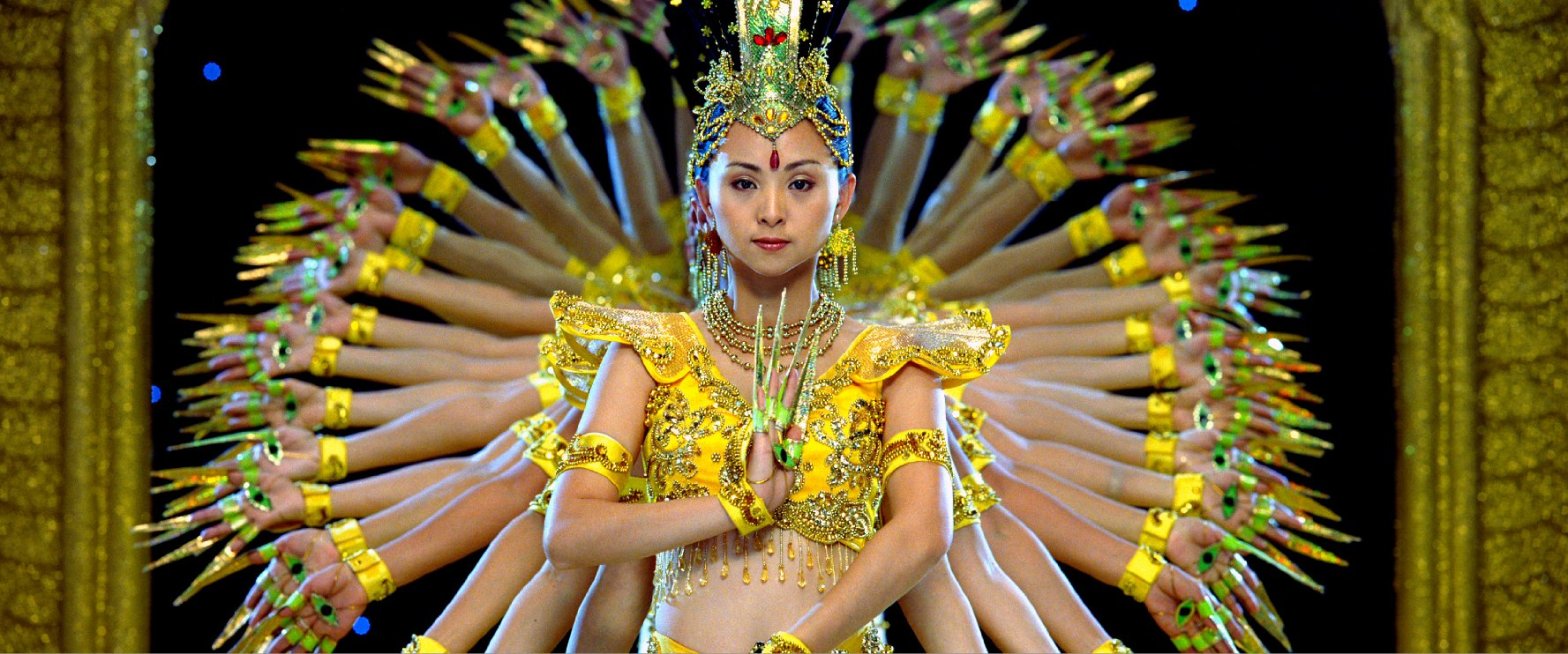
Ron Fricke and Mark Magidson’s Samsara (2011) is a documentary that chronicles what I would like to term the “choreography of life.” Unlike virtually all other documentaries, there are no spoken words, no traditional narration. But, the “music” track is beautiful. (Some of the track, such as the Islamic Prayers “sounds” like music but isn’t, technically or culturally.) Before going further, please take a minute to view the trailer below:
Samsara means:
the cycle of death and rebirth to which life in the material world is bound.
In Samsara, viewers get an intimate look at how much two-legged Homo sapiens have in common. Through the process of creating, eating, fighting, playing, surviving, working, worshiping, they express and reflect profound hopes and fears. Yet, Homo sapiens live in very different words, depending on where they live.
Homo sapiens, Samsara shows, are beautiful, cruel, mysterious, and irrational, sometimes all at the same time. Homo sapiens torture themselves and others in hopes of achieving some kind of acknowledgment, be it in this world or another world. Homo sapiens have profoundly altered the Earth, a predator that threatens all life. Homo sapiens are very prone to the ritual and the myth and the choreography.
By “choreography of life,” I want to draw attention to the ways in which everyday life is so throughly “choreographed” by a whole host of geographies, peoples, and cultural/social institutions. (We should, for sure, allow for human agency, too, but that’s another conversation.) While watching Samsara that is what kept coming to mind.
This film shows example after example of highly performative choreographed rituals at places where they worship but also where they work and live. We move and operate without necessarily thinking independently or even knowing exactly what we are doing. Forget about why, humans don’t even know what they are doing–doing themselves and doing to others–really doing. Mores and rituals and institutions mesh all together, along with geography, to determine how our lives are choreographed. Choreographed such that nothing gets too unstable. Choreographed to know our place and to teach and to entertain and to be trained. Such choreographies of life can be read from the vantage point of any geographic scope–from a town, to a region, to the planet–and they sync together in surprising ways.
Other thoughts this film prompts: We don’t know our larger place in the circle of life. For many of us in wealthy nations, our everyday life is very throughly divorced from all of the things we use. We essentially don’t know anything about how our beds, cars, computers, couches, foodstuffs*, ovens, or anything else came to be–from when it was “raw chemicals” to the finished product. The choreography of our “post-industrial” lives prevents us from being fully connected to our life.
(*Added 7/18/2017 – I just learned about the term “locavore” from Guntash’sblog– check it out. The basic idea is that we’re no longer locavores and this has important implications when thinking about Food Studies, History, etc.)
I highly recommend this film and would love hearing your thoughts! H/T to Dr. Michael Wesch (I’ve mentioned him in several blogs), I learned about the film from his YouTube video here.
Thanks for reading, and for regular readers especially, I hope you like my new website design!
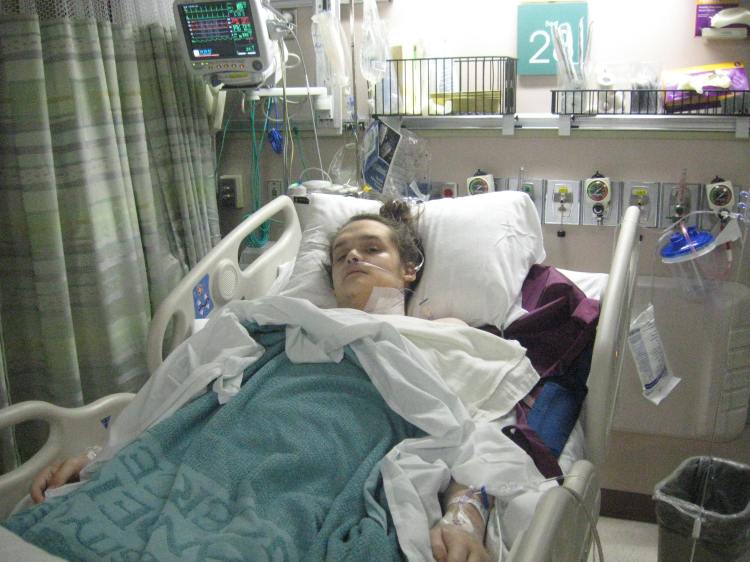
It was Wednesday, March 11, 2009. To my shock and horror, I gradually realized that I was effectively paralyzed from my legs down. With vivid memories of surgery #2, I wondered what would be next. I was unable to do anything on my own for days and days after the surgery (surgery #3 of 5, as of June 2017). Going from being independent to completely dependent on strangers for everything is quite the experience. I had bracelets on both arms and both legs and signs all around my room that said “Fall Risk” and “Do not get up on your own.” Yet, at least at first, I was on so much pain medicine, I was almost unconscious.
Doctors had removed a baseball-sized tumor and other smaller tumors from my left pelvis at U.T. M.D. Anderson Cancer Center. One of the tumors was hiding and not detected by the many MRIs and CAT Scans! The surgery and recovery had many complications stemming from where the tumor was and the resulting nerve pain and spasms and from the substantial loss of muscle during surgery.
The nerve pain in the left leg started several years earlier and gradually worsened. I made the video below a few days before the surgery. In it, you can see the painful and involuntarily spasms that were increasingly occurring in my left leg. Be sure to watch the full thing! It’s unlike anything you’ve seen before.
Error
This video doesn’t exist
I was in the hospital for almost two weeks after this surgery and had to attend physical therapy for four months to gradually regain strength. I had to use a walker for over a month. I was unable to drive for a few months. Unable to think for a few months. Of course, numbness was very present and persists to this day. This surgery made already-bad and on-going stomach problems worse, problems that also persist to this day.
And this was my second semester in graduate school! I really lucked out that the University of Houston’s Department of History treated me so well during my recovery.
To learn more about Neurofibromatosis, please start by reading my past blogs on the topichere.
It was Wednesday, September 6, 2000, sometime late in the morning. I was in the intensive care unit following major surgery (surgery #2 of 5 for Neurofibromatosis, as of June 2017) and screaming for help.
I was screaming because every tiny little breath hurt like fire and nails. Every tiny millimeter I moved or turned hurt like fire and nails. Nothing before or since has even approached the pain of these hours. I was screaming because there were about fifty Mardi Gras necklaces around my neck!
Because I didn’t know where I was or what had actually happened. Because I was alone. I was screaming. I was screaming because no one could hear me.
A few months prior to September 2000, one of my many doctors at U.T. M.D. Anderson Cancer Center was listening to my heart.
“I think I hear stomach noises.”
Thus began a puzzle that would eventually result in days and days and days of work and of heart monitors, X-rays, MRIs, and specialists galore and ultimately in major surgery that would take almost a year of recovery.
The doctors found tumors on my diaphragm and phrenic nerve. The diaphragm was paralyzed. Further, my left lung had collapsed and moved over toward the right side. My heart had moved from the left side of my body to the right side of my body. My stomach had floated up to where my left lung should have been.
My chest housed a stomach, a heart, and two lungs all tightly pressed against each other. My body was a mess! The discovery of the tumors helped explain the shortness of breath I had been having since 1998.
The surgery was major and required removing the tumors, tying the stomach down, reinflating the lung, and much, much more.
The nurses couldn’t hear me screaming because during the process of removing the tumors, my vocal cords were in the way. I was screaming, but all that came out was a tiny little whisper, a whisper that could only be partially heard when someone put their ear directly in front of my mouth. It took about six months to regain my voice. It easily could have never returned.
And I was never really alone. I just had to wait “x” amount of time before my mom could come to the recovery/ICU area. And I knew roughly where I was but not enough to know I was safe during those early post-surgery hours.
During the hospital stay, I was mean and grouchy toward everyone and everything, and I was very afraid. I was 14. And the nurse who put all those beads around my neck at first only made everything from that point on more frustrating!
This is the surgery that I call the heart, lung, chest surgery. (Although, it actually directly involved pretty much everything above my bellybutton!) Officially, in the broad classification system, the surgery is considered a thoracotomy. I am 1 of only 9 people to develop such tumors on the phrenic nerve. I am 1 of 2 to have and survive the surgery to remove them.
Today, I continue to have diminished capacity in my left lung – such that an X-ray would suggest I have pneumonia, all the live long time.
I am so glad we have such great doctors and nurses, great hospitals and medications, and such opportunities to live, thanks to science.
Dr. Andrew Joseph Pegoda
To learn more about Neurofibromatosis, please start by reading my past blogs on the topic here.
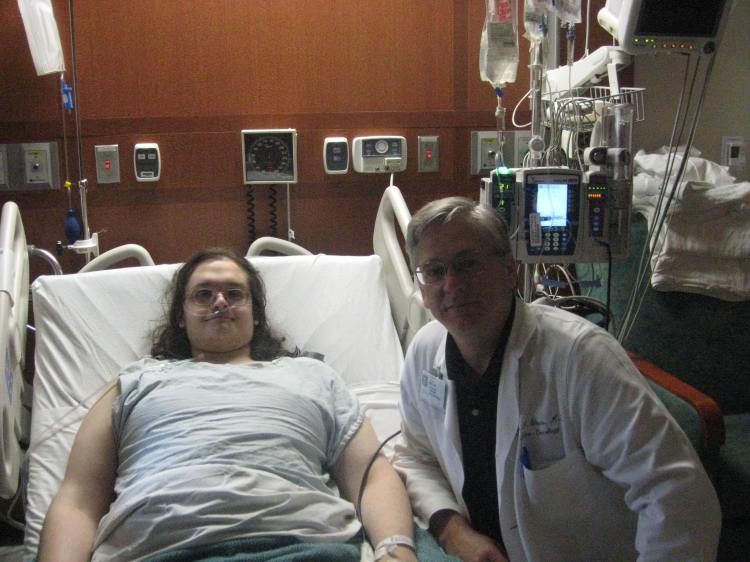
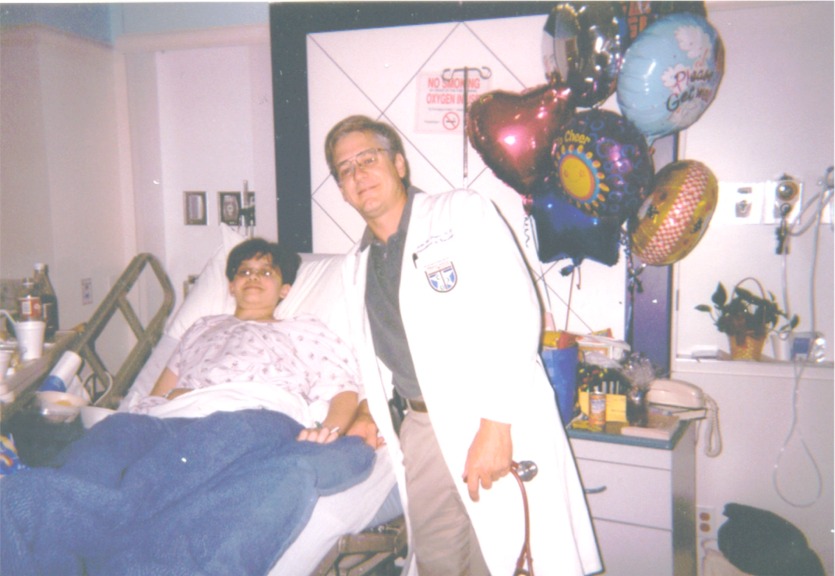
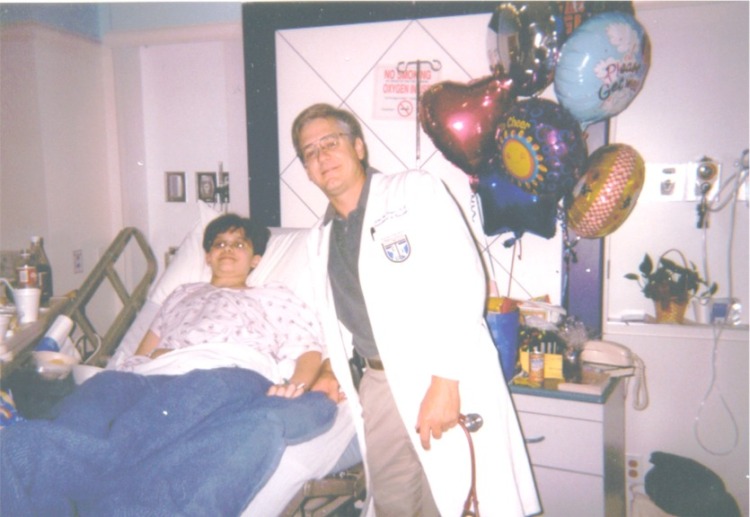
A few days after the surgery, pictured with Dr. John M. Slopis, who is and has been my main doctor since 1991.
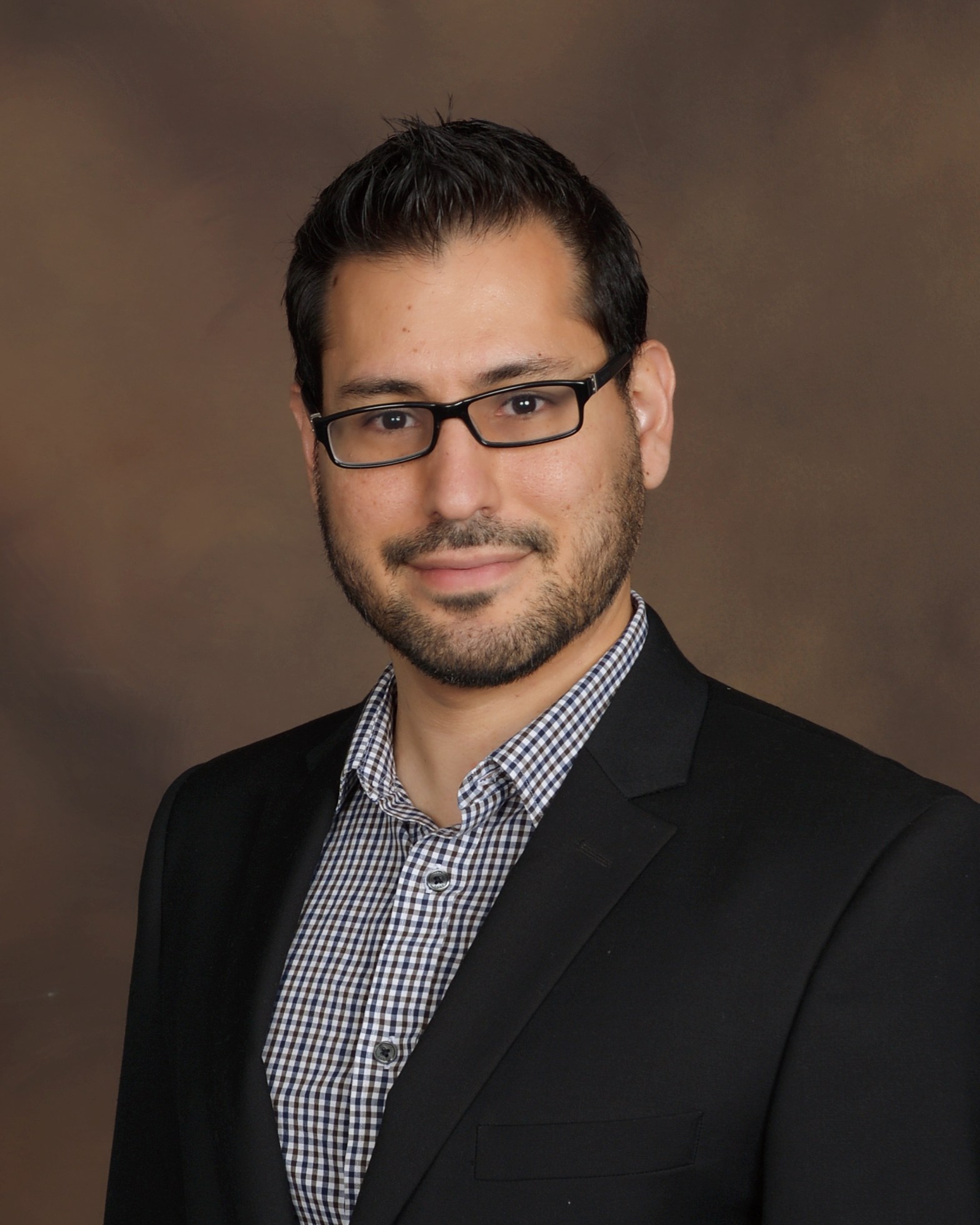
Dr. Andrew Joseph Pegoda (AJP): Andrés, thank you for participating in my interview series! You always blow me away with your knowledge and insight. Are you ready to talk more about your teaching and research?
Dr. Andrés R. Amado (AA): Thank you Andrew. You’re very kind. I’m ready.
AJP: First of all, could you tell us what it means to be an ethnomusicologist? What is “ethnomusicology”?
AA: That’s a great question. And not a simple one. I spend a whole semester on it in one of the graduate seminars I teach.
The short answer is that ethnomusicology is a relatively young academic field that studies music, usually from an ethnographic perspective. In other words, we try to immerse ourselves in particular cultures (however defined) and gain first-hand knowledge of their music through lived experience, performance, interviews, participant observation, and so on. Some ethnomusicologists see the discipline as a hybrid between music and anthropology; however, it includes a wide variety of methodologies and theoretical approaches, so the definition I just shared does not apply in all cases.
Even when the word “ethnomusicology” was coined, or rather, standardized with the founding of the Society for Ethnomusicology in the 1950s, there were already competing ideas of what the field should encompass. Broadly speaking, two emphases emerged: Some scholars engaged in ethnomusicology to enrich musical knowledge through the study of musical systems outside the Western art tradition (the so-called classical music), while others were drawn to ethnomusicology because of its anthropological potential, in other words they sought to advance our understanding of human cultures and societies through the study of music. Both had precedents in other fields like folklore studies, cultural anthropology, and comparative musicology.
AJP: What, then, are some of the biggest on-going debates about what it means to be an ethnomusicologist?
AA: Over the years, ethnomusicologists have argued whether their field is defined by the types of music they study, their methodology (and if they should even assume they share one), or theoretical approaches. For instance, should ethnomusicology primarily focus on the study of non-Western musics? Or “folk”/ “traditional” musics? What about commercial or popular musics? Should ethnomusicology exclude the study of Western classical music? With respect to methods and theories people debate whether we are more anthropologists than musicologists, or the other way around, and to what extent we may also be historians, music theorists, semioticians, or cultural activists/advocates. These debates haven’t entirely been settled so they resurface periodically in different guises. Defining our disciplinary identity is like pushing Sisyphus’ boulder up the mountain. The task never ends.
I personally identify as an ethnomusicologist on a contextual basis. I conduct historical and ethnographic research. I study popular music and music that may be considered “cultivated,” or closer to what historical musicologists study. Some people label me an ethnomusicologist because I study Guatemalan music, but in certain cases I’m more of a music or cultural historian.
AJP: What are your research areas within ethnomusicology? How did you determine what topics to research?
AA: When I was studying music as an undergraduate, I realized I wanted to continue doing it professionally. I had a hard time deciding whether I wanted to study performance (I was drawn to choral music and conducting), music history, music theory, or ethnomusicology.
After some research, I realized that music in my home country, Guatemala, was largely neglected in all of these fields, and I thought that perhaps I could contribute a thing or two on the subject.
Even though my first questions on Guatemalan music centered on sixteenth-century polyphony, several researchers encouraged me to pursue ethnomusicology, perhaps projecting the old bias that all “non-European” music should be the domain of ethnomusicology. Who knows. But I had taken a world music survey and an anthropology course that broadened my thinking about music and culture, so I did not take offense to being directed towards ethnomusicology. Still, as I looked for graduate programs, I sought out schools that conceived of the boundary between historical musicology and ethnomusicology as fluid, if they even saw one at all.
I was fortunate to gain admission at these kinds of schools. I pursued my Masters at Arizona State University where I studied ethnomusicology with Ted Solis and Richard Haefer while also studying choral conducting and working as a Teaching Assistant for instructors of courses in U.S. vernacular music and the canonic Western music history sequence for music majors. I went on with my doctoral studies at the University of Texas at Austin where all graduate students in ethnomusicology study musicology and vice versa.
My current research on Guatemalan music focuses on the nationalization of the Marimba repertoire in the 20th century, and on sacred choral music in the nineteenth century. And since moving to the Rio Grande Valley, I have taken interest in the music of the U.S.-Mexico border as well. In these contexts, I explore the intersections of race/ethnicity, politics, religion, and their various musical expressions.
AJP: In other conversations, we have talked about how there are different rules of etiquette in ethnomusicology at times, such as students more often being welcomed to call professors by their first names. Could you tell us about this, and why it is important?
AA: Titles matter. They reinforce social hierarchies. We use them to affirm people’s places in society, including our own.
I was raised in Guatemala, a country with a legacy of hundreds of years of colonization. I was also raised in a conservative religious household. In those contexts, I was taught that politeness and respect entail addressing people by their titles: Mom, Dad, Aunt, Uncle, Mr. or Mrs. Or at church: Brother, Sister, Elder, Bishop, and so on. In Guatemala, education is a hard-earned privilege in many cases, so we tend to recognize people who hold academic and professional degrees with appropriate titles: Licenciado or Licenciada (Bachelor’s or law degrees), Ingeniero or Ingeniera (engineer), Arquitecto or Arquitecta (architect), profesor or profesora (teachers, not necessarily professors), and of course, doctor or doctora. We also have various levels of formality to address interlocutors in Spanish: usted is formal, tú is less formal. In Guatemala we also have vos, which is more familiar than tú. Combined with titles, the use of these pronouns and their respective verb conjugations delineate various strata in Guatemalan society.
Raised in this environment, imagine my reaction when Ted Solis, a well-respected scholar, insisted that I, a mere student, call him “Ted.” I could not bring myself to do it at first. But as I got socialized into ethnomusicology, I learned that using first names is the norm, so calling people by title began to feel odd. When everyone around me calls my doctoral advisor “Robin,” I could not call him “Dr. Moore,” you see? So I cave in, but only partly, as I’ll explain in a minute.
I should first note that we actually have epistemological reasons for using first names in ethnomusicology. We don’t do it to try to be “cool,” or as an exercise in false modesty. We do it because we try to see ourselves not as “studying people” (which seems colonialist to us) but rather as “learning from people.”
Since the postmodern turn and postcolonial moment in U.S. academia in the 1980s and 1990s, ethnomusicologists have become more sensitive to the colonialist legacy of the discipline and the power imbalance between researchers and those whose music they study. We now tend to avoid the term “informants” in favor of “consultants” or even “teachers” when referring to our field associates. They in fact hold the knowledge of their own music and culture, and we do not. In a very real sense, they teach us. Our academic training may grant us the privilege of sharing and theorizing some of our experiences with them, but to what extent do we represent or misrepresent them in the process? Do we speak about them, with them, or for them? What is our relationship and what are our moral responsibilities towards them when they share their music and knowledge with us?
I understand that using first names does not make the colonialist aspects of academic research disappear. Some might see this move as condescending, pretentious, or even dangerous, since it may in fact hide our own privileges and thus render our hegemonic positions more insidious.
However, I still think that using first names at the very least reminds us, just as titles do, what our place can/should be while conducting fieldwork. In the field, you are a student. And even more generally, what is a scholar if not a professional student? As I teach, I routinely encounter students who are more knowledgeable than me in particular musical and cultural traditions. Why not learn from them as I try to share with them what I have learned? You can imagine that as one approaches teaching and scholarship in such ways, titles become less relevant, even hypocritical, perhaps. Using first names, does not give us license to ignore professional boundaries, nor does it dissolves power dynamics, of course, but it should at least remind us to remain curious and open-minded as we interact with others.
That said, I know that people from traditionally underrepresented groups in academia make an opposite argument. They ask to be addressed by their titles as a reminder to students and colleagues that they belong to erudite communities, and as a recognition of their credentials, which they took great pains and sacrifices to earn, particularly in environments of systemic oppression where the cards were stacked against them. Through titles, they claim the respect that may be denied them, as women, People of Color, immigrants, LGBTQ+, disabled, or whatever the case may be. I understand and respect this position.
In general, my approach is this: I invite students, especially graduate students, to call me by my first name. I work at an institution where the culture is very much the opposite, so nobody takes me up on the offer. Having been in their shoes myself, I understand their apprehension to calling me “Andrés,” so I don’t insist. I’m “Dr. Amado” to them and that’s fine. In fact, I have grown to appreciate the respect and affection with which they use the title.
AJP: I’m also interested in how you identify. How do your identities influence your research and teaching as far as privilege and oppression go?
AA: Some of your readers might find me insufferable by now, because yet again, I cannot give you a short answer. Once again, I’ll say that it depends. I suppose this means I should identify as the annoying professor, right? Maybe that’s my identity.
In all seriousness though, I have, over time, come to appreciate the performative and relational aspects of identity. In other words, we constantly construct and negotiate our identities as we perform them in relation to one another’s constructs, and those of the social groups in which we interact.
I have a multiplicity of identities that intersect in various ways at various moments, and they change over time too. I can be an extremely privileged individual in certain contexts: I have three post-secondary degrees and two secondary ones, I’m fluent in three languages, I earn a living wage, I am a cisgender male, I have a typically abled body. In other contexts, I may find myself at a disadvantage. I don’t fit this country’s criteria of “Whiteness.” Here, I’m considered a “POC” (Person of Color, although I’m not quite sure what “Color”). Interestingly, my Guatemalan official ID describes me as “White,” so how is that for a relational identity? Furthermore, even though I’m a legal resident and pay taxes in this country, I’m not a U.S. citizen, so I do not have a voice at the ballot box and do not have representation at the local, state, or federal levels of government. I’m an alien. I can also identify with sexual minorities and even religious minorities to some extent.
I could go on and on, and haven’t even begun to discuss how these different intersections of identity play out differently when I go back to Latin America. But my point is that identity is complex. Accordingly, it needs sophisticated theorization and thorough analysis from as many angles as possible, including music.
Music is an important component of how people perform and therefore construct identity. If music is “a thing” (and we could argue about that, one might think of it more as an activity, for example, but that’s a different subject) it may be viewed as a highly versatile and multifaceted semiotic medium, a complex system in which we create and convey meaning; consequently, music plays a crucial role in the construction and deconstruction of identities. One cannot overstate the importance of music, for example, in the construction of nationalism, since at least the Enlightenment, and perhaps earlier.
As you can imagine, the literature addressing aspects of music and identity is vast, so I won’t pretend I can do it justice here. I’ll wrap up my answer by stating that this literature informs my teaching in many ways, from curriculum decisions, to assignments, and class discussions. Because people identify through music, understanding how such identifications occur is important, not only academically but also at a personal level (for me and each student).
AJP: I sure do appreciate your detailed and thoughtful responses, Andrés, and I know readers will too. Can you tell us more about your teaching? Maybe to start, why ethnomusicology is important for students to learn about?
AA: Since I already established my identity as the annoying professor, I will continue in that role for a little while longer, if I may.
I’ll push back against your question a bit because it seems fixated on “ethnomusicology” as a discipline. And understandably so. Ethnomusicology is a weird word, one that not many people have heard, and one whose legitimacy in academia ethnomusicologists and their allies continuously fight to establish and defend. And I do appreciate the platform you are giving me to bring awareness to ethnomusicology. But considering what I have said before regarding identities and disciplinary labels, I will articulate a different position, one to which some ethnomusicologists might take exception: I do not believe that “ethnomusicology” per se, is important for students to learn about. I would argue, that it is important for students to learn to think about music critically and from a variety of perspectives, ethnomusicology being an important one of them. A better question might be, why is MUSIC important for students to learn about?”
Ethnomusicology can tell us something about music as a cultural practice, but we can also learn about music from historical musicology, from psychology and other neurosciences, from musical performances themselves, as audience members and performers. I’m not going to draw a territory around me called “ethnomusicology,” plant a flag on it, and defend it. At certain times and places there is a need for that, to be sure.
But in general, I think what needs defending is the study of vernacular musics and commercial musics as legitimate components of history and culture. I argue in favor of broader definitions of music and their fields of study. I wish to highlight the hegemony of the Western canon while also acknowledging its aesthetic potential (and thus its value). In other words, I hope to advance cultural relativism and reflexivity. On these subjects, ethnomusicology has a lot to teach us. But let’s not forget, for example, that on feminism and queer theory, historical musicologists led the way since the advent of the so-called “new musicology” of the 1980s and 90s, and that only more recently did ethnomusicologists follow in their footsteps.
In short, I believe students should learn to think carefully, critically, and analytically about music and not take its significance for granted. To me, ethnomusicology is a tool to that end (and one of my preferred tools, I admit), but we should not confuse the tool with what the tool can help us achieve. Does that make sense?
AJP: I can tell that we both are really focused on providing students with opportunities to learn and think critically. What topics, theories, people, do you most look forward to teaching and why?
AA: As a Latin Americanist, I look forward to teaching Latin American musics and cultures. These traditions are overlooked in the Western canon, but the research on the region continues to expand. I include the cultivated traditions of Latin America as I teach the Western History sequence. I also enjoy teaching the indigenous and popular repertoires, the intersections of these musics, and exploring their relations to broader social and cultural issues in the region (such as colonialism, imperialism, Eurocentrism, exoticism, and so on). As my institution continues to grow and hire more musicologists/ethnomusicologists, I hope I’ll be able to teach more courses in my specific area of specialization, which has been a challenge given my current responsibilities.
I’m also intrigued by the growing sub-fields of music and disability studies and medical ethnomusicology, which focus on the cultural dimensions of disability, healing, and well-being, and how music can intersect with them. I’m currently collaborating with a colleague in Social Work who is proposing a course we would team-teach as an introduction to art therapies, including music. I don’t claim to be a music therapist, but at the basic level we intend for the course, I can expose students to various ideas and literature on the subject.
I confess that I also love teaching the canonical music history sequence. Even as I acknowledge the problematic aspects of this tradition, I do not deny I find some of the music profoundly moving, intellectually intriguing, and in many ways significant.
I pretty much find everything about music fascinating, so I’m glad I get to teach all these different traditions and issues on a regular basis.
AJP: Have any authors or texts particularly influenced your teaching and/or research?
AA: Yes. Besides the obvious influences of the scholars with whom I studied directly, I can think of a few.
Too be concise I’ll name but one: Tom Turino. He’s now an emeritus professor at the University of Illinois at Urbana-Champaign. He retired around the time I finished my doctoral studies. As I pursued my Masters at Arizona State University, I found about everything he wrote relevant to my questions and interests. He specialized in the study of Andean and Zimbabwean music. He also developed compelling applications of Piercian semiotics to music.
Logically, I applied to study ethnomusicology at the University of Illinois with Turino for my doctoral work. Besides, that school has a great reputation in the field. My two graduate mentors at ASU studied there with Bruno Nettl, one of the most prolific ethnomusicologists around. Even though he was already emeritus by the time I applied, he was still publishing and giving occasional lectures and classes at UIUC, so I could have studied with my academic grandfather, if you will, had I gone to there. And I was admitted into their program, but I also was admitted to UT and two other schools that I liked for other reasons. Choosing my doctoral program was tough.
AJP: So why did you eventually decide on the program at UT?
AA: UT has a prestigious program. Besides their joint department of musicology and ethnomusicology and distinguished faculty, the university also boasts one of the largest Latin American collections in the hemisphere (the Benson Library) and more Guatemalinists that probably any other school in the United Sates: historians, anthropologists, linguists, archeologists, and literature scholars, all specializing in the study of this small yet complex country. I also had heard nothing but wonderful things about the city of Austin. If that weren’t enough, I was also offered the prestigious editorial assistantship at the Latin American Music Review, an important journal in my field published by the UT Press and edited by the person who would become my doctoral advisor, Robin Moore.
Over the years, it’s become increasingly clear to me that the University of Texas was the right choice for me. And not only because of the professors and the Latin American collection. I don’t wish to minimize the influence the faculty had on me. I owe them A LOT, and hope they know of my gratitude for all their support and mentorship. I could say a lot on that subject. But I would be remiss if I didn’t also mention my fellow graduate students.
And here I go back to your previous questions on what scholars and authors influence my research and teaching. I look up to my cohort of graduate students as well more established researchers and mentors; I studied with people who are fun, smart, collegial, very generous and open to sharing ideas, collaborating on projects, and extremely encouraging.
My cohort was also very diverse, so I learn a lot not only from their academic research, but from their lived experiences as well. In the UT musicology/ethnomusicology department I met students from Canada, the U.S.A., Mexico, Costa Rica, Colombia, Brazil, Jamaica, China, India, Tanzania, and Estonia. Besides the geography, the program was diverse in other ways. I met two graduate students old enough to be my grandparents; they had retired from life-long careers in other fields, and came back to school to earn doctorates in music because they felt passionate about the subject. Research interests also varied widely, from plainchant, to jazz, to music as intellectual property and intangible cultural heritage, to Broadway musicals, to Psychobilly rock, to eighteenth-century Portuguese-language opera.
I should add that even though not all of my peers stayed in academia after UT, they don’t cease to inspire me. This is yet another reason why I sometimes feel inadequate when addressed by an academic title. I know people far smarter than me who followed a different path where they don’t go by “doctor” or “professor,” and yet they are just as much, if not more deserving of such distinctions. There’s more to a person than their title or lack thereof.
AJP: Wow, wow… We’ve covered a lot. Thanks so much. You have given readers much to think about. Is there anything else you would like to add?
AA: Of course. I could talk about these things all day, but I think this is probably enough for now.
AJP: Sounds good! Until next time. Thanks so much for your time.
Andrés performing as a vocalist with the UT Caribbean Ensemble Fall 2012 Concert.Andrés getting ready to perform with the University of Texas Pan American (now The University of Texas Rio Grande Valley) African drumming ensemble, directed by Dr. Virginia Davis in April 2014.“Gigantes.” These giant puppets are used in the “baile de gigantes,” a traditional dance dating back to colonial times. Photograph by Andrés, Antigua Guatemala in July 2012.Andrés roasting a marshmallow on cooling lava at the Pacaya volcano near Guatemala City in 2012.
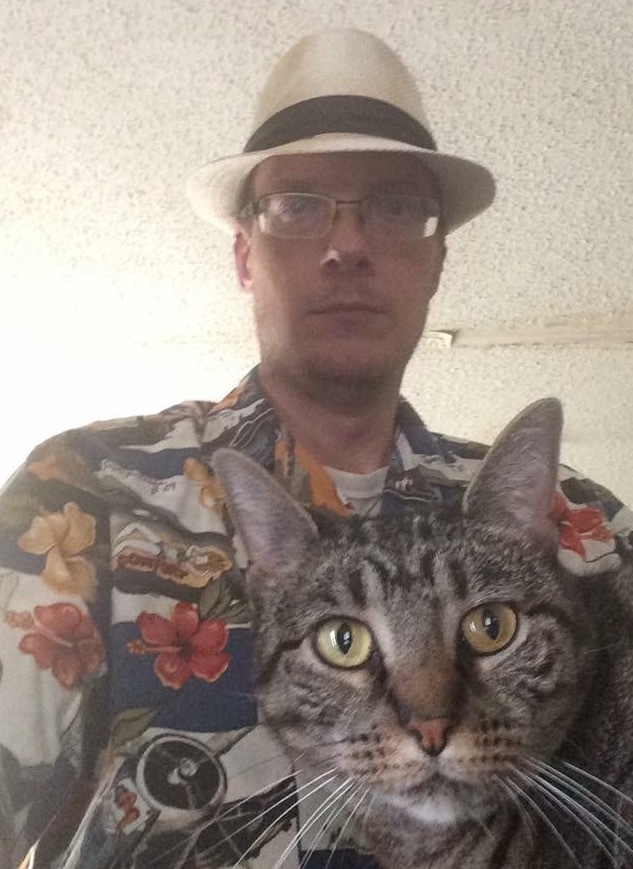
Yesterday I talked with my friend, Professor Brady Hutchison. He is so passionate about history and about teaching and is a really nice and interesting person. Enjoy the latest installment in my interview series.
Dr. Andrew Joseph Pegoda (AJP): Hi Brady. I really appreciate your participation in my interview series! Are you ready to talk more about your teaching and love of history?
Professor Brady Hutchison (BH): Thank you for asking me to do this interview. I’m always ready to talk history! Or cats!
AJP: Oh, goodness. Cats. Let’s move on before we both get completely distracted! I wanted to start with this question since it is especially unique to you. Most professors go to college, grad school, and then basically start working in higher ed. You didn’t follow this path, so I was hoping you could tell us about your experiences before teaching?
BH: Well I went off to college and majored in History because I liked it. I had no firm career plans. While in school I applied for a job with the fire department, and they hired me. After I graduated, I decided two degrees were better than one and so I got my M.A. in History, too! I started teaching part time as a side job. Then I transitioned over to law enforcement from the fire service and worked as an arson investigator. Things happen for a reason! I was seriously injured on the job several years ago and forced to take a medical retirement. But I kept on teaching. I think having had a career outside the classroom helps me connect with my students.
AJP: Did anything else draw you to teaching? BH: It is the family business. My mother is a retired elementary school teacher. My brother is a high school teacher/coach. His wife is an elementary school principal. Last but not least, my wife is a high school social studies teacher. I was kind of the black sheep in the family!
AJP: So it really is in the family! What exactly draws you to history then?
BH: I have my great-grandmother and my grandfather to thank for my love of history. My great-grandmother was born in 1898 and lived to be 96. Her grandfathers were Civil War veterans, and she passed on stories they told her. My grandfather was a World War Two veteran, and he opened up to me about his experiences. I like to know why things happen and I think history gives us some of those answers. History is like one big reality show!
AJP: I love how you have so many interesting and personal connections to the past with your family. How do you bring this passion into the classroom?
BH: Some days are easier than others. What I try to do is work as many personal stories from everyday people into my lectures as I think it helps the students connect with the material. I really enjoy seeing the lightbulbs turn on in my students’ heads when they start making connections.
AJP: What are your favorite topics to teach?
BH: The world wars. Not so much the battles, though they are important, but all of the accompanying change they brought. Right now we are in the midst of the 100th anniversary of World War One events. The British have done some incredible things to commemorate it. A World War One tank driving through Trafalgar Square. 60,000 uniformed reenactors at train stations on July 1, 2016, for the Somme anniversary. It’s an exciting time to teach the subject!
Since I really only teach US History surveys, I don’t have much of a chance to cover Russian history outside of the Cold War though I work in as much as I can. I’ve always been fascinated by Russia and even took the time to learn the language. I’m particularly interested in the Revolution and the Soviet experience in World War Two, or as they call it, the Great Patriotic War.
AJP: Are there any authors or texts who or maybe former professors that have particularly influenced your teaching and/or research?
BH: The biggest impact on my teaching is my 12th grade English teacher, Mr. Parks. He brought such energy and enthusiasm to class that you couldn’t help but want to learn. He pushed me to be successful. I can write a semi coherent sentence because of him. I hope I can be half the teacher he was.
I’m a big fan of Max Hastings, the distinguished British military historian. Orlando Figes is another excellent historian who has done incredible work in Russian History. And I have you to thank for educating me about the IWSCP!
AJP: Ah, oh…The Imperialist White Supremacist Capitalist Patriarchy or IWSCP and bell hooks. That’s another thing that could have us distracted for hours! If you had to pick one thing, what do you most want your students to remember in ten years?
BH: Everything that happens in the world today has a historical back story. We ignore it at our peril.
AJP: On another note, I know you are also a blogger and have had a few different blogs. Can you tell us about this?
BH: I am a chaotic blogger. I’ll write religiously for a few months, then not write a word for six months! My current blog, Ghosts of the Past, covers a lot of different historical subjects. I think the last post I did was about sports in the radio era. My favorite recent post was about the execution of the Romanovs. In fact, I’m giving a public lecture about that in July at the Deer Park Public Library. I blog under a nome de plum, Lee Hutch. (Hutch is what most people call me.)
AJP: Are you working on any other projects? How is your novel coming? What is it about?
BH: The novel is making slow but steady progress. 15 years or so ago, I had the opportunity to interview several men and women who worked as Firefighters in Germany during World War Two. They were 16-18 years old and survived firebombing raids. My novel is based on their experiences and takes place during a November 1943 raid on Berlin as seen through the eyes of a German firefighter and a British Lancaster pilot. The tentative title is So Others May Live. The first draft should be finished by the end of the summer. I did a series of blog posts which discussed it in a bit more detail and also contained an excerpt. It blends my fire service background with my history background. The research was pretty grueling and parts of it are very tough to write given what I have to describe. But I’m having as much fun as one can with such a somber subject.
AJP: Wow…we’ve covered a lot. Is there anything else you would like to add?
BH: The great Civil War historian Bruce Catton said of our profession “We are the people for whom the past is forever speaking.” That sums up my views on history and teaching better than anything I could ever say myself. Which is probably why he’s famous and I’m not!
AJP: Great. Thanks so much for your time.
BH: Thank you for the opportunity and give my regards to Dr. T!
Long before I had theoretical or historical knowledge to fully articulate my idea, I always found many aspects of Christian theology to be either contradictory or unusual when recognizing the broader context. Let me explain with a specific example. Lots of thoughts below that some will find uncomfortable but that have been on my mind for years.
Christian theology says that the Church is the bride of Christ. This is a very queer aspect of this theology. (This is not to be confused with Queer Theology, which would be completely different.)
The Church, according to dominant Christian theology, consist of people who have been saved or “born again.” These people are men and women.
Thus, things get interesting. Even more interesting when all of the history and biology and relevant social constructions are factored in.
Specifically, if the Church consist of men and women and the Church is the bride of Christ, who is deemed to be male, we have a situation where the ultimate result is all kinds of blurring and bending of ethical, gender, and sexual mores.
For example, this theology has Christ, the son of the Christian God, marrying a group that consist of both men and women. Here we have manifestations of same-sex marriage, the feminization of men, polygamy, and/or polyamory.
Additionally, aspects of Christian theology hold that marriages are dissolved in heaven and that everyone is brother and sister. So the result, in some ways, is people who were married, become brother and sister (including any offspring they had as humans), and then marry Jesus. In addition to the above, here we have some kind of incestial relationship resulting, added to the fact that Christian theology says that we are all children of God/Jesus and therefore, brothers with Jesus/God.
The above are all ways in which this theology is very queer – weird, abnormal, and depends on a blurring of what is considered normal and what is followed elsewhere.
Of course, there are social constructions involved every step when looking at history and science. We know that marriage is always changing and is brand new, historically, when considered millions and billions of years. We also know that the categories of “male” and “female” are irrelevant and inaccurate when science is recognized.
The above also helps show how problematic any theology is because it depends on applying socially constructed concepts and ideas based on knowledge available in a specific time and place to all times and all places, including those beyond this planet.
Just over one week ago I had surgery #5 at U.T. M.D. Anderson Cancer Center to remove two painful Neurofibromatosis tumors on my left hand. Unlike my first three surgeries, the two most recent ones have been comparatively minor.
Here are a few before pictures:
And after pictures:
The experience at the hospital was outstanding. U.T. M.D. Anderson Cancer Center truly is the best. I remember shortly before the surgery started the nursing anesthesiologist said, “We’re going to take good care of you.” Going into the surgery I wasn’t worried about anything and had full confidence in my doctors and nurses.
Overall, this has been the quickest recovery from a surgery, thus far. It’s not over yet, but…Pain has been, comparatively, minor, as have most other post-surgery complications. As always, the areas operated on feel–in what can only be described as–weird. My entire left hand, really, feels weird: numb, tingly, and occasionally like there is something stuck in my hand somewhere, which is all perfectly normal. I also don’t have full use of my left hand right now.
Another very common post-surgery experience that I am all-too-used-to is being in a brain fog. This is caused both my pain medications and the anesthesia. My mind has been numb, making it somewhat hard, sometimes very challenging, to concentrate, to think, to talk, or to write. It’s always somewhat weird and scary when you can’t use your mind, especially when your life really depends on it. The brain fog hasn’t been as bad this time but it’s still there and it comes and goes. The other night I was reading a short passage, and while I didn’t have trouble reading it, per se, it felt like it was a struggle – like I was reading from a foggy distance – not sure how to describe it.
Typically, it takes at least a month to fully regain all mental abilities.
Now, it’s somewhat a matter of when not if surgery #6 will occur. Dealing with lots of tumors (and pain) is part of having Neurofibromatosis. Hopefully, I’ll still have good insurance at that time.
With this blog article, I am happy to bring you the next installment in my Interview Series. (There are many more to come!) In May, I talked with Dr. Tracy Butler about her teaching. Dr. Butler is a professor at the University of Houston and teaches in the Women’s, Gender, and Sexuality Studies Program and in the Department of History. Our conversation is below.
Dr. Andrew Joseph Pegoda (AJP): Tracy! Thank you for taking time to participate in my interview series for my blog. I always love talking with people who I know love teaching and learning and thinking as much as I do!
Dr. Tracy Butler (TB): Oh, it’s my pleasure. Thanks for thinking of me.
AJP: Why do you teach, and why Women’s, Gender, and Sexuality Studies (WGSS)?
TB: Well first, I had some really great teachers, so they inspired me to teach, but also, I’ve just always been a huge nerd. I was one of those kids who always loved school and loved learning. I wanted to gain as much knowledge as I could about a subject that I was interested in. I loved it so much that I wanted to instill that desire and that love in others.
As for WGSS, I’ve been a feminist from a young age. I grew up in a family of four girls, so it was kind of natural for me to think, “Yes, women are people who deserve equal rights.” I never questioned the validity of feminism, or questioned why we need it. My older sister, Laura, was into women’s studies and taught me a lot, and then I started reading on my own. I wrote papers about it in high school and took classes in college. When the opportunity to start working at Women’s Studies arose and then later the chance to teach classes, it seemed like a natural fit for me.
AJP: Could you tell us more about your background. Especially, how you identify, and how you balance your own privilege in the classroom?
TB: I identify as a straight cisgender White woman, so I realize that I carry a ton of privilege in the classroom, despite my identity in one marginalized class (as a woman). When I first started teaching, I was really intimidated by my privilege, especially teaching at such a diverse campus like the University of Houston. I’ve learned a lot through reading new material, but also through listening to my students and allowing them to share their individual experiences. This is partly why even when I lecture, I still incorporate discussion into it. I don’t want to take up too much space in the classroom. I’m still working on that.
AJP: I think we almost all wish we had more time with students in the classroom! What topics, theories, people do you most look forward to teaching, and why?
TB: I think that changes every semester. bell hooks is a favorite of mine, and intersectionality is always a huge hit with students, but last semester I introduced some new material on the social constructions of marriage and sexuality, and I think that was my favorite this time. It was so interesting, new and fresh to me, and really fun to teach.
AJP: It always seems to help keep the course new and exciting when we change things and when we are excited about the material. Can we talk about intersectionality a bit more? Lately, there have been several articles where the author is very critical about how people are applying the term. One article was saying “intersectionality is not the same as diversity,” and another one was talking about how intersectionality has been “colonized by White people.” What are your thoughts about this? What is “intersectionality” to you? TB: Well, I haven’t read either one of those articles, so I can’t comment on either one, but to me, intersectionality means acknowledging that people are whole human beings, with multiple aspects of their identity, but many parts of those identities often get ignored within liberation groups because they’re focusing on fighting for a single cause. For example, the feminist movement is often criticized for not being intersectional enough, either because it focuses on mostly white women’s issues, or mostly straight women’s issues, or it excludes trans women. I even observed some of that in some of the testimonials of people who attended the women’s march. The problem is, ignoring the intricacies of people’s identities doesn’t work, because people are multidimensional human beings. Also, there are often parts of people’s identities that are hidden, so people should be conscious of that. For example, you can’t tell by looking at me how I identify in terms of sexual orientation, or religion, or even ethnicity. And making assumptions about people can often be hurtful, and in some cases, even oppressive.
AJP: I really like the way you put that. Thank you. Moving along, are there any authors or texts that have particularly influenced your teaching and research?
TB: Ooh, that’s a good question. Well, since I’m a Latin Americanist/Mexicanist by training and some of what I research is related to intersectionality and also relations between the Global North and Global South, I really like Audre Lorde, Kimberle Crenshaw, but also obviously, Gloria Anzaldua. I also really enjoy Philip Marfleet’s work on the politicization of immigration and the refugee status, which is especially relevant in the current political climate. His work is one of my favorites to teach, actually. I think it’s so important right now.
AJP: On this note, are they ways in which your research or personal interests impact how you teach WGSS?
TB: Oh, absolutely. I mean, how could it not? This class is all about identity politics, right? I know that instructors disagree about this and approach their classes differently, but we do get political sometimes in my class. I don’t try to tell them what to think, but rather how to think, but I do that by introducing current events and discussing them and asking them to think and talk through them and sometimes students get very passionate, which to me is okay. It is a difficult balance because you don’t want to turn students off if you seem like you’re pushing too much of an agenda, but at the same time, this is ultimately a class being taught through a feminist lens, and I’m honest about that. We may not always agree on things… feminists do not agree with each other about everything anyway, but I do want them to understand feminism, so yes, sometimes it is personal. One of my personal passions is yes, social justice, but more specifically, immigration reform. I’ve been passionate about that issue for years, ever since I started reading more about immigration history during my master’s studies. I include it in this class, which I think a lot of students are not expecting…but I think it’s important and relevant to this class. It’s an issue with lots of gendered, racialized, and class-related implications.
AJP: For sure, it’s important for students to be “uncomfortable” at times and for them to learn that discussing current events is not only okay but important. Too often people brush aside current events hoping they will somehow “go away.” If you had to name one thing, what would you most want students to gain in your class?
TB: I would want them to gain an understanding of intersectional feminism, of course, but I also want them to be able to apply it to their own lives and learn the best ways for them to take action. We talk a lot about activism and how each person approaches it differently. I want them to find a way to contribute to positive change in any way they can, and that may look different for each person.
AJP: “Intersectional feminism” – could you tell us more about what that exactly means?
TB: Intersectional feminism is a liberation movement aiming to bring about equality from a multidimensional point-of-view. So while feminism may have originally been born out of the idea of bringing about gender equality for women, the definition of its goals have changed over time to become more inclusive. Intersectional feminism fights for trans rights, gay rights, racial justice, gender equality, disabled people’s rights, economic justice, immigration reform, etcetera, because ALL of those issues affect marginalized groups of people. Its mission is to overturn the imperialist white supremacist capitalist patriarchy that bell hooks talks about.
AJP: On another note, I about think about how we can get people to see the value of non-STEM courses. Do you have any thoughts on how we can help people see that WGSS and other Liberal Arts-based courses are essential, too?
TB: Oh, I think listening to other students who have taken this class might do the trick. I’ve had many students who tell me how much they enjoyed the course, but others for whom it seemed fundamentally life-changing. A lot of students have told me they wish they had taken this class earlier, or they wish it was a required course. So the students gain a lot out of the class in terms of understanding power and how it influences or colors their lives. Beyond that, obviously, there is the benefit of having regular writing, reading, and critical thinking practice, but I think this course in particular promises much bigger benefits than that.
AJP: That’s great to hear. I know your students really do love your class! Okay, wow…we’ve covered a lot. Is there anything else you would like to add?
TB: I just want to say that the Introduction to Women’s, Gender, and Sexuality Studies class means a lot to me. I learn so much from my students, and I enjoy teaching them. It means the world when I can see them “getting” it. I still remember seeing some students make connections between different types of injustices, like in the context of intersectionality. A lot of my students, particularly my students of Color, understand this even before they start the class. They just don’t always have a name for it, until we talk about it. It’s really something to see them make these connections and talk about them.
AJP: There really is great power in learning how to name a given problem and to realize one is not alone. Great. Thanks so much for your time.







 Dr. Andrew Joseph Pegoda