Primary Sources: History, Ethics, and Commodities

Several aspects of the historian’s general treatment of traditional historical documents has occupied significant mental energy lately.

Items such as letters are generally not meant to be read by audiences en masse (or sold). Anne Frank’s diary was also not intended to be read by audiences (or sold by publishers) around the world (and was certainly not intended to be an account of the Holocaust, which it is not, despite common belief).

In my African American History class we talked about the following document today from Major Problems in African American History Volume I. How would the sender and receiver feel and/or the relatives and/or people who were in a similar condition feel that this letter, that their letter is being read in History classes around the country? It is vital to consider the original audience of letters and to recognize–even though the use of such sources is necessary per se to understand the past–that by using such private letters, for example, we are violating certain codes of deep personal space. It doesn’t matter if the person is deceased or not.

IMG_0228

I also wonder how Dave Waldrop and his cousin would feel knowing this private communication is sold for public consumption in a book that goes for around $100. In ways, already rich White people (the publisher of the book) and the status quo are getting richer off of their supposed attempt to counter the status quo through this publication. If Waldrop were still alive should he get royalties from the sale of this book? Should his family get royalties? Why is the past “sold” in this way? 

I am also bothered by books that sell primary sources for $50-100 or more. I don’t mind the $3-5 versions of book-length primary sources. But virtually any primary source reader runs $50 to $100 and these sources are all available free on the Internet. Not to mention there aren’t that many differences book-to-book. Granted the books have edited versions of the primary sources and introductory comments providing context, but why should publishers (remember: authors don’t make money off of academic books) make so much money, essentially off the words of others. Why should we continue to buy and assign such books?

This is a large part of why I assign Weekly Packets of primary sources that I design instead of assigning a reader. I generally like to have students read full unedited/unabridged primary sources, so they get the full idea, but when needed I can easily edit a document. I can also provide introductory context, as needed. This saves students money, and doesn’t allow the status quo to make even more money off the words, thoughts, and actions of others.

Another thing that has been on my mind and is something we talked about in my United States History courses last week is the notion of gaze in Great Depression photography. Take a look at the following, which is one of many, many possible examples.

0057f3350b5e30e38a1310955a6f2896.jpgWhat is the rhetoric of this picture? What is the photographer’s gaze (and thus, the viewer’s)? Why was the picture taken and framed in the way that it was? Why weren’t they given a “makeover” before their picture was taken, for instance? How would these two Girls feel if they knew we (and History classes across the nation and world) studied a picture of them as an example of poverty and suffering in the Great Depression? Is it ethical to study such a photograph? Is it ethical to take a picture of people who are clearly suffering? How does the deliberate setup of the photo influence our interpretation of it? 

One final word about primary sources (for now!) – those we study were not designed to be examined in a History class, to be placed under a microscope, or designed to serve as historical stand-ins or exceptions. In ways, this is a profound example proving how everything and anything is History, but it also speaks to the power (and abuse?) historians have.  

Texas Independence Day, Timelines, and Privilege

Today is Texas Independence Day. Woohoo, right? Well, not so fast. 

Texas Independence was accomplished through deaths and injuries on both sides and ideas of superiority on both sides, although especially on the Texian side with their ideologies from the United States that would soon officially be named Manifest Destiny. In the aftermath of the Texas Revolution, enslavement escalated, efforts to rid the state of Indians continued, and Hispanic Women lost rights, for example. Except for White Men, the Texas Revolution was hardly “revolutionary,” at least not revolutionary in a positive way of expanding rights. 

One aspect of studying and teaching History that particularly fascinates me is the idea that different groups have different historical timelines (and naturally, different interpretations of events). For instance, the Black timeline of United States History is very different than the White timeline or Hispanic timeline. Different events were important and some “important” events are of no significance to another group.

Celebrating Texas Independence day, especially celebrating it as a singularly good thing, privileges a very specific White timeline of History and “whitewashes” associated History. It omits Mexican perspectives on the issues, and omits that the revolution at its core was not simply about spreading so-named liberty. If White settlers from the United States had been able to continue coming to Mexico and easily bring/keep their enslaved property, there would not have been an independence movement in the 1830s the way it developed, if at all.

If anything, Texas Independence Day should occur on the anniversary of the surrender (celebrating the day independence is declared suggest that Texas was destined to win from the beginning), but this would still be problematic because nations take time to recognize new nations. Indeed in part because of the existence of slavery and secret but not-so-secret United States involvement, Mexico refused to recognize Texas Independence until over a decade later when Mexico was forced to give up its land in present-day California, New Mexico, Arizona, etc. 

Of course, too, parallel concerns apply to revolutions and civil wars across time and place. 

a03fa080-d259-4fea-ab89-5fab17c2005d

Three Strategies Guaranteed for More Successful Group Presentations

I like to have students occasionally work on tasks in small groups. In-class group work generally consists of my having students analyze primary or secondary sources or responding to one of my famously broad questions and then having each group present their collective thoughts to the class.

While students are sometimes resistant to work in groups (they say they would rather just hear me talk more! or they say they are shy), this ungraded exercise (tip #1) has tremendous andragogical value. For instance, it gives them an opportunity to discuss the readings. Students who didn’t read or didn’t fully read or maybe didn’t understand everything can fill in these gaps in a safe, low-stress environment. 

When students present to the class, I require everyone in the group to stand (tip #2). This has the effect of getting more than one of them to talk, even without prompting, because they are already standing. That is, they are all in the “ready” position to chime in and specifically add some of their own thoughts. Making them stand also makes them feel (and look) more official. 

I quickly discovered that students, if allowed, would stand up (or stay seated!) and just face me. If I was standing in the front, the students presenting in the front would just face me, no matter how much I asked them to face the class. The students in the back would see just me and a bunch of backs, too!

So, for some time now, I have deliberately moved around and stood as far away from the group presenting as possible (tip #3). If they are in the front, I’m standing in the back. For example, the picture below shows the room I taught in today. One of the groups was approximately where the red star is; I was standing about where the red circle is when they talked. When the group where the yellow octagon is presented, I was standing about where the yellow square is. While not perfect for groups in the middle of the room (and I try to position groups such that this doesn’t happen), this “forces” groups to actually face the entire class and talk loud, so I can hear them! By being as far from them as possible, if I can hear them, pretty much every one can. This also works in getting other students to watch the students presenting, not me. 

Every time I teach my goal is to have every student talk at least once – this is accomplished by having students read aloud brief quotations, answer interactive questions, and working in groups, for example.

Thoughts?


IMG_0225

The Raw Numbers: Texas and Enslavement

Year Enslaved Black Population According to Tax Records # of Enslavers Total Population (mostly excludes Native Americans)
1825 443   1,800
1834 ≈2,000   24,700
1838 5,786 1,049  
1840 11,827 2,163  
1844 22,852 3,399  
1846 30,505    
1848 40,308    
1850 48,145 (58,161 according to census) 7,747 212,592 (includes 397 non enslaved Blacks)
1851 58,740    
1852 68,584    
1853 78,306    
1854 90,003    
1855 105,186    
1856 113,139    
1857 124,782    
1858 146,370    
1860 160,467 (182,566 according to census) 21,878 604,215 (only 153,043 of these were born in Texas)
1861 169,166    
1862 186,884    
1864 240,099 (≈275,000 according to full data)    
Year Total Enslaved Population Costs/Values of Enslaved People
1836 5K (20-25% of pop) average $575

($15K USD 2013)

1845 30K (25% of pop) average $345

($11K USD 2013)

1850 58K (30% of pop) average $400

($12K USD 2013)

“prime field hand” $1,200

($37K USD 2013)

skilled/blacksmiths $2000

($62K USD 2013)

1860 183K (30% pop) average $800

($23K USD 2013)

See also: 

slave-family

An Exercise in Interactive Learning

I’m always anxious and willing to try new technology in the classroom. This semester my small experiments using Poll Everywhere have worked better in all my classes than any other semester so far. Part of it has been me learning how to use their system, part of it getting their system to work in the classroom and with everything else going on, and getting it simple enough to explain in a quick second so it doesn’t take precious classroom time. The Poll Everywhere technology has recently really improved, too. (Before students had to text a special unique code for each different question with their response, now they text one code once – explained below.) 

In my HIST1378 (United States History Since 1877) class, we used this today and had a lot of fun. They said we need to do this more often!

After going over the syllabus and our first lesson, I asked students to text “PEGODA” to 37607, if they didn’t mind participating and had a phone that could text. (There is also a way to do it with Twitter and a URL, but we didn’t use those today.) I explained that all answers are fully anonymous and not graded and that they might be part of a blog!     

I then opened the first poll. The prompt was “Today I Learned:” Results below. While not all were exactly correct, we had just gone over the information and were able to immediately clarify some points. Students who hadn’t spoken, “spoke.”  

Screen Shot 2015-01-24 at 11.17.30 PM Screen Shot 2015-01-24 at 11.17.49 PM

We then took a multiple choice review question. One of the students suggested that next time I should hide answers until everyone has answered so the “popular choice” doesn’t get more popular for that reason alone. I think that is possible. 

Screen Shot 2015-01-24 at 11.18.36 PM

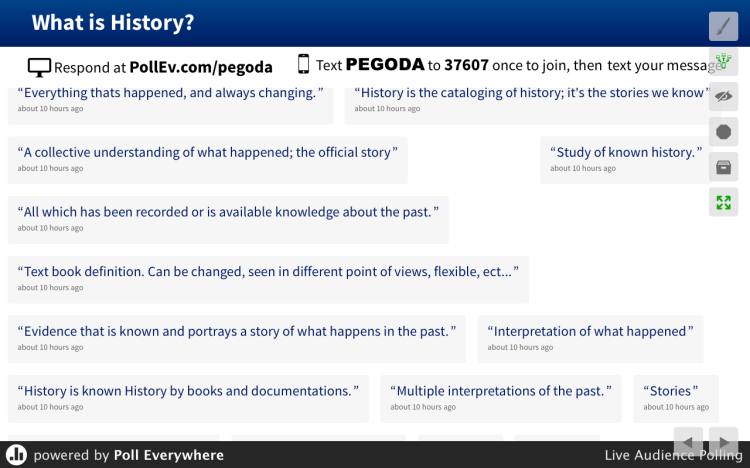
We did one more review question in our test of the system. “What is History” was the prompt. (Regular readers will know I’m really big on the difference between history and History.) Responses were: 

Screen Shot 2015-01-24 at 11.19.55 PM Screen Shot 2015-01-24 at 11.19.50 PM

Word Clouds can also display results: 

Screen Shot 2015-01-24 at 11.18.52 PM

I’m interested in whether many other college classes have ever used these and what the experience has been? I’m interested in using this method of Q&A more often. It only took about 2-3 minutes per question – 5-6 all together, so not bad at all. The free system for higher education only records 40 responses and does not track responses, so it couldn’t be used for any graded work or attendance. I kind of like that it is fully anonymous to me and to other responders. The paid system is a few hundred dollars a year and allows unlimited responses, group competitions or something, and allows the instructor to track students. I worry that such tracking would result in a loss of magic. Thoughts, dear readers and fellow educators? 

Memorization Without Meaning Is Counterproductive: A Case Study Looking at “What is Texas History?”

This semester I am thrilled to be teaching Texas History again. Yesterday in class we spent a little over half of the period really analyzing the question, “What is Texas History?”

I decided to do this as the second lesson (the first lesson is “What is History?” that reviews some basic terminology and course expectations – we also started off by drawing pictures of “the typical Texan.” EVERY ONE, the Men and Women, in the class drew–or started to draw–a Man with cowboy boots, a hat, and the all the related gear) of the semester this time so that students have some better idea of our approach throughout the semester and aren’t (overly) surprised. Last semester a few of the students were surprised at times when we talked about the World War I or the Holocaust in a Texas History class. In fact, the first question for this part of the lesson I asked students yesterday was, “Just thinking in general terms, would you say World War II is Texas History?” They uniformly said, “NO.” I waited a second and someone said something like, “Sure people in Texas were involved but it’s not really Texas History.” That’s where we started challenging and discussion default responses and default discourses related to the What-is-Texas-History questions.

We watched the trailer for Office Space

I asked students, “Is this Texas History?” Again, they said, “No!” I said, well it was filmed in Texas. They still said no. I said, “Well do people experience traffic and working in offices in Texas?” Then we talked about how it is Texas History in a variety of ways.  

We then watched the trailer for Secondhand Lions

And guess what they said: Yes, that is Texas History…Because of the guns, the old-fashioned life style, the animals, and country setting. This movie was not filmed in Texas but the story was set in Texas (although this is not made clear in the narrative). 

We also watched and discussed part of the music video of Whiskey Myers’s Ballad of a Southern Man. Whiskey Myers is a Texas-based, Texas-grown band. 

Finally, we watched and discussed part of this music clip of the McAllen, Texas, Valley Symphony Orchestra’s Chorale Holiday Concert from 2011. 

With the orchestra clip we talked about what it means that this music is enjoyed in Texas. 

Through conversations related to all of this, we discussed that Texas History is World History in some ways. Anything/anyone/etc from Texas, in Texas, about Texas, or that had influence in Texas is fair game as “Texas History.” If we would have had time, I would have pointed to a location on the map just North or just South of the geopolitical Texas borders (the borderlands!) and said, “Does Texas History happen here?”

A good amount of what we discuss this semester will be outside of the boundaries most people think of when it comes to Texas History: boundaries that more often than not begin with Stephen F. Austin and end with the Mexican-American War or the Civil War. The “What is Texas History” lesson will be the beginning of an on-going semester-long conversation that will partly result in a paper on this topic. This is important for many reasons, one being that nothing happens in a vacuum, geopolitical borders are meaningless.  

Of course, we also spend time discussing things that make Texas unique per se – such as that due to its geographic location it was used to “store slaves for save keeping” during the Civil War. Such discussions are also very important   because things do develop differently in different places due to different needs, demand, culture, etc.  

In courses that I teach, I like to develop an over-arching goal that can be stated in a sentence. For the second US survey, the critical analysis of primary sources and everyday cultural artifacts with an eye on racism, sexism, and heterosexism is what I hope students remember most and use the most in their life. For Texas History, it is to have a strong awareness of historical memory and deeper recognition of the complexities related to “What is Texas History?” 

As class was ending, I said, “Now don’t be surprised on Tuesday when we talk about Christopher Columbus and his connection to Texas History!” I also said, “What do you one of the quiz question might be?” One said something like, “What are the four criteria for whether something is Texas History or not?” That’s when the specific thought, in specific words came to me that memorization without meaning is counterproductive. I responded let’s take it broader than that. They guessed that one of the questions will be, “What is Texas History?” (And that’s pretty close!)

We also spent time talking about “What does it mean to be a Texan?” and did a brief historiographical exercise. 

If you can’t tell, Thursday was a really fun class!

Globe_red_black

How the Santa Myth Further Blinds (Rich White) People to Their Privilege

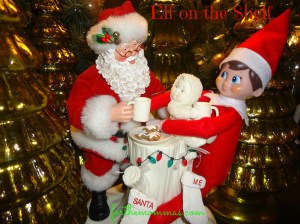
Traditions related to Santa Clause are not new or unheard of; although, they are increasing and manifesting in new ways, such as with the Elf on a Shelf tradition.

From a psychological perspective, the Elf brings fears predicted in 1984 and that increasing have very real manifestations to life. (Side note: Overall, Brave New World’s predictions have been more accurate. Brave New World foresaw a dangerous world in which information would not be censored but its people would be so intensely distracted on soma they wouldn’t care to be informed, as suggested by some.)

The Elf also depends on a kind of dangerous behavior modification plan.

And the Elf represents and privileges heteronormative, cis, and White/non-Black individuals.  And, of course, Santa is almost always White. 

Another problem with the Santa Myth was described very appropriately in a meme I saw earlier this week. It went something like this:

Parents: Give children expensive gifts such as an iPad directly from you, not Santa. Children shouldn’t have to try and understand why Santa gives some kids expensive electronics and others cloths or a basketball.

This example helps us further see the classism, capitalism, and Middle-Class Privilege built into the Santa tradition.

In many cases, therefore, Santa discriminates by pre-existing economic statuses. Or rather, parents/guardians use Santa as a way to be further blind to their economic privilege / Middle-Class/Upper-Class Privilege.

One additional aspect of the Santa tradition kept me up last night: According to myth, Santa’s helpers (elves) spend all year making toys for the good boys and girls (good = rich??). In reality, who makes these toys and other presents? Men, Women, Boys, and Girls in horrible working conditions in China or other countries which exploit workers even more than they are in the United States. Therefore, Santa Myths delete the poor people who actually make presents and give White people credit. Additionally, why give Santa and his team credit for things people actually spend hard-earned money to buy? The Santa tradition is kind of communist when you think about it!

Be sure to read this excellent blog for information about how Rudolph is also problematic.

Elf-on-the-Shelf4

Culture, Control, Colorization, and The Elf on the Shelf

The “Elf on the Shelf” tradition has become massive. I’m not sure when it started, but I have only known about it for a year.

If you are not familiar with it goes something like this: On December 1 Santa sends an Elf to each house. The Elf flies to and from the North Pole daily. The Elf might bring presents each day, too. The Elf’s duty is to land in a different place each day to observe whether or not the children are being good enough for Santa. The Elf cannot be touched by humans.

My personal thoughts were that it sounded like it could be fun but also a lot of work for the parent(s) and further commercializes the holiday season. Recently in one of my classes we were talking about contemporary culture and my students, to my surprise, almost uniformly suggested that the Elf on the Shelf tradition sounded very creepy.

This morning the Facebook page Addicting Info shared Professor Says That The Elf On A Shelf Is Preparing Your Child To Live In A Police State.” (Here’s another one about it. Here’s the professor’s full study.) This article makes many good, persuasive points and contextualizes the Elf and related cultural phoneme. A number of people agree with the premise of the article; however, many of the comments are degrading and overflowing with flat-out anti-intellectual. A few follow, directly as left by the commenter. 

  • That’s beyond idiotic. When children get older they realize that these are simply traditions, – i.e. adults making children’s lives more fun and magical. I love science and research but not when dumbasses come up with stupid sh*t like this.
  • Someone needs something far more productive to do with their time. It’s a toy.
  • I would love to know where This Professor got his education. Think he fell off of a truck sneaking across the border. How Dumb Can someone really be.
  • CAN’T KIDS BE KIDS ANYMORE? Stop analyzing everything…Personally, I think he is creepy, but if the kids like it , that is what counts..
  • WOW. This is just beyond stupid. Teaching kids to behave and follow the rules somehow equates to preparing them to live in a police state?!?!? It teaches them how to live in a civilized society. This is even more stupid and crazy than people who have a problem with Rudolph.
  • I think this whole story is BS .. I’m mean really!!! It’s just for fun and to make into something like this story is just to scare people!! How ridiculous! Maybe this professor has wayyyyyyy to much time on her hands .
  • Cant people just have fun anymore without being psycho-analyzed about it?

These comments make me very sad. For one thing, they are perfect examples of cyber bullying–especially the ones that included name-calling. Bullying, because of my critiques of culture and of the IWSCP, that I am all too familiar with. They are also an example of how thinking is not valued in our culture. Pointing out new and different thoughts is not valued either. From a cultural studies perspective, any sincere thought, perspective, or critique is important, relevant, and true, to at least a few. In the case of this article, many assume the professor and related article was written by a Man, when it was written by a Woman. People who left these hostile comments clearly do not understand or appreciate different points-of-view. Remember the cliché about the importance of entertaining a thought? Likewise, these people critique an article warning of censorship and police-state-activity, when they themselves are in effect speaking to censor and police the thoughts that they disagree with, they don’t understand, or rather, don’t want to hear.

A wonderful Christmas present to the world would be tolerance and celebrations of diverse, radical ideas. But this would require people to see and protest the status quo. Think how happy that would make bell hooks! 🙂  

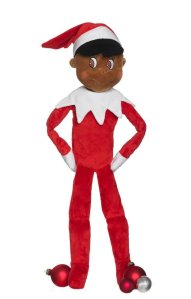
My personal concern with the Elf of the Shelf is the ways in which they are (and aren’t) racialized/colorized. For a list of available products on Amazon, click here. Immediately, you’ll notice White Elf, after White Elf. After going through at least one full page of results, I came across this one described as “The Elf on the Shelf: A Christmas Tradition with a girl Scout Elf with brown skin/brown eyes” with the option of buying it as a “Brown Eyed Elf” or “Brown Eyed Girl.”

71rsH466+9L._SL1500_

In terms of the politics of skin color/colorization/racialization, the “brown skin/brown eyes” product does not reflect anywhere near the true diversity of skin that is colorized/racialized as Black. Naturally, they can’t represent all skin tones, but by doing a search for “black dolls” on Amazon, there are plenty of legitimate possibilities. As noted in various Doll Studies and other studies, Black children frequently feel ashamed of their skin color. Part of this is not seeing their skin represented in a positive way. 

Their is one additional Elf on the Shelf product that is important to critique. Check this out.

51DLCHX0YyL._SL1000_

This strange product is not part of any regular Elf on the Shelf packages. The skin tone is really strange and unnatural in places. The exaggerated, unnatural eyes make it a caricature or something really close to one.

So, just as Santa is White, so are these Elves, for all practical purposes. There are no Hispanic, Japanese or Chinese, or Middle Eastern Elves either. There are also no gender-ambiguous or gender non-confirming ones. People don’t realize how important such representations and stories are, especially given that they are the only ones told.  

Why can’t we have a Christmas tradition that truly embraces diversity? 

Thanks for reading. 

Check out this posting from last Christmas: The Rhetoric of Two Christmas Songs – Hidden Power of Words Series, #3