1. we see, understand, and interpret the world according to the everyday world in which we live – fully or even partially escaping it is impossible
2. interpretations change over time – if History where the study of the past, interpretations wouldn’t really change that much
3. we subjectively define events and periods and chronologies
4. historical memory looks at how most people, even scholars, understand the past, especially events for which they have little familiarity
5. the evidence we save, deem important, and use is subjective according to then-popular mores and/or what has survived the test of time
6. versions of the past taught by institutions are heavily, heavily censored and shaped
7. the past is, simply, inaccessible
If History were simply the study of the past and society was comfortable with studying the past, we wouldn’t have the textbook debates we do and wouldn’t have the very important field of historical memory (per se). If History were simply the study of the past, we would have ready access to the past – in this way, the aim of studying the past is impossible, as we can’t keep careful details of how billions and billions of creatures have lived.
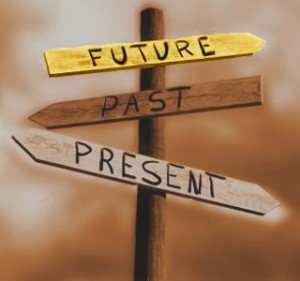
Elsewhere I have argued that there is no such thing as “the present” – that everything is “the past” or “the future.” I still stand by this, but for purposes of this blog and given the lack of appropriate words in English, I’ll have to stick with using “the present” in various ways, depending on the purpose at that time.
Articulating various responses to “What is Texas History” with my students continues to fascinate me, as does teaching and learning more and more Texas History, and I wanted to share a few things in particular that have been on my mind.
In my Mexican American History I class (stay with me!), we were recently reading about pre-contact Native Americans who, according to the book, lived in “Mexico,” “Texas,” “New Mexico,” and “California.” We talked about the possible problems and limitations of this since contemporary boundaries between Mexico and the United States and various states of the two nations have almost absolutely zero meaning to pre-contact, pre-colonized peoples. Continuing with this line of thinking, a variety of thoughts occur. One, for only a tiny bit of history has “Texas” had any kind of meaning or even existed. Likewise, Native American groups we arbitrarily classify as being part of “Texas History” are unfairly lumped with Modern mores and ideologies of which have zero meaning to them.
Instead of calling it Texas History, perhaps we should call it Southwestern History or something more regional or thematic. This would avoid the quasi ahistorical practice of using today’s geopolitical practices for past peoples. And this might help escape the consequence of everyone having the shape of Texas “tattooed” in their consciousness. Such regional history classes have problems too since covering the entire World or Western World or Eastern World in one or two semesters is even more impossible. But, then too, isn’t every class World History??
Questions about the boundaries of Texas History (or other topics) are also interesting for what they include and don’t include. I still basically stand by by previous definition of Texas History: Something qualifies as Texas History if it is in, from, about, or has influence in Texas. But, I have additional thoughts and a few potential reservations.
For example, by this definition, in a way there is no difference between Texas History and World History, as everything across the world and across time and place has influence in Texas.
On the other hand, this is partly its power: Notions of Texas Exceptionalism quickly fade away with a slightly world-based context.
At the same time, however, consider a review of the 1945 film Mildred Pierce published in a Dallas, Texas, newspaper. This would fall under the umbrella of Texas History. But, clearly, such a review would be highly unlikely to be unique or significant to the political/cultural area of Texas or have any kind of unique or significant influence. Essentially the same review could have been written by the same person, especially if he/she moved around a lot, in any number of states. On the other hand, if that person grew up in Texas, their ideas would for sure be shaped by the educational system in Texas. Questions like this also partly launch us into discussions of history vs. History. What parts of the past do we remember and find valuable, and why?
Additionally, given the dynamics of Modernism and capitalism and en masse monopolies, conceptualizations of “Texas History” or “Mississippi History” do not have the power they once did. Between the flood of highways, traffic, McDonalds, Subways, Walgreens, and countless other texts, most big (and small!) cities and towns are more and more often almost identical and indistinguishable. How much–on a broad historical level–is different between the big cities of today?: Would we notice if say Dallas and Houston switched places? or if Austin and Oklahoma City switched? And then we have to ask if this is even really that new of an occurrence…for example, there weren’t that many differences–on a broad historical level–between various of the larger cities during the time of Colonial British North America. Or, too, Texas being a state with enslavement connects it very closely with other southern states. This makes “comparative” history have importance but, as I’ve written about before, comparative history as its own set of ethical concerns.
With Wal-Marts everywhere, how many things are unique in 2015 to Texas in the kind of systemic, institutional ways that make the kind of “Big H” History that is really important? Even something like oil is not fully unique to Texas. Texas and its notions of exceptionalism and its mythology of “cowboys and Indians” might be one of the most unique things!
Technology also greatly reduces regional differences as humans modify natural and create artificial environments every day. Whereas in prior eras geography really affected and changed life in given areas, now days we modify the environment. Such modification comes in the form of air-conditioning and the ability to create or obliterate hills and lakes, for example. We have to remember whereas in prior nations regions had great significance in terms of the groups that formed in such region, such is not the case today. This becomes even more noticeable with a state like Texas and its tremendous environmental diversity and tremendous size.
Part of it boils down to that nothing happens in a vacuum and context, context, context is important.
The past few weeks have flown by. This semester I am teaching Texas History, Mexican American History, and four sections of First Year Seminar (which is basically an “Introduction to Critical Thinking” course). I have around 130 students, and I have an exceptionally talented group of students.
My students in Texas and Mexican American History are blogging instead of having tests and quizzes, and they are doing a really nice job. For the first week, students mostly wrote about their personal backgrounds. Week two blogs are due this evening!
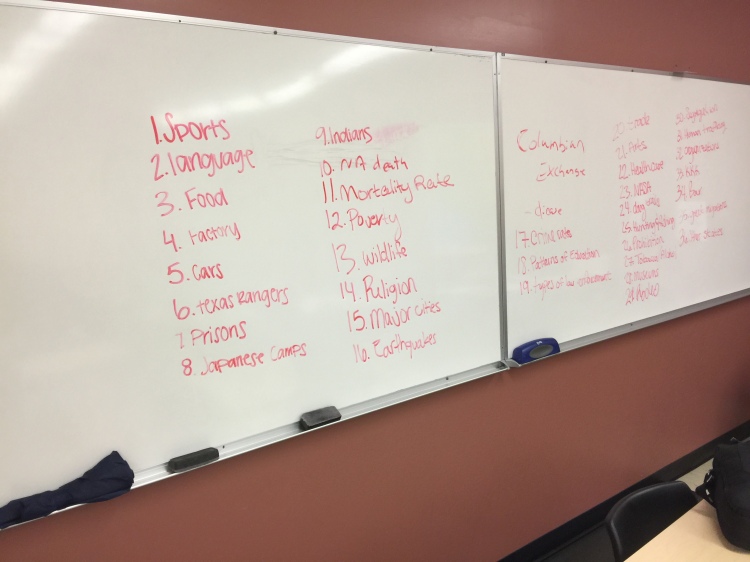
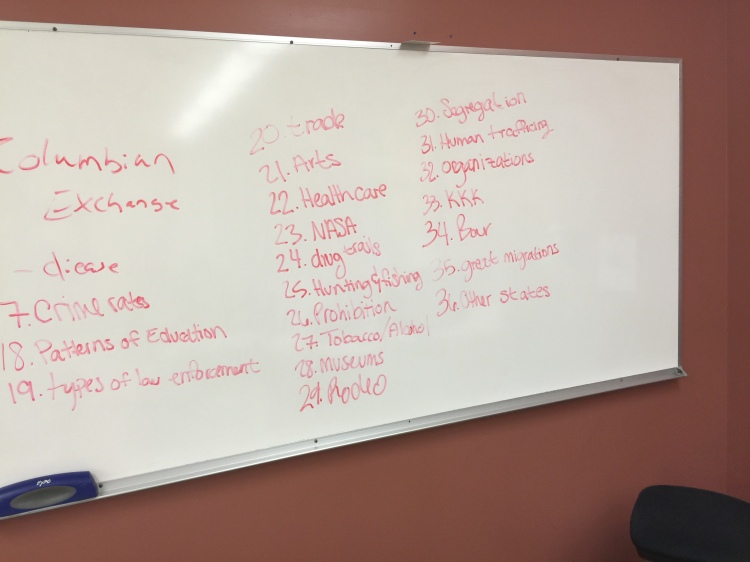
So far in Texas History we have talked about “What is Texas History,” geopolitics, the Texas textbook/education war, geography, and biography. We did a really awesome activity yesterday whereby we deconstructed the atlas we are using for the course. Students came up with 36 things the book does not include that it really should. (I always get a student in the class to write on the board for us.) We talked about possible reasons and consequences.
In Mexican American History, we’ve discussed the historiography of the field, the White/Black Binary, and Ancient and Medieval Iberia. This class is small enough we can all sit in a circle each class!
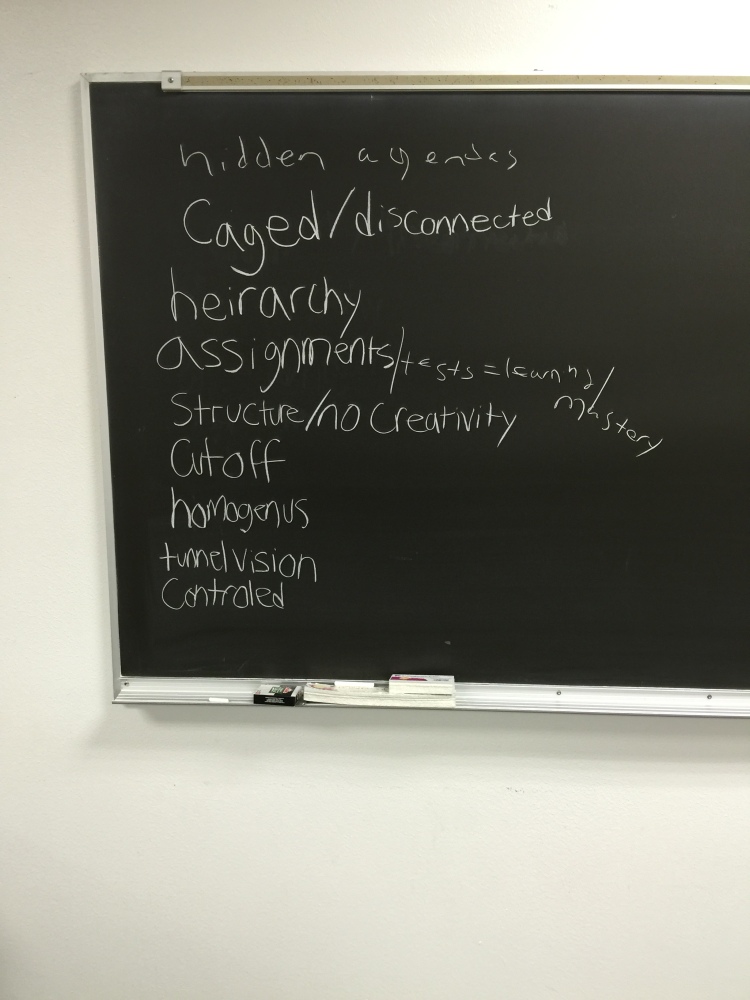
In the First Year Seminar, we’ve talked about the notion of citizenship to the institution, categories of critical thinking, active learning, formal structures that can be used to critically think, and the common reader for all new students. We did one activity, adapted from Michael Wesch, where we discussed what the classroom walls say. Here’s a picture of what the Wednesday am class came up with.
Teaching students and learning from students continues to be extremely exciting, fun, challenging, and what keeps me going.
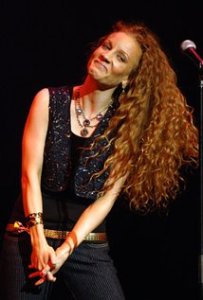
Amanda Marshall is a singer based in Canada. In this blog, I look at how and why her music is really neat and special. Most importantly, her music is very feminist and free of so many of the problems we see in our contemporary music.
Amanda Marshall has been my favorite singer since the mid 1990s. Her band, her voice, and her songs are perfect and very unique. The “live” versions (many are available on YouTube, many of these are linked on the unofficial Facebook fan page) are very different than the CD versions in most cases. All are of outstanding quality.
Before going further, take 6 minutes. Relax. Close your eyes. And please listen to this:
I am the Amanda Marshall fan! She is one of just a few singers who I would love getting to visit with. 🙂 I have every song she has recorded on both of my computers, on my iPhone, and of course, on all of my backup systems. Once a long time ago–sometime in the late 1990s–I got word that she was going to be on some radio station somewhere far away but it was going to stream live on the Internet, and my parents let me stay up late (past midnight for a 4th/5th grader is a big deal!) to hear her.
While in Canada her music has generallyranked very highly, her music hasn’t been given the same opportunity in the United States or elsewhere.
I have never figured out why she isn’t an everyday house-hold name. She certainly deserves to be one more than many who are house-hold names.
One thing that makes her a really special musician is that all of the songs on her major CDs are 100% original to her. Many of them she wrote or co-wrote. The others songs were written for her by friends. She never sings “her version” of already-popular songs.
Her songs all tell some kind of story or life lesson; discuss feelings (not looks); have some kind of special, positive message; and/or communicate that any kind of relationship must be about mutual, consensual love. The positive messages in these songs is communicated without being over the top or even that obvious (except for Believe in You). Its regular, adult contemporary music that goes against the usual beat. Many of her songs are autobiographical in full or in part. AND unlike so muchmusic that perpetuates the Culture of Rape, Marshall’s music never does that. Additionally, her music frequently uses gender neutral pronouns.
It was just last night that I went through all of her music song-by-song, line-by-line to look for any potential problems. Now, I like her more than ever before. Music that sounds great, is unique, and is free of racism, sexism, heterosexism, cisgender sexism, classism, imperialism, etc. What more can we ask for!
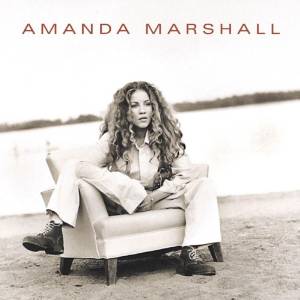
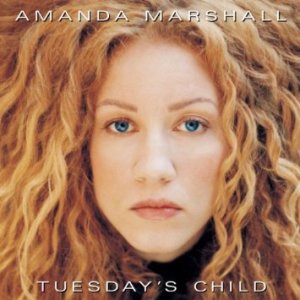
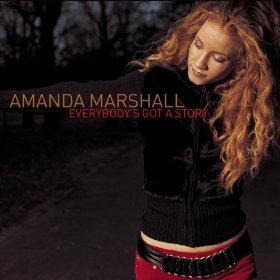
Below, is a list of her songs with the lyrics linked. A brief excerpt, summary, and/or comments are provided for some of the ones I really, really like. On the right you’ll see the album cover. Clicking on the image will take you to the Amazon page to buy a copy! If you want to start with her music, I would recommend her 1999 album as the prefect starting point. Or pull up YouTube!
Shades Of Grey– linked above – the difficulties of having interracial parents and her grandmother’s negative reaction
You can’t change a stubborn mind You can’t see the world if your eyes are blind What does it matter anyway In our darkest hour we’re all just shades of grey
I’m a tough tough game that no one can master I’m a tall tall tale no one believes I’m a long dark night with no morning after Lucky you You get the best of me
Double Agent– absolutely love this one about navigating the world as being Black while looking White
I’m a double agent on my momma’s side The shit I hear you say just blows my mind Every time, recognize Though who I am to you is not a lie I don’t have to volunteer and say That I was born a particular way I got not uniform, I’m camouflaged in any light Obviously you can’t tell I’m a double agent on my momma’s side
Red Magic Marker– a final declaration of love but with an understanding that it may not be reciprocated
Sunday Morning After– one of my least personal favorites, but explores the questions that follow an unexpected adventurous night
Love Is My Witness– something of an attempt to define and explore the meaning of love
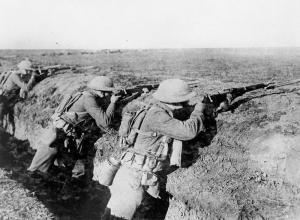
Thomas Hardy’s “The Man He Killed” greatness is in part its application to a variety of settings and times:
Had he and I but met By some old ancient inn, We should have sat us down to wet Right many a nipperkin!
But ranged as infantry, And staring face to face, I shot at him as he at me, And killed him in his place.
I shot him dead because — Because he was my foe, Just so: my foe of course he was; That’s clear enough; although
He thought he’d ‘list, perhaps, Off-hand like — just as I — Was out of work — had sold his traps — No other reason why.
Yes; quaint and curious war is! You shoot a fellow down You’d treat if met where any bar is, Or help to half-a-crown.
Today I have been spending an unusual amount of time thinking about the circumstances in which people meet or come across each other. How many potential relationships (that don’t result in death) are missed because we “meet” walking past each other in the mall or because we “meet” at a restaurant where one of us is the customer and one of us is the manager?
Expanding this thought and more importantly: Sandra Bland has been on my mind a great deal. If she and the officer with which she had the initial encounter had met in a gun-free zone at a concert at a college, how very different would things possibly be? If they had met at Prairie View A&M University some weeks later about an event at the college, how different would things possibly be?
If Trayvon Martin had met George Zimmerman face-to-face in daylight, how very different would things possible be? If they had met at mall seeing a new video game advertised, how very different would things possible be?
With some important exceptions, the only thing preventing consensual relationships and peace are culturally constructed and (generally) culturally sanctioned symbols of and uses of various forms of authority. Forms of authority where one party has absolutely authority and control and the other virtually none are dangerous. Notions of power, place in society, and geographic location matter a great deal.
We must learn to overcome the fear enabled and perpetuated by symbols of absolute authority, and we must learn to do the best we can to look at people for who they actually are: breathing, living beings with hopes and fears who don’t deserve to die or be placed in a cage for decades or longer and do deserve to be understood and helped.
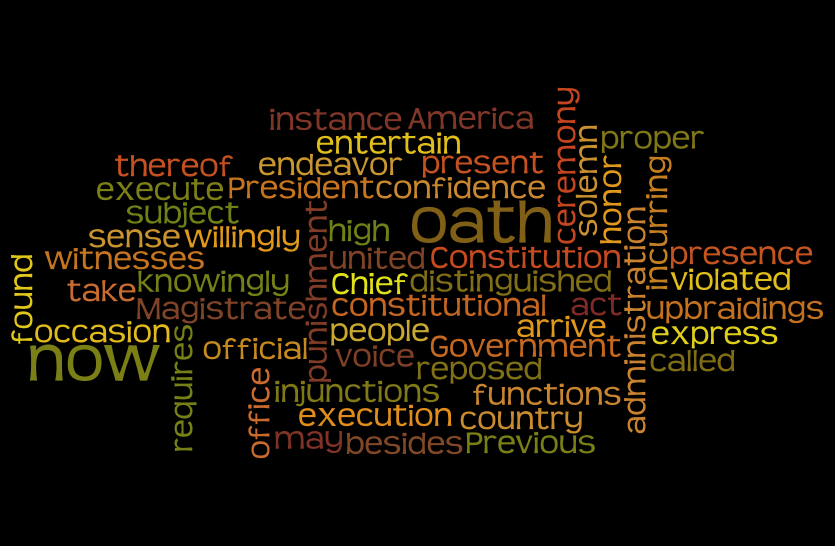
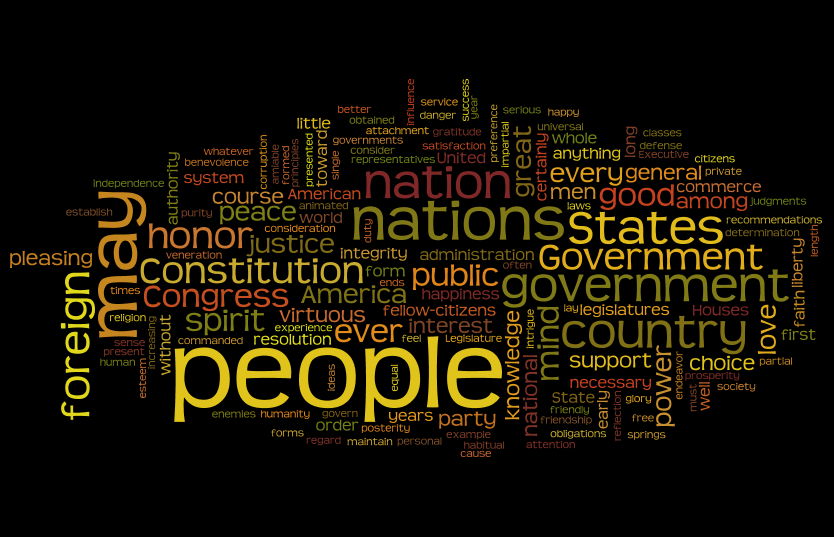
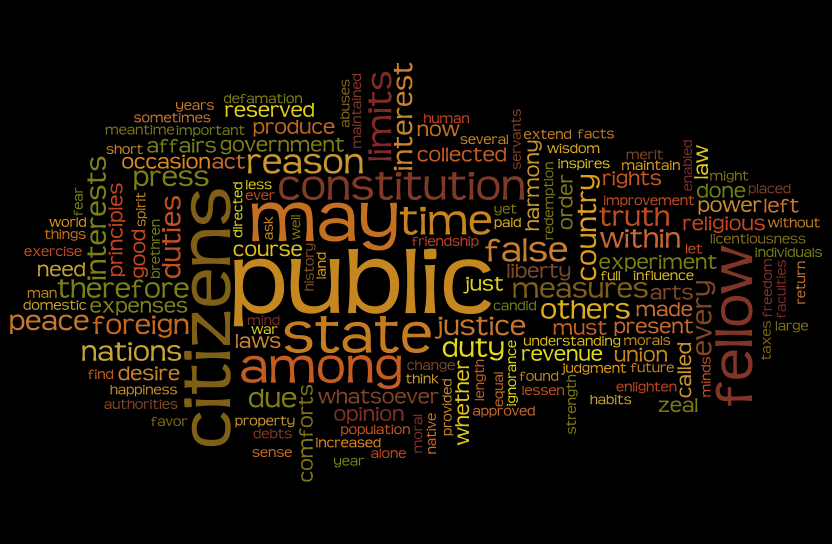
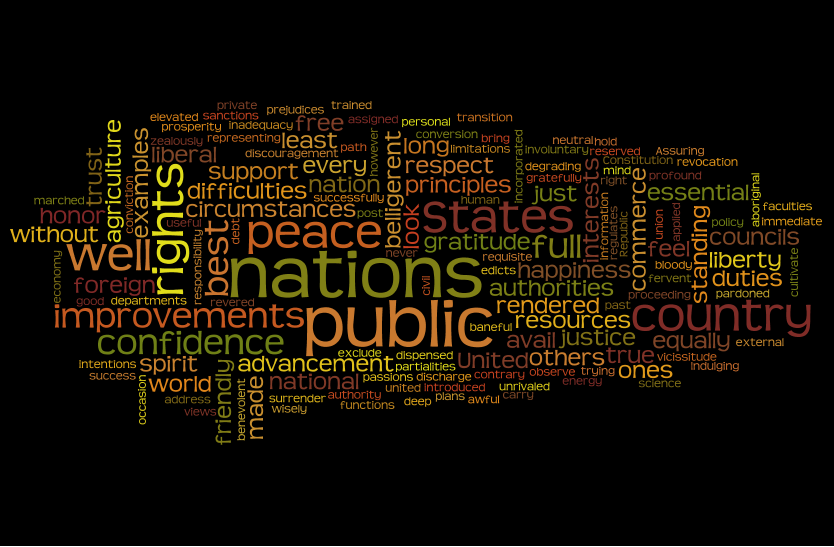
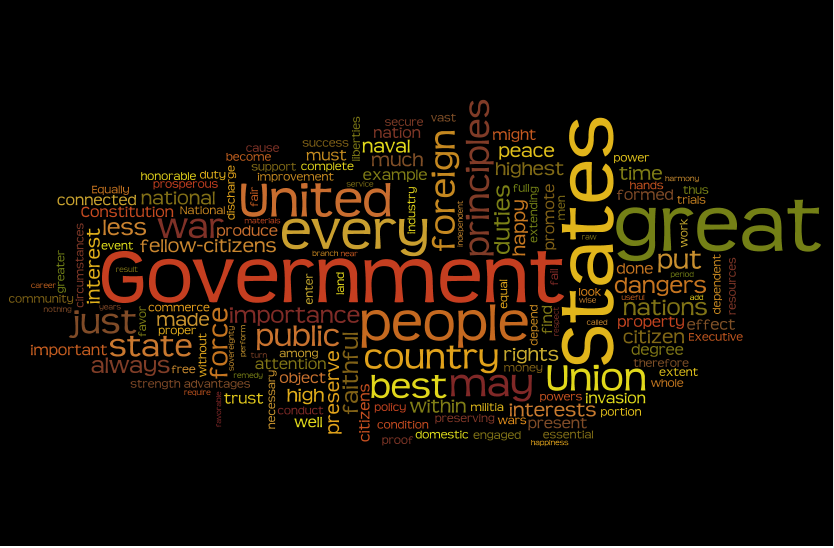
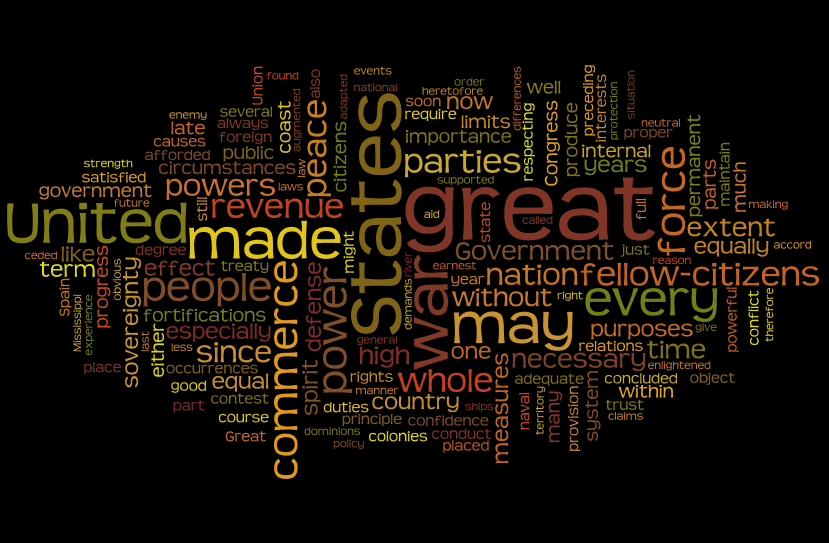
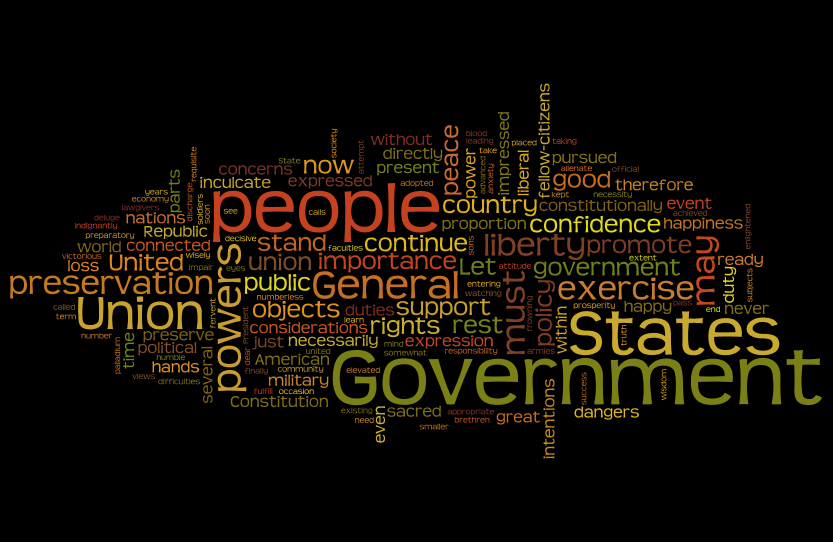
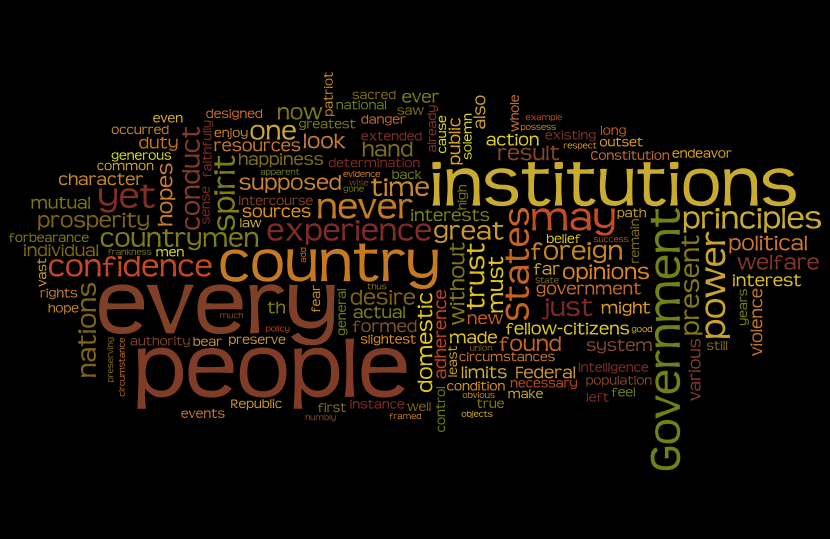
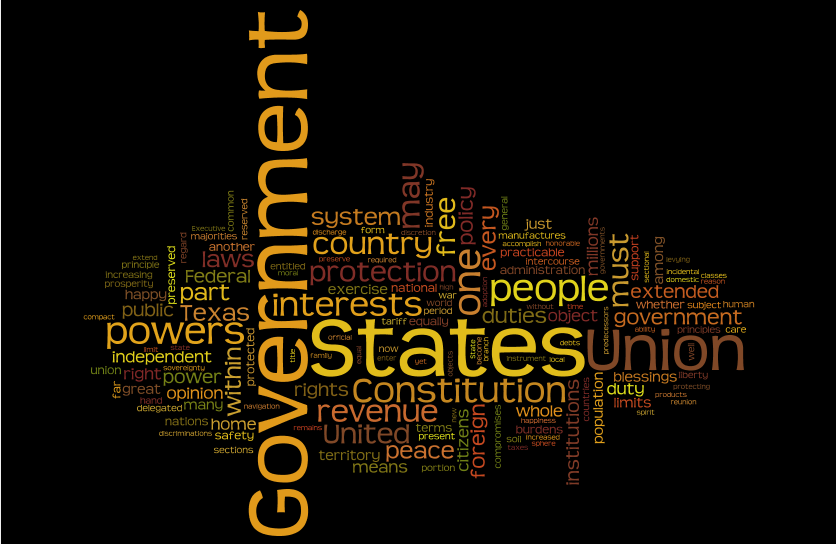
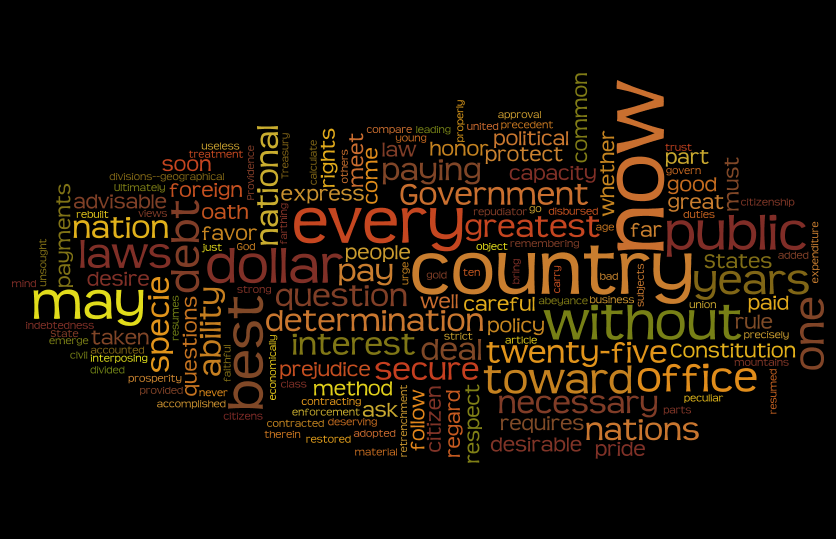
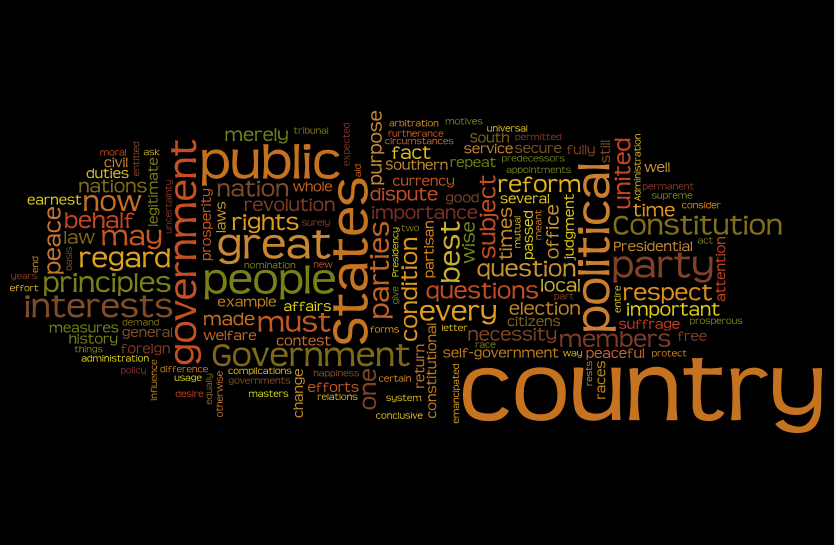
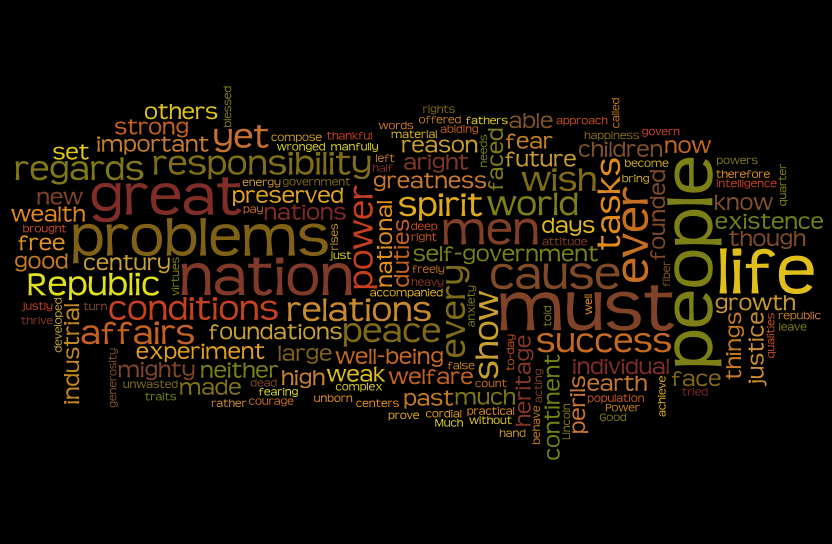
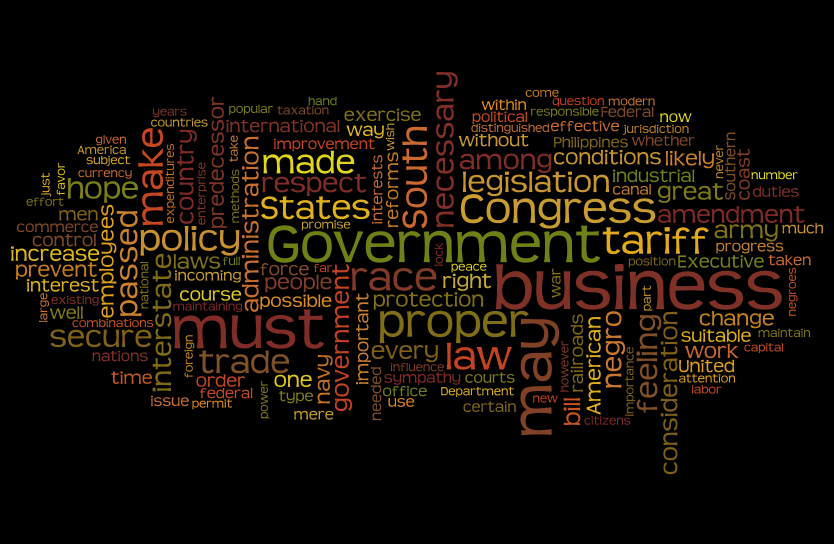
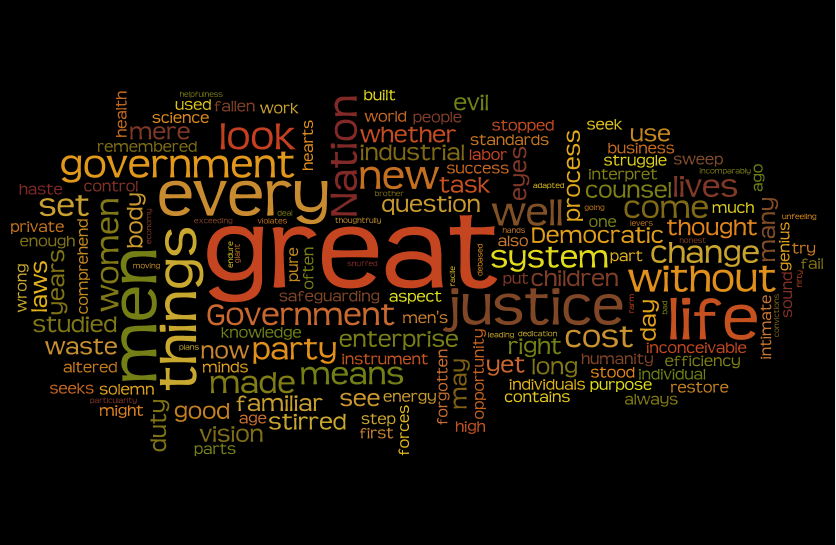
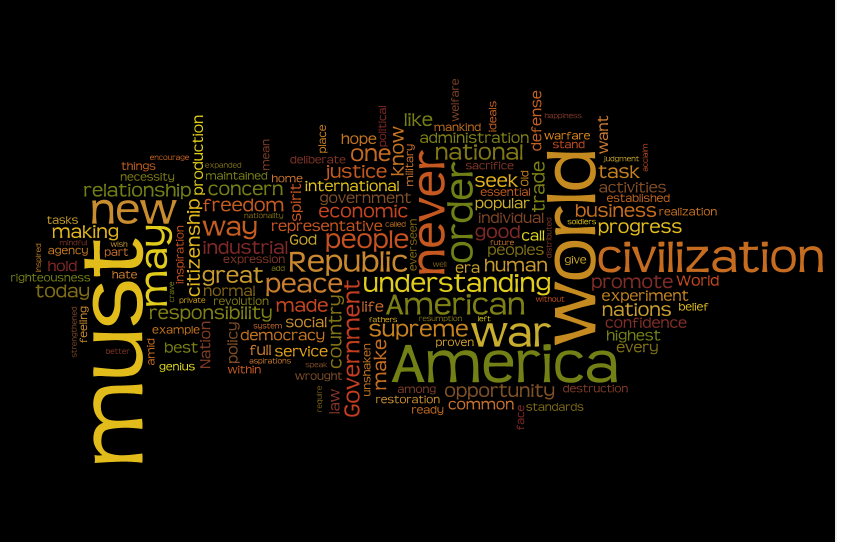
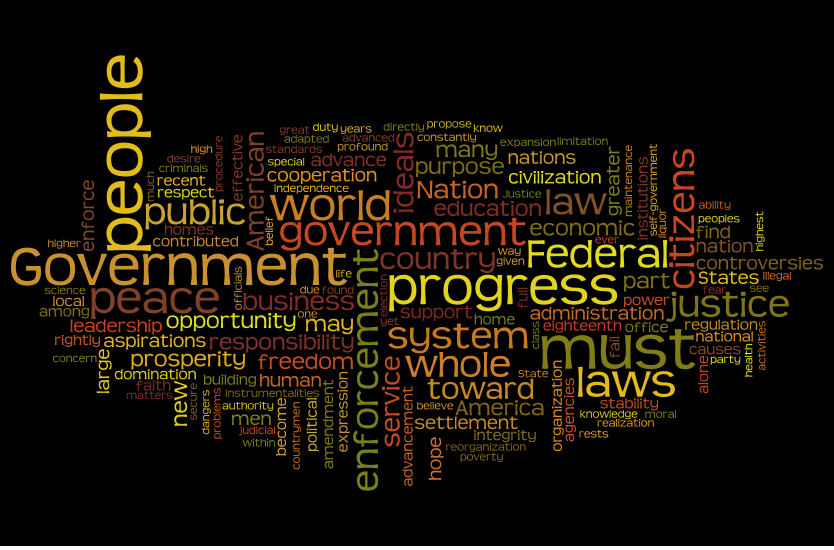
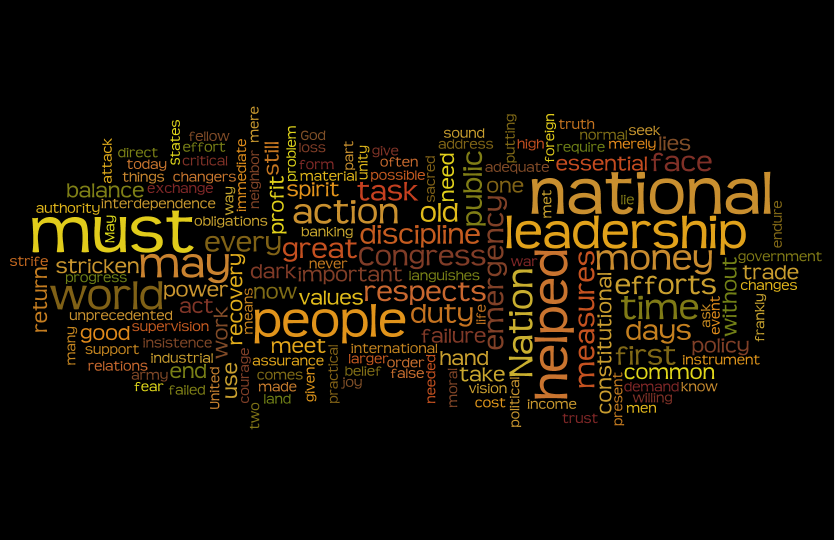
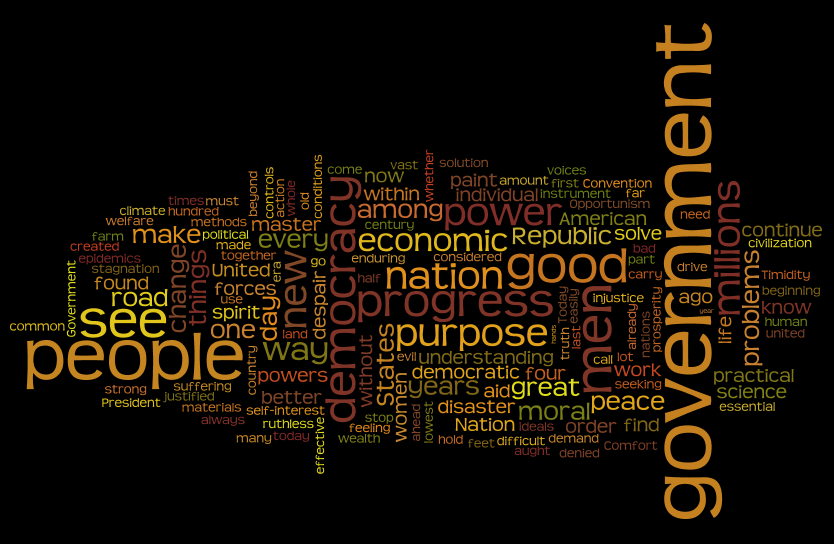
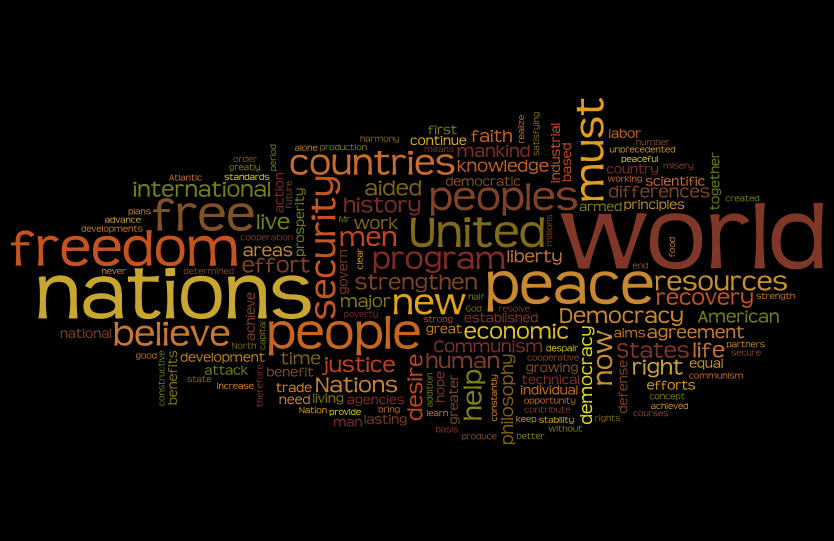
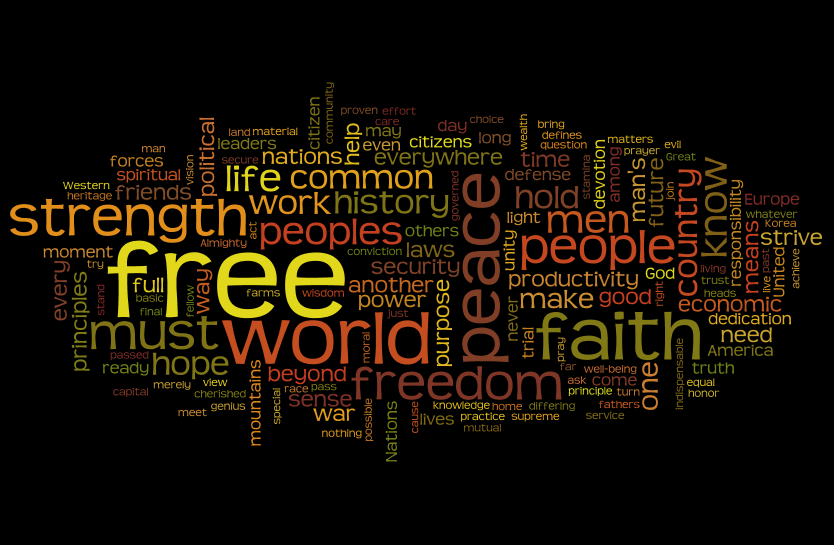
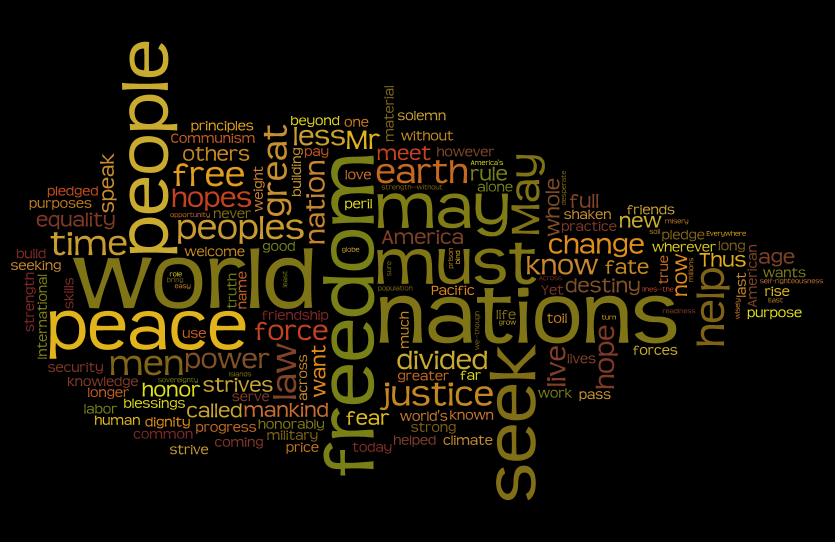
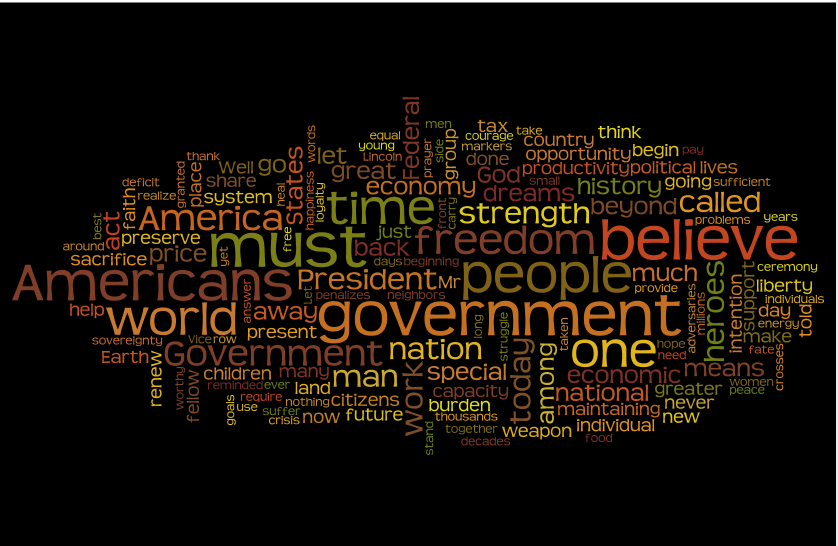
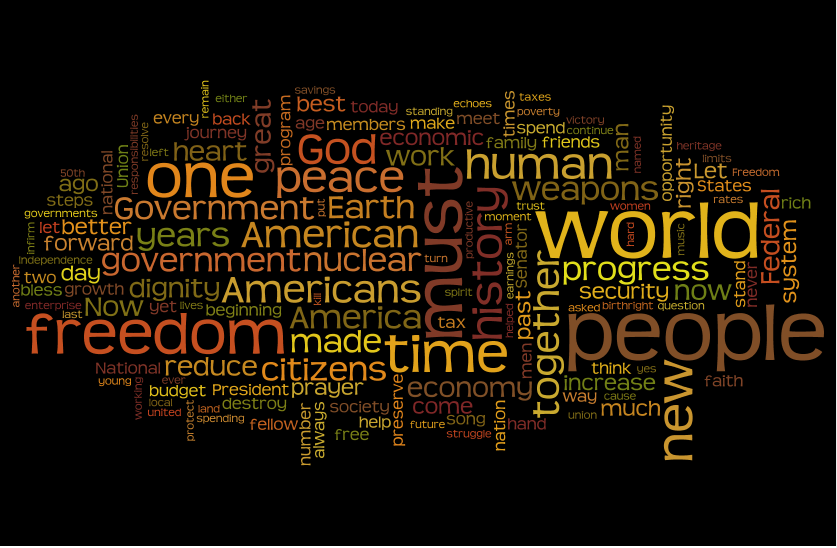
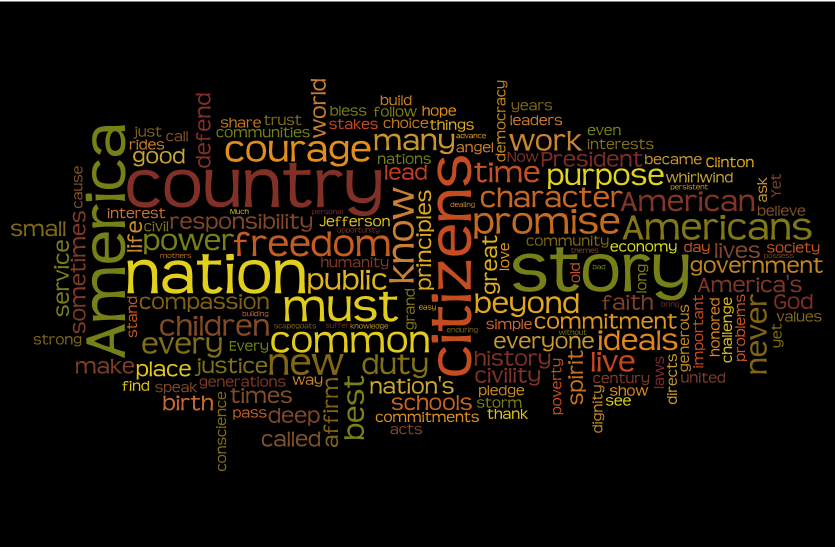
Data makes for some uniquely powerful and important studies. Word Clouds are one tool among many used in the field of Digital Humanities. In Word Clouds the bigger the word, the more often the word appears in the original text.
This two part series (seepart one here) looks at presidential inaugural addresses. Part one was just the evidence. Part two here will offer some brief questions and analysis.
Combining of all of the speeches together, there are a total of 134,379 words and 9,326 of these are unique (i.e., the total vocabulary used in all of the speeches combined). The most used word is “the” (10,020 times!). After filtering similar words, the most common words are reflected in the Word Cloud above.
Additionally, some of the most interesting ones are:
government, 594
country, 295
constitution, 297
freedom, 186
war, 176
history, 98
God, 89
business, 66
education, 33
slavery, 25
While by no means a perfect or comprehensive examination, Word Clouds provide an important way to examine what at least some of the big issues of the day were. Word Clouds in ways…capture the unconscious. People are not necessarily aware that they are using the same words and ideas over and over.
Take the following examples of some of the most used words in select inaugural speeches:
“people” – John Adams 1797
“public,” “nations,” “rights” – James Madison 1809
“war,” “country,” “British” – James Madison 1813
“government,” “states” – James Knox Polk 1845
“war,” “union,” “God” – Abraham Lincoln 1865
“government,” “business” – William Howard Taft 1909
“must,” “world,” “civilization” – Warren G. Harding 1921
“democracy” “know,” “nation,” “human” – Franklin D. Roosevelt 1941
“faith,” “world,” “free” – Dwight D. Eisenhower 1953
“America,” “world,” “must” – William J. Clinton 1993
Like film and other cultural artifact, these speeches and their most used words–and only looking at the words, not the contents or contexts–clearly reflect major issues of their day. The same thing could be said when looking at the most common words of all speeches combined. What does it say about our nation that “war” is the 89th most common word used in all of the speeches?
But, I’m also interested in what these speeches do not discuss or discuss only a little. For example
women, 30
soldiers/soldier, 12
culture, 7
immigrant/immigrants, 5
environment, 5
Indians, 3
lynchings, 1
African American/African Americans, 1
veterans, 0
sorry, 0
movies/movie/film, 0
What these speeches discuss is as important as what they do not discuss.
These speeches are also really interesting to me at the movement for at least two other reasons.
1) They provide further evidence that the United States was not established as a Christian nation and that such a notion is not all that promoted in these speeches, even today. “God” does not appear in any inaugural address until 1849, and then only once. In total, “God” or “God’s” appear 103 times and “Lord” 6 times in all of the speeches.
Here’s one interesting chart that maps the use of “God” from the first speech to the most recent one. The real light purple color means zero uses, the darker the color the more uses. This chart does not distinguish between speeches. It only maps chronological change.
One more interesting one. This displays the same data with “government” added as a comparison. As the chart shows, “God” has been used more often over time, and “government” is used less often.
Here’s the same chart with an increased number of divisions in the data:
2) I have also been very interested in what people call our nation. Do they say “United States,” “United States of America,” or “America”?
“America” or “American” drives me nuts personally. I always say United States or United Statesian.
But, what do presidents say?
This chart follows the use of “United States.”: (The light purple color means zero in that data set.)
And “America”:
Based on a comment by Benedict Anderson in Imagined Communities, I am curious that the United States doesn’t use “United States” more often. Anderson says that names like the United States reject nationalism at least by what they are named. All of the “states’ rights” people should love to use “United States.” “America” implies one place, one government, a nationalistic imagined community.
Charts made possible by: http://voyant-tools.org. All of the options are really neat, and provide a unique way of reconsidering information and history.

 Teaching students and learning from students continues to be extremely exciting, fun, challenging, and what keeps me going.





























 Dr. Andrew Joseph Pegoda