The “Big Idea” Gender Studies Syllabus

This is the third installment in my “Big Idea Syllabus” series inspired by Dr. Michael Wesch’s “Big Idea” Syllabus for Anthropology. My “Big Idea” Syllabus for History can be found here, for Writing here. The “Big Idea” Syllabus for Gender Studies follows. 

  • Gender is an important, valid field of inquiry, and because women and gender-nonconforming people have long been ignored, under recognized, and systematically Othered, gender studies is all the more important. 

  • People we call (and who currently identify as) women matter. Men, too. People who are in between or who are neither matter. People matter and are valid. Empowering all people is vital. 

  • Gender and sex are both social constructions–along with every thing else–exist on spectrums, and constantly change and vary by location. 

  • Such constructions and mores come from science, religion, fiction, traditions, laws, hopes, fears. Nothing has to be the way it currently is (and if you study the past, you’ll see how much it always varies). 

  • Cultural ideas about and representations of sex/gender shape every thing and manifest in how people think and live and manifest through what people are allowed to wear or allowed to think, where there allowed to labor, what dreams are permissible, what resources society provides, etc. 

  • We cannot begin to understand gender and its impact without fully considering other categories of identity created and deemed important by the powers at be and how all such identities are positioned, positions that can vary day-to-day, place-to-place. Intersecting identities include ability or disability, citizenship, economic standing, race, and religion. Understanding dynamics of privilege/oppression is vital. 

  • Life experience matters. Every one makes history. Every one has important perspectives.

  • To live is to protest. The fight for freedom must occur everyday. The personal is the political.

Dr. Andrew Joseph Pegoda


Wheel of Fortune’s Ableism Affects Pat and Vanna, too.

Wheel of Fortune‘s ableist tendencies are endless. I’ve previously written about some of these here.

But its ableism extends in other directions, too. Back in August of this year, I made a social media post focusing on Vanna and wrote:

She is 62 and still “looks” (is “required” to look) much younger. If she gained some weight or started showing signs of aging (and refused plastic surgery/etc) or needed a cane or anything else, she’d likely be replaced or eliminated. Ableism and normativity negatively impact her, too.

These thoughts have resurfaced given that Pat is currently on sick leave and that Vanna is hosting. (Vanna is doing a wonderful job, by the way.) Pat got sick. The show must go on. So he has been temporarily replaced. While this–temporary disability–is certainly different, it still matters and matters in the context of disability being part of life.

I have thought more about Vanna, too. Say, she decided to “go gray,” as is said, or was unable to wear high heels and dresses or couldn’t do all of the traveling and longs days they do, I imagine they would be looking to replace her or change her role. Or the social media criticism directed toward her would increase. 

And, importantly, Vanna knows all of this.

Society makes sure of it.   

Ableism forces Vanna–and people across the planet–to resist aging, to resist change, to fear disability. Ableism trains people from birth to hide signs of losing–or not having–said ableism. Ableism effectively locks people in at a given time and place and position: Vanna is suspended somewhere between ableist expectations for a widely-recognized media/television personality and Vanna’s biological body. Vanna receives little say. 

Dr. Andrew Joseph Pegoda

239 visits. 180 hours. Office Hours.

I continue to really love office hours (and even thrive on them!), and I had another semester of wonderful and very busy office hours, even busier than last semester! Here’s the data breakdown for the Fall 2019 semester. (Added 11/29 10:15 AM: Unfortunately, you might not be able to see the full data correctly unless you’re on a regular computer.)

This semester I was in the office available to meet with students a total of 132 hours (Mo/We 12:00-3:50 and Tu/Th 10:30-11:20). Students were present for 103 hours or 78 percent of this time. There were 239 office hours visits from 96 unique visitors totaling 10,821 minutes (180 contact hours – due to multiple students being present at once most of the time). 21 of these visits were by appointment and outside of regular times. 


The following table breaks down each class I taught (or group, in the case of students working on Honors College projects) and how many came to office hours at least once.

Group in group came at least once total visits
Women’s Studies 29 22 45
Queer Theory 29 16 85
GLBT Studies 32 21 30
GLBT Studies 29 10 17
“Heathens” 18 14 32
Honors 3 3 16

Total, I had 138 unique students. (2 students took me for 2 classes.) 62 percent of these students came to office hours at least once. Additional visitors included 10 former students not taking a class this semester and 5 non-student visitors. 


The following table breaks down session lengths.

The average visit lasted 45 minutes.

Length of visit # of visits
Less than 15 min. 47
15-30 min. 52
30-60 min. 83
More than 60 min. 57


The following table breaks down how many times each student came.

Of special note, 2 students came 16 times and 1 came 22 times.

# of visits # of students
1 70
2 16
3 5
4 1
5 5
6 1
7 1
8 1
9 or more 5


The following table breaks down why people came to visit. 

Reason for visit # of visits 
General Visiting 134
Class Questions 58
Paper Review 24
Honors College  18
Program Information 5


Office hours are one of my very favorite parts of teaching! I don’t understand why so many professors report having empty office hours all semester. Creating an inviting space and welcoming students works magic: They come and come again! 

Dr. Andrew Joseph Pegoda 

Notes on Invisible and Unpaid Labor 

I regularly think about invisible labor and unpaid labor–it’s everywhere. 

For invisible labor: We don’t see the people who empty our office trash cans. We don’t know the people who pick our fruits and vegetables and who deliver them to our local stores. What if grocery stores had a picture of who picked our fruit on the packaging? On the opposite side, invisible labor also applies to whatever it is CEOs do and other people who make enough money for life in 2019! 

For unpaid labor: The vast majority of professors in the United States are not paid for office hours, for planning, for grading, for answering emails, for attending meetings, or for mentoring: They are only paid for the 45 or so hours in the classroom face-to-face with students. Such unpaid labor, totaling in the thousands of hours per year per professor, often goes unacknowledged or unnoticed by the institution despite its importance and partial visibility to students.  

An example I recently learned about is “aesthetic labor” (see, Invisible Labor: Hidden Work in the Contemporary World). Have you considered the time and the cost–the invisible and unpaid labor–society generally expects of people who have a job? People are expected to uphold certain grooming standards. Women are generally expected to shave any visible hair other than hair on their head (excluding the face) and to wear conventional makeup. Frequently, employers also require a certain type of clothing–be it very casual or very formal, very fitted or otherwise. All of this is invisible and unpaid labor expected by companies and/or customers. Employers want their subjects to appear “pleasing” to customers. Body type/shape is policed at some businesses, as well. 

And then there is “emotional labor” as another important type of invisible and unpaid work. This is relevant in all jobs. People have bad days. A boss psychologically abuses them. A customer (or patient, or student) physically attacks them. Work–whether good or bad, whether fun or stressful–takes emotional tolls on people. Don’t you feel bad for the people who do road and bridge construction? They are directly in the middle of exhaust from hundreds and thousands of vehicles, as are workers at fast food establishments who take your order face-to-face in the drive-thru. People have their de-stressing techniques. Such emotional labor might include seeing a professional therapist, taking a hot bubble bath, or talking to loved ones. And don’t forget the therapists and educators who are vulnerable to Secondary Traumatic Stress from caring about and listening to the difficulties other people face. 

As much as people can, people need to demand visibility and demand compensation. 

What labor do you perform that is invisible to others? What types of invisible labor do you know about? What labor do you perform for which you are not paid (and should be paid!)? How might businesses incorporate invisible labor into their employees’ paychecks?

Dr. Andrew Joseph Pegoda

Big Business and the Media that Facilitates Its Lies, Chick-fil-A Edition

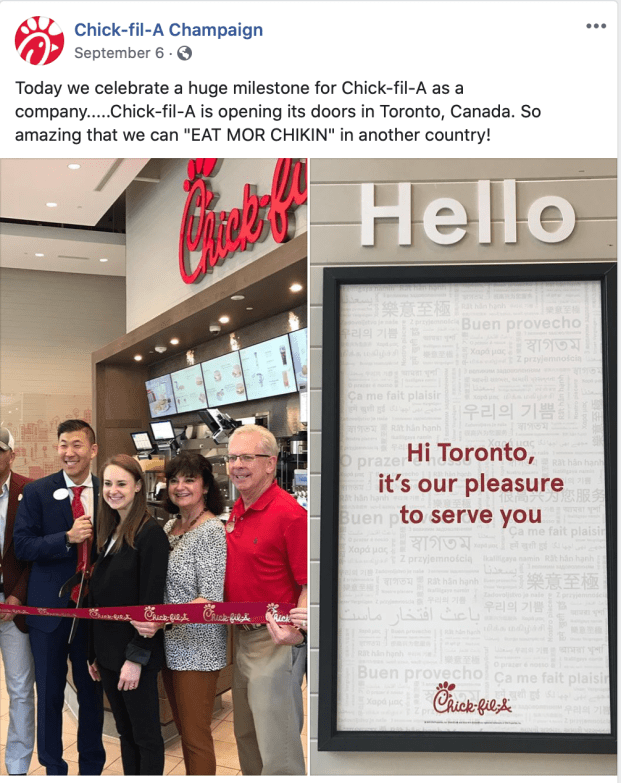
In September 2019, Chick-fil-A opened its first location outside of the United States in Toronto, Canada.

The problem — this is a lie. 

Chick-fil-A actually opened its first location in Canada in the mid-1990s but was unsuccessful. Chick-fil-A attempted another, also unsuccessful, entrance into Canada in 2014. In addition, Chick-fil-A opened at least two (possibly three or four – information is very hard to locate) locations in South Africa, also in the mid-1990s, and closed all of these a few years later. 

Its first attempts opening outside of the United States all failed and resulted in closed stores.  

Now, Chick-fil-A is giving it another try and it continues to obsessively announce that this new restaurant in Toronto is its first international location. Its first official press release in July 2018 announced, “Chick-fil-A Selects Toronto for First International Location.”

Screen Shot 2019-11-10 at 10.13.42 PM.pngWhy is Chick-fil-A lying? Chick-fil-A, the “Christian” company (that claims to be) guided by Biblical principles?

The Facebook page for Chick-fil-A Champaign had posts about this “first international opening” that (somehow!) came up in my newsfeed, so I posted a reply asking for clarification since this was inaccurate. They deleted my comment, and they blocked me. For asking a question

What is Chick-fil-A hiding? 

And why aren’t any of the hundreds of articles carrying coverage about the latest launch in Canada doing basic fact checking? The information is not hard to find. And why don’t any of them remember about Chick-fil-A’s previous attempts to operate outside of the United States?

Moreover, in early October 2019, Chick-fil-A opened a location in Reading, England, described as its second international location by media reports.

(And in response to en masse protests by supporters of human rights, the mall where this Reading location is located has already announced the lease will not be renewed beyond the initial six-month terms.)

Based on its history and on the on-going protests at locations outside of the United States, I wonder when (and where) Chick-fil-A’s next “first” international opening will be. 

Dr. Andrew Joseph Pegoda

I’m an Ordained Minister.

In my Secularisms and Atheisms class, students are reading Living the Secular Life. In one place, the author talks about the Universal Life Church that allows people to easily become ordained.

Curious, I Googled “Universal Life Church.” The website asks people to give their name, email address, country, and state. With this and a confirmation that this person is 18 years of age or older, the personal is immediately deemed an “ordained minister.”

It’s weird.

Being a minister with a click of the mouse.

But what does that really mean? Not much. At least not necessarily or immediately. The “Universal Life Church” is not a regular church—it’s a secular organization. It’s reputable and dates to 1962.

I quickly realized that such an organization has important purposes. In order to for two people to get married, for example, laws across the United States require that a minister or a judge (or in a few cases, an elected official) preside over the ceremony. People who don’t want to be married by a stranger or by religious doctrines are out of luck!

Enter the Universal Life Church, which certifies anyone as a minister and which works as an effective and legal way around theoretic laws. In the one week since I became a minister, I’ve heard over a dozen stories from friends about being or knowing someone who is a minster through the Universal Life Church in order to marry friends in non-religious ceremonies.

A need for people to help with important rituals in our society but focused on humanisms instead of theisms clearly exists. Maybe, I’ll get to help with that. 

Dr. Andrew Joseph Pegoda (or should it be Rev. Dr. Andrew Joseph Pegoda)

Waiting Room Conversations

I just wanted to make a brief post about an interesting waiting room conversation I overheard while at M.D. Anderson recently. 

An older White man was talking with another older White man and said: 

Trump has done what he can but the rapture is still coming soon. If Hillary had been elected, it would have already happened. And the democratic candidates for president are butch of squirrels.

I want my ashes thrown in my backyard so I’ll already be with my family with the rapture happens and we’ll be reunited easier. 

He made so many more interesting comments, too! 

Like others, his finds no cognitive dissonance between his implied moral beliefs and Trump’s absolutely horrific behavior. 

He’s notions of eschatology seem more informed by the Left Behind fictional series than other more credible texts. 

He equates a group of people—which includes women and People of Color—to animals. 

He seems to think Yahweh isn’t actually that powerful, since his remains need to be placed in his backyard.  

He has an oddly US centric view of the world, especially for when thinking about “end times.”

And he didn’t care that other people around him would find these ideas, especially about Trump and Democratic politicians, highly offensive, especially given Trump’s push to continue concentration camps in the United States.

(And potentially being sick, given the setting, is absolutely not an excuse for his behavior toward fellow humanity.) 

Dr. Andrew Joseph Pegoda

122 visits. 74 hours. Office Hours.

I’ve always had busy office hours as discussed here. Invisible Labor is pervasive in our world. People labor in ways that are often unseen, unacknowledged, and/or even unpaid. In order to help counter this, I tracked visits this semester. The results follow. 

I had 135 students this semester across 5 classes (plus one independent study course). 28 of these students took me for at least one (if not two, three, four, or five) course(s) in a previous semester.

There were 122 office hours visits during the Spring 2019 totaling 4,480 minutes (about 74.5 hours)

The average visit lasted 37 minutes.

  • 38 visits lasted 15 minutes or less
  • 23 visits lasted 15-30 minutes
  • 34 visits lasted 30-60 minutes           
  • 27 visits lasted 60 minutes or longer

Visitors came from a variety of groups.

  • 11 – Former students (who are not taking a class this semester)
  • 31 – Queer Theory class
  • 35 – Intro to Queer Studies classes 
  • 11 – Comparative Creation Myths class 
  • 31 – Intro to Women’s Studies class 
  • 3 – other 

There were 61 unique visits but lots of repeats.

  • 43 – 1 visit
  • 7 – 2 visits
  • 3 – 3 visits
  • 5 – 4 visits
  • 1 – 5 visits
  • 1 – 6 visits
  • 1 – 10 visits
  • 1 – 16 visits

Visits occurred across the semester, mostly in April.

  • January – 15 visits
  • February – 34 visits
  • March – 30 visits
  • April – 43 visits   

Visits occurred for the following reasons. 

  • 64 – general visiting
  • 31 – class questions
  • 27 – discussing paper draft 


Dr. Andrew Joseph Pegoda