Review of Aaron Alon’s BULLY (2017)

From its directorship by Dr. Aaron Alon, its powerful story line and unforgettable thirteen original numbers written and composed by Alon, its cinematography, its sound, and its talented cast of performers and singers, Thunderclap Production’s latest release, Bully (2017), is a highly-original masterpiece about bullying, depression, gender, queerness, and suicide. In the space of 58 minutes, this musical pushes viewers to see the multifaceted dynamics of bullying. 
 
One of Bully’s numerous strengths rest on the profound silence of its lead character, Sam, a young high school student. Sam only whispers two words in the entire film. His silence recognizes the feelings of depression and isolation faced by many victims of bullying and emphasizes how much cannot be known about a person’s inner thoughts. Also important to note is that none of the characters attempt to speak for Sam. 
 
Another strength is that Bully has no artificial conclusion or resolution, per se. All too often fictional stories act as if they must deliver justice, answer important questions, or otherwise wrap everything up. Bully mirrors reality. Bully does not provide a false conclusion or false sense of happiness. Bully recognizes that bullying is a profound, institutional problem with complicated causes, unpredictable consequences, and no quick remedies. At the same time, Bully absolutely includes happiness, explains how life gets better, and shows how many people genuinely care for Sam, including his parents, the school counselor, the coordinators of the community vigil, and even to a limited extent, one of the bullies. 
 
Unlike most films about bullying, Bully is aimed at adults—not children or young teenagers. This allows a greater focus on the harsh dynamics of bullying as it actually occurs. Because of this, Bully gives important attention to the adults involved—reporters who bully grieving parents, parents of the bullies, school administrators, and people helping the community heal after Sam’s death, for example—and attention to real-life physical and verbal violence. 
 
The lyrics and accompanying instruments made every song powerful, without exception. Performers across-the-board deliver emotional performances where they have clearly fully become the characters they portray. Three performances that especially stand out are Alon’s “He’s a Child” (Monica Davis and Amanda Passanate), Alon’s “Who’s Next” (M.E. Frazier, Jr.), and Alon’s “Raise Your Voice” (Tamara Siler, who has an especially beautiful and strong voice). 
 
Bully is powerful and will leave you thinking. Please make sure it’s on your viewing list. This musical deserves wide viewership and acclaim.

I eagerly await Dr. Aaron Alon’s next film! 

Dr. Andrew Joseph Pegoda

The “Big Idea” English Studies Syllabus

Revised and Expanded July 2022

  1. All forms of life communicate in never-ending give and take processes. Homo sapiens and their ancient ancestors have always communicated with one another and with other forms of life. Current-day humans communicate through any number of compositions, including poetry, biography, wills, musical scores, text messages, and much more.
  2. When guided by curiosity, studying how humans communicate is not just interesting but vital, if we are going to learn. Academic discourses such as Crip Studies, Critical Race Theory, Queer Theory, Rhetoric, and Women’s Studies help decode and complicate artifacts of communication and each offer different and particular insights.
  3. The development of spoken and written languages represents one of the greatest accomplishments in world history, making sophisticated, archivable communication possible. Language is hard. The study of semiotics helps reveal how outstanding this feat really has been. Humans develop languages from various symbols that are grouped together and assigned sounds, all of which arbitrarily represent persons, places, things, ideas, qualities, and much more. Humans code-switch and code-mesh regularly, too, which is to say they adjust how they communicate and combine different traditions of language, depending on the specific setting.
  4. Powerful people like to control and judge how people communicate. “Rules” that exist have various functions. Sometimes they allow communication to be possible, but other times they try to limit creativity or limit possible changes and challenges to how languages are practiced. Frequently, too, the rules of grammar or of “professionalism,” for instance, have the consequence of perpetuating privilege and oppression when non-majority accents or grammars and non-majority traditions are automatically deemed incorrect and inferior.
  5. There are ultimately no essentialist rules as to how Homo sapiens can or should communicate, and how they speak and write constantly changes. All languages are culturally and socially constructed. English as practiced in the United States today will be unintelligible in just a few hundred years. When reading and writing—communicating—whether informally or formally, knowingly or unknowingly—Homo sapiens are constantly pushing current limits and are changing and challenging the mores of how their languages are practiced.
  6. Because seeing and understanding and reading and writing and speaking—language, life—are always in (re)development, Homo sapiens must keep learning. Writing is re-writing. Speaking is re-speaking. Reading is re-reading. Perfect communication does not exist. Informal instruction (such as through cultural productions, conversations with others, or other manifestations of the historical unconscious) and formal instruction (such as in History or Science classes or dedicated Composition classes) help guide people through this process. Such life-long instruction allows for the possibility of the very best that can be produced and consumed at a given time and place.
  7. Language itself is powerful. Language control us, determining what is even possible to think. We also control languages. In some way or another, all Homo sapiens are readers and writers. All forms of language want to accomplish something and/or to explore ideas. And this “something” mirrors hopes and fears of the time and place in which it was produced. It’s deeply historically embedded. This “something” also blurs all boundaries between fiction and nonfiction.
  8. There are a variety of ways in which Homo sapiens ‘read’ texts. Humans read books or films, as well as each other, the weather, or a room, for example—all of which are “texts.” Consensus, stable interpretations, from the perspective of hermeneutics, do not exist: A second read will reveal not only details missed the first time but brand new, never-seen-before-in-history information.
  9. And so too, there is no limit to how Homo sapiens can take their ideas and communicate them, alphabetically or non-alphabetically. The most effective authors will use appropriate evidence, will ethically use rhetorical techniques to their advantage, will embrace critical thinking, will plan, will engage with others, and will accept that writing is a never-ending process. They might learn the “rules” and then adjust or break them to better communicate, or they might just start with breaking the rules. Humans communicate most effectively when they read and analyze regularly.
  10. Homo sapiens have an opportunity and a profound responsibility. They can help preserve languages and artifacts created across time and place, and they can create their own honest, high-quality texts—for such allows us to appreciate and understand ourselves and others more effectively. “The dead do not like to be forgotten.” Language helps them live in perpetuity.

A few thoughts about Christmas songs, the related theologies, and traditions.

A powerful lesson happens when we have understandings of the past informed by evidence: the realization that most things considered “traditional” or as having lasted forever are actually new developments–often in the past century, sometimes in the past decade or two. Of course, this doesn’t detract from the power associated with the mores and rituals and the related creations of usable pasts. 

Christmas, as generally currently celebrated in the United States, is roughly a century old. Many of our classic Christmas songs developed during the World War II era. Other aspects, such as the Elf on the Shelf, are much newer. Collectively, celebrations in the United States today combine traditions, many of them pagan, from far coldest parts of northern Europe, the Middle East, and for some families, present-day Mexico. 

This also applies to the theology connected with aspects of the Christian celebration of Christmas. Theological notions that Mary was a virgin and that Jesus was the son of God, for example, were first developed and added decades after they had all died and slowly refined over a dozen centuries. And they continue to be written and rewritten. 

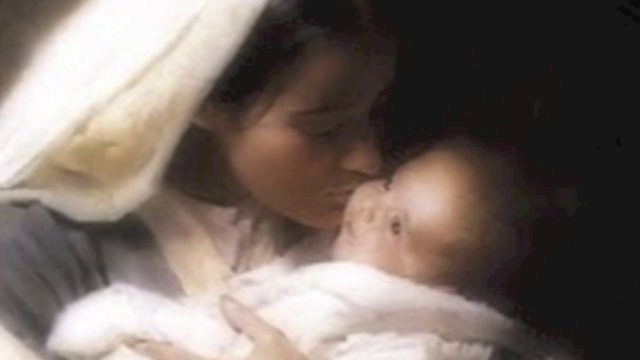
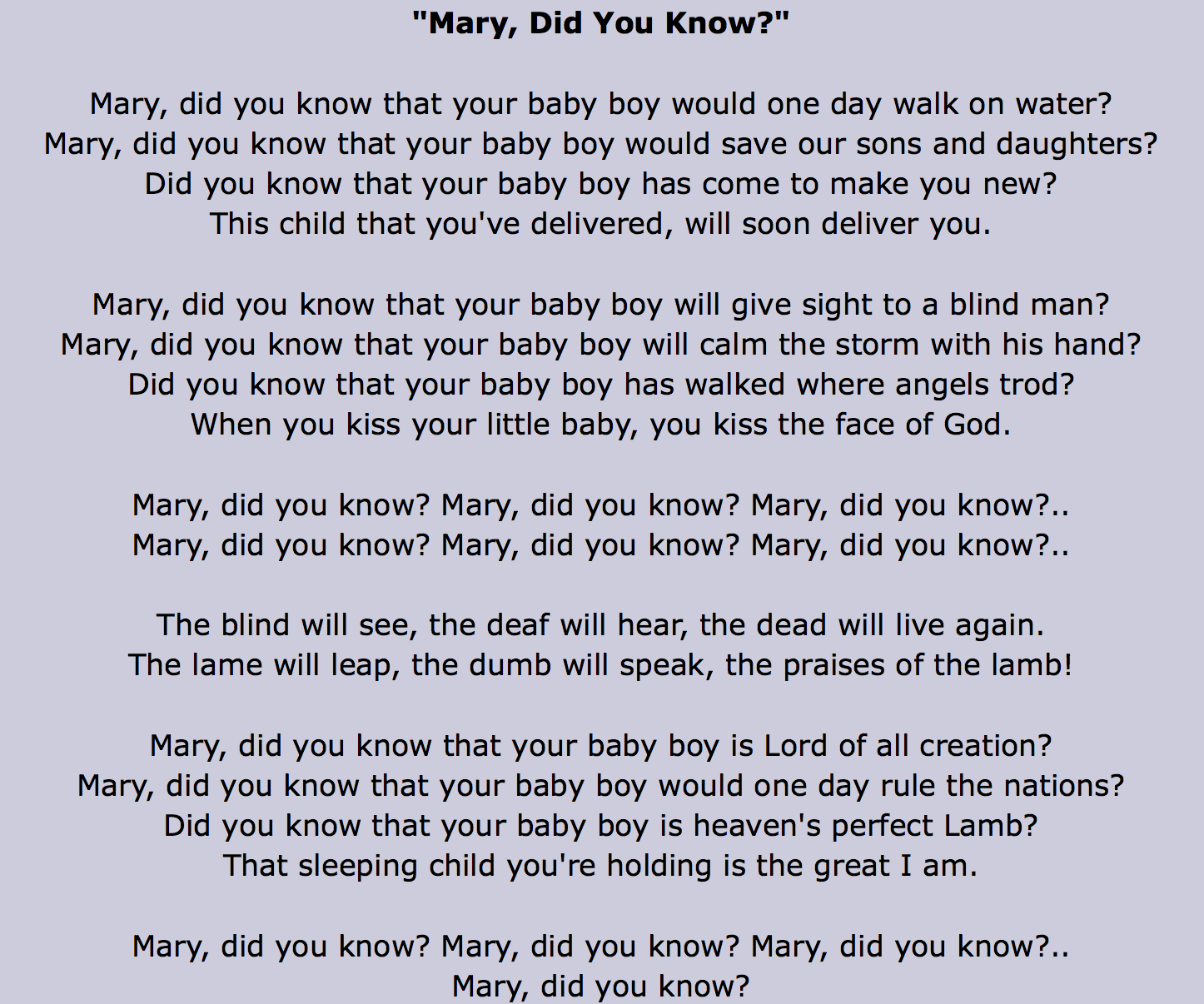
On this note, the newish song “Mary, Did You Know?” (1991) caught my attention yesterday. 

Side note: Much of Christmas music (in small doses) is very nostalgic. Some of it, lyrically and instrumentally, is “aesthetically,” very good. But then there’s the issue of the many implausible (and inaccurate) mythologies it memorializes and perpetuates. Yet, listening to and studying such provides important exercises for cultural analysis and for understanding other texts that inform contemporary theologies.

“Mary, Did You Know?” is a great example of a more contemporary theological text. As this article points out, this song contradicts extant foundational texts, texts that say Mary did know, but this song portrays women as ignorant, submissive, and weak. Such characteristics are perpetuated and reinforced as Biblical mandates by Fundamentalist Christianity, even though these dehumanizing “rules” for women largely originated in theological (and non-“theological”) texts outside the collection of works called the Bible. 

Screen Shot 2017-12-25 at 4.08.28 PM.png

The song does everything it can to take away all of Mary’s agency and humanity. “Mary, did you know” is stated nineteen times. Does Mary know anything? Can Mary do anything? According to this song, no. 

The song is also “creepy,” as defined by Adam Kotsko is his Creepiness. If such were “true,” the message and following actions would be overwhelming for mortals. Additionally, I have previously written about how Rape Culture provides important and useful ways in which to analyze the Christmas story. In “Mary, Did You Know?,” Mary does not know she was pregnant with God/the Son of God. That’s (a kind of) rape. Even in theological texts that say Mary did know or Mary was asked, consent is not possible because of the “age,” knowledge, and power differentials (see Sex and Harm in the Age of Consent.)

Dr. Andrew Joseph Pegoda

7 Stages of Having and Recovering from Surgery

  • Living almost in a state of complete unconscious – basically unaware of surroundings and having a memory of about one second and basically dependent on others for everything
  • Finding everyone and everything irritating and frustrating
  • Being just well enough that the pain really begins
  • Trying to think or remember something and being completely unable
  • Worrying about everything and being constantly scared of everything
  • Having ups-and-downs in mood and energy by the hour and then by the day
  • Basically being okay but adjusting to a new normal

These are based on my experiences. Some of the stages overlap, naturally, and have occurred in slightly different orders.

Dr. Andrew Joseph Pegoda 

Major Surgeries and “Major” Surgeries

Something that has been on my mind:

I have had six surgeries now: Brain surgery in January 1991, heart/lung/chest surgery in August 2000, pelvis surgery in March 2009, first hand surgery in May 2015, second and third hand surgery in May and December 2017.

The first three were major surgeries that required several months to a year to be anywhere near recovered. These were also much riskier (although very necessary) surgeries. The scars from these surgeries (except the brain surgery) still hurt occasionally (generally a bit less over the years), but I don’t see them. 

The scars from the hand surgeries are ones that not only hurt regularly, but I see and feel them all the time. So while these surgeries were minor and have had a shorter recovery time, they were effectively “major” surgeries–in a much more psychological way.

I am aware in a new and different way that I have had many surgeries and will only have more and more with longer and longer recovery times as the years go by.

Dr. Andrew Joseph Pegoda 


Preparing for Surgery (again) and Toxic Masculinity in the Waiting Room

On Monday, I’ll be having surgery #6 at M.D. Anderson. This is the second surgery this year! Luckily, it’s a small one again–this time to remove two tumors on my left hand. Recovery should be pretty quick, overall, but I’ll be unable to use my left hand for about two months, all-in-all.

During the preop appointments this past week, I overheard parts of one particularly interesting and problematic conversation.

An older man was with this wife and daughter. They were talking about Matt Lauer, and the older man exclaimed:  

I don’t know of anybody I haven’t made a pass at! 

He laughed and laughed.

They laughed and laughed.

Such a comment reveals a complete disregard for decency and shows a perfect example of rape culture. I also think his words are interesting because he did not mean “anybody” – he meant people he read and he deemed: young, attractive, and female.

He also effectively confessed–in a room full of people knowing their would be no consequence–to being a bully, at the very least. Now, I’m wondering what else he did to all of these people. What happened if they rejected his advances? How often did he cheat on his wife?

(Well, he didn’t know I would be writing an article about it!)

At some other point, his wife suggested that the women accusing Lauer of sexual misconduct and rape knew what they were doing/what they wanted and only wanted to get money.

People–across the board–can perpetuate rape culture. 

This family also complained about the wait. They hadn’t even been waiting 30 minutes. I’ve waited 4-6+ hours for an appointment many times. M.D. Anderson is full of medical doctors and nurses and others who dedicate their energies to saving other people. I can wait.

Anyway, their daughter went to the check-in station to complain.

They were also complaining about patients who “would get offended” if the nurses checked vital signs and whatnot in the waiting room.

Always remember: Toxic masculinity and privilege/oppression exist every where. bell hooks would remind us that men are also victims of patriarchy. Men cannot be blamed without also blaming–and reforming–culture everywhere. 

Dr. Andrew Joseph Pegoda 

Book Review–“The Rise of the Nones: Understanding and Reaching the Religiously Unaffiliated”

I read James Emery White’s The Rise of the Nones: Understanding and Reaching the Religiously Unaffiliated (2014) this morning in preparation for a new specific topics course I am teaching this spring–Atheists, Other “Heathens,” and 20th C. United States.

White writes from the perspective of a long time pastor and a follower of Protestant Christian theology and for an audience of people seeking to build their church rolls. Most problematic, he believes that Protestants in the United States must reject secularism and “must do whatever it takes” to force the United States and its peoples into Protestant lifestyles. Throughout his work, White is unwilling to recognize that there are (and always have been) people who deliberately do not want religion in their life and in sharp contrast to Why Christianity Must Change or Die, White is equally unable to acknowledge religion’s on-going problems. 

The Rise of the Nones does not trace the rise of atheism or agnosticism per se but the rise of people who do not specifically identify with traditional organized religion and who do not maintain traditional church memberships. The rise of people who are only spiritual or who find their God in anything/everything concerns White greatly. And “atheists” or “agnostics” basically do not exist in White’s world. 

While ignoring the role of science during the last twenty years, as well as the egregious behavior of far too many Fundamentalist Christians during the same time, White takes the majority of an entire chapter to criticize Darwin’s and Freud’s groundbreaking discoveries for contributing to the long decline of Christianity! White seems to have no grasp of how their theories–even where ultimately flawed or incomplete–transformed the world in important, life-saving ways. White also fails to grasp the Hummingbird Effect–or basically how their ideas were products of their times and places and were connected to other manifestations of Modernism. Darwinism and Freudianism–even if by different names–were inevitable.

White further criticizes people who do not yield judgement on others. White longs for a world where Protestant Christianity dictates what is right and wrong and where there are what he calls “absolutes.” So much for, do not judgeHe even rejects views that embraces consent, no harm, and happiness as sound guides to good morality. Throughout The Rise of the Nones, White is critical of any kind of complexity. On numerous occasions, he very clearly misrepresents or misunderstands contemporary postmodernism and poststructuralism.

White makes it very clear that he stands against Queer people/LGBTQQIAAP people and the culture that and people who use Facebook, iPhones, and other such products because they are too focused on “me” and the “i.”

And he hates Wikipedia! While it had problems in the past, scholars increasingly have deemed it an excellent resource and better than traditional encyclopedias. 

Even further surprising: in part by citing FoxNews (!!), White is critical of Catholics and suggests on at least some level that they are not even Christians.  

While on the note of evidence, White almost exclusively cites Websites when there are credible books available that would provided nuance and sophistication. In other cases, he presents anecdotal data–in sloppy ways–as if it were produced in regular scientific studies. 

Maybe not as surprising, he strongly dislikes churches that use modern music.

I did not read part two anywhere near as closely because it was much more a step-by-step guide to–in his view–convert people and because it came after the FoxNews citation, which caused his credibility to drop a great deal immediately. (And it was not a citation critically analyzing FoxNews, to be clear.) 

The Rise of the Nones does not truly seek to understand and accept “the nones” from its refusal to fully acknowledge the scope of their reasons or the true extent to which they are “the nones.” Moreover, White clearly wishes to live in a theocracy. While the Untied States is too much of a theocracy already, his positions effectively advocate further dismantling laws and traditions.

Why do more and more ministers and politicians want to live without any notion of democracy? Why do they hate the United States? Why do they hate diversity? 

Give the further rise of Trumpism, White’s view that Protestant Christianity must spread by any means necessary is particularly alarming, especially because we see people like him doing that right now and we are seeing how this leads to further violence. White effectively believes that only his positions are correct and that everyone else is doomed to hell. 

If only all people could recognize how complex the world is and how consequential their actions are:

In every historical example, missionaries pave the way for other colonizers and capitalists, and often, are themselves the colonizers and capitalists, with intention to dispossess and accumulate whatever they can, including but not limited to souls, land, labor: there are no missionaries with good intentions.

Dr. Andrew Joseph Pegoda


“TODAY ONLY” Extra Credit Opportunity – A Surprising Teaching Experiment

On Sunday, November 5, 2017, I had an idea.

I immediately emailed all of my students during the middle of the afternoon. The email announced an extra credit opportunity that would only be available until 11:59 pm. I gave students a few blog articles to read and requested that they leave a meaningful comment on each one.

And let me tell you.

I have never seen such a strong response to an extra credit opportunity. Students responded en masse and made outstanding–most meaningful–comments! 

Usually, most students who do extra credit do not need to for purposes of raising their grade. And my students this semester–across three unique classes, five sections–are earning grades parallel to all other semesters.

My theory is that students basically didn’t have time to procrastinate when it was a “now or never” situation. Procrastination is a huge problem for people today, college student or not. I usually offer three small extra credit assignments per semester–that if completed drop a lowest assignment grade–and only about 5-15 percent take the opportunity. In contrast, 40 percent of my students completed the “one day” offer.

I had hesitations about the one day offer because people are busy with other course work, family, or work obligations, but I still thought it was worth a try, especially as other extra credit opportunities always had a window of at least one week, often two weeks. After the fact, I had several students say they worked all day Sunday or whatnot and could they have an extension. I said, yes, of course. But–procrastination?–most of these ultimately did not complete it.

On this note, across universities, classes, and professors, recent years have seen a slow rise in the number of assignments that are not submitted. While it remains disappointing and frustrating and confusing, situations where 35-50 percent of students do not submit an assignment are now the norm. This applies to the freshmen and seniors. In one of my classes this semester, roughly 20 percent of the possible small assignments were not submitted. This number is lower than the 35-50 percent number in part because of numerous in-class writing assignments.

Dr. Andrew Joseph Pegoda