The Most Racist Question (EVER?) on the Texas STAAR Test

Regular readers will remember my very long and question-by-question critique of the 2013 Social Studies STAAR Test. You can find the full version here and a summarized version here. I have been re-reading and re-visiting my thoughts about this test, as well as looking at the 2014 version because I was invited to give a guest talk/lead a discussion about these issues, which will take place tomorrow evening. (Many thanks to those who invited me!)

While preparing, this image (titled The County Election) and the question with it really stuck out from the 2014 STAAR Test:   

STAAR-G8-2014Test-socstud

 This painting of a Missouri scene was completed in 1852. Such scenes would look dramatically different after the —
A. ratification of the Fifteenth Amendment
B. Second Great Awakening
C. emergence of Manifest Destiny
D. expansion of the factory system into the South

Can you guess what the “correct” answer is?

It is “A” – the Amendment that, in writing, gave Black Men the right to vote.

Several thoughts cross my mind:

How would having Black Men voting make this image “dramatically different”? Perhaps the test writers were thinking about what would be “dramatically different” to people in the 1850s and 1860s and their mores, but the question does not say anything that would really allow this to apply. Or if they do intend to only suggest there would be (some) Black Men voting, describing it as “dramatically different” could pose complications, especially when we consider the once-again increasing significance of racialized rhetorics in the Obama Era. “Different” alone also makes it problematic, with its connotations of bad.  

Another thought I have is that there was/is a strong stereotype, especially created/perpetuated in Birth of a Nation, that Black Men during Reconstruction were uncontrollable and dangerous once they were not enslaved (neo-enslavment is a separate discussion) and had the right to vote.

Another, historically speaking Black Men did not have the vote for that long and even during Reconstruction (before the full development and codification of the Culture of Segregation) Black Men were never free from voter intimidation.

The question, even as a multiple choice question, could but does not make these complications clear. Consequently, it suggests that White people were peaceful and orderly and the Fifteenth Amendment changed this.   

The STAAR Test, as overlooked as it might be in a cultural context, is just as much a cultural artifact as films or song lyrics. The questions, construction of the questions, the answer choices all speak a great deal to society’s hopes and fears, especially hopes and fears of those with power. The rhetoric of who is and who is not included is important, as is the Test’s frequent use of broad statements such as “citizens” or “colonists” when it really means “[White] citizens” or “[White] colonists.” Such wording, such rhetoric suggest to young, impressionable students that things were better than they were and better than was even possible, and makes our job as History professors so, so much harder. Unlearning is harder than learning, psychologically and physiologically.

Disguised Racism?: A Very Brief Analysis of a Postwar Image

Untitled

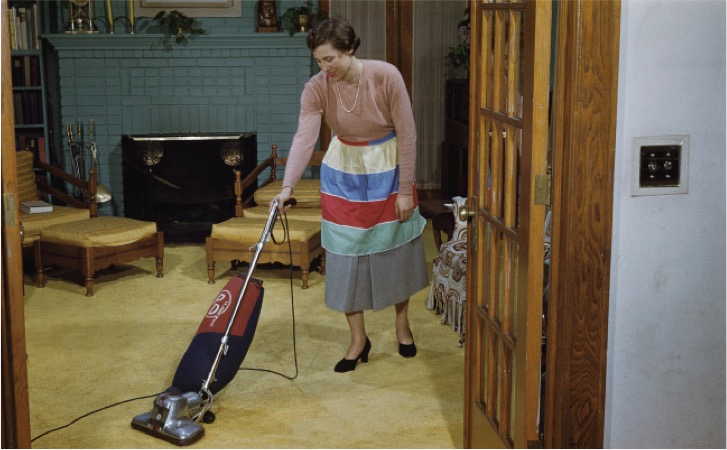
This postwar image and ones like it regularly appear in textbooks. Scholars use such images to make arguments about how new technologies made housework less time-consuming and advertising made these appealing necessities.

Other arguments focus on the sexism of having a Woman use the vacuum in this advertisement – a Woman who is wearing an apron and presumably also cooking lunch and dinner.

Still other arguments rest of the implied harmony and peace and content for this Woman and her implied husband and children, and such argument focus on the corresponding problems with this rhetoric, specifically what it ignores. 

Additionally, such images served to reinforce that with World War II over, the Women who had taken jobs needed to go back home. In the later years of the war, about 35% of Women were employed, up about 10% from before. 

But, I have never seen an argument or analysis point out that in reality in the vast majority of cases, the Woman depicted in this picture and all the Women for which she becomes a historical stand-in would seldom, if ever, actually vacuum their own home. White families hired Black Women (and immigrant Women) to do their cooking, cleaning, and frequently, childcare, too, and they paid them far below any kind of reasonable wage and generally offered little respect and thanks in return. 

Regardless, though, this image–and the countless parallel ones–delete and ignore Black Women and their work and their agency. That’s the true take-home message here. 

The Nature of History, History as Entity vs. Example, and Texas History

Teaching Texas History for the first time this semester has provided much to think about, especially questions revolving around both “What is Texas History?” and “What makes something ‘Texas History’”?

Another way of looking at these questions is to ask, what gives a place its own history?

Take the boundaries of the geopolitical area called “Texas.” Unlike boundaries in European nations or even pre-contact Indian settlements—which were fought over and defended and the result of years and years and years of slow building and which resulted in various alliances and conflict groups—the boundaries in Texas were artificially (i.e., politically) created by pen and paper one day.

filewpdms-republic-of-texas.jpg

Parts of Louisiana, New Mexico, Colorado, Kansas, Oklahoma, and Wyoming were part of the geopolitical area claimed as “Texas” at some point. (The coast of Texas was originally part of Florida, too!) Last night I googled, “when Colorado was part of Texas” and got this interesting result. This article brings up interesting questions about what it really means to be a Texan. Consider how different Texas is to someone living in Houston v. El Paso v. Brownsville v. Amarillo v. Dallas (v. Fort Worth!) v. Midland. Texas is a huge place with many identities and peoples. The default narratives of Texas History (the myths) leave much out.

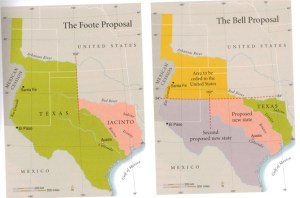
Some of these areas and boundaries were disputed, but the United States stole everything it claimed and more from Mexico during the Mexican American War of 1846-1848. The Compromise of 1850 gave Texas its present-day shape, but this could have easily been different.

Untitled Untitled2 Untitled3

While the southern border with the Rio Grande is a true example of a borderland and how areas frequently develop political boundaries, not so much for the rest of Texas. How does the subjective nature in which Texas came into existence challenge what we call Texas History and what is the domain of Texas history?

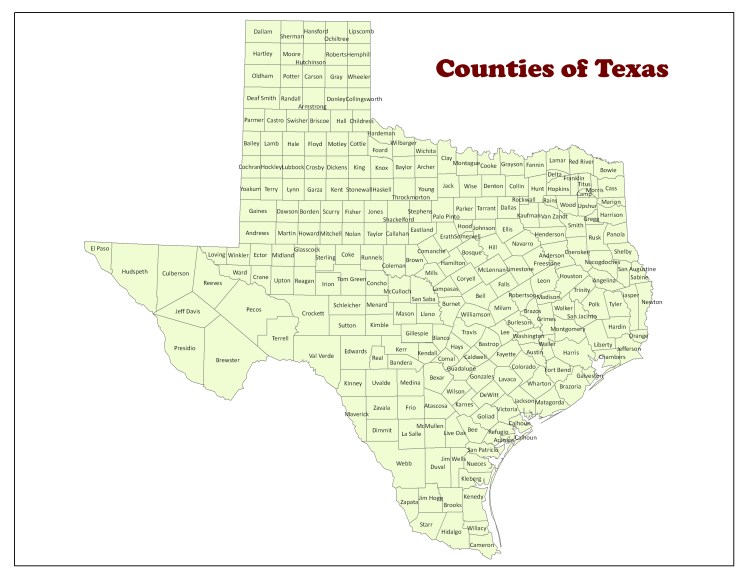
A similar problem also occurs when we look at the shape of counties. Most are just square boxes. These do not represent any kind of human boundary created for reasons that typically result in boundaries when looking at the course of World History.
TexasCounties

Straight lines and ninety degree angles are rarely meaningful when it comes to discussions of human differences and associated causes and effects! These boundaries do not represent blood and tears for hopes and fears.

Another question I have been thinking about is Texas History as the study of examples of what happened in Texas, compared to Texas History where Texas is its own entity per se. For example, the KKK and destruction of Native Americans is part of Texas History because it happened in Texas, for sure. But the same things happened in every other state in the nation. In Dallas there was a KKK Day at the state fair in 1923, but what makes this Texas History and not United States History or Southern History, the History of any other city, county, state, or other geopolitical area?

For sure, when teaching Texas History I want students to know (and hopefully internalize) that slave auctions did happen in Texas – we do this by looking at around a dozen different newspaper clippings. I also want them to realize that the KKK did operate in Texas, that Women did demand rights in Texas, but these are part of much larger historical trajectories.

Students come into Texas History expecting narratives that historians largely consider mythological and not worthy of serious attention, so to speak. And these myths are shared by people across the United States as being Texas. Legends of cowboys and Indians and stories of the “Old Wild West” are extremely overstated and still don’t contribute toward something that could be a Texas cannon of History.

Texas as an entity of its own really comes into play recently with all of the textbook battles, since Texas controls a large part of the national education industry. These battles result from the ways in which the State Board of Education operates in Texas – but even still all of the United States are so interconnected (and connected with the World) that it is hard to say this is Texas History.

The process of constructing History is somewhat easier with the United States because it is more of a full entity per se. Take Gold Diggers of 1933 -it clearly reflects themes of the Great Depression and speaks to hopes and fears of its day to those living in the United States at that time, but does it reflect the hopes and fears of those people in Texas specifically? It does, perhaps not as much as some other places considering how rural Texas was at the time, but the United States as a geopolitical area is the important reference point.

It is almost as if Mexico and all or almost all of the other states make the borderlands of Texas. Texas interacts on a very real, everyday level with peoples, ideas, and institutions in New York, California, and many other cities, states, and even countries.

There are for sure important stories that would show Texas as its own entity by looking at why Texas has so many large cities–but then again we get into questions that Texas was basically just created, not an area fought over and defended per se.

On another note, people in Texas frequently like to embrace Texas Nationalism and express hopes that Texas will be its own nation again one day. For all practical purposes, Texas never was its own nation, really. And today many cities in Texas fall into the “Any City, USA” box given how homogenized everything is – homes, businesses, roads.

Texas is seldom its own entity. Conflicts and memories associated with the Alamo are presumably more Texan than anything else in Texas History. Even when it is, the Alamo is associated with a series of events in one very small part of what became Texas.

During the Civil War, people in the South brought around 40,000 enslaved peoples to Texas for “safe keeping.” What does Texas mean in this case? They clearly did not go all the way to El Paso, for instance.

Pardon all of the hypothetical questions posed here. And sorry for the disorganized nature of these thoughts. I’m basically just really interested in how the ways in which Texas History can help us understand the larger nature of how History is constructed and remembered and then in turn, how the shape of an area influences what we call History. Texas was created by documents and wars between federal governments in a very short period of time.

Institutions in Texas–such as enslavement and basic governmental structures–were transplanted to Texas using preexisting templates in the United States and New Spain/Mexico. The subjective and quick ways in which Texas came to be provide some good examples of how the trajectory of history could have easily been very different. How different would a Texas History course be if, for instance, one of the other proposals for the shape had been favored?

Studying and teaching about Texas makes me realize how very much Texas is connected to the United States. It’s very hard to separate narratives about the two. And that makes me wonder how much more than I have realized the United States is connected with events around the world.

Another different thing about United States and Texas History is that, in terms of World History, there isn’t very much of it. A large part of why there isn’t very much History is because 90% of Indians died within a generation or two after 1492. People in European countries and other places around the world have been where they are for many more hundreds and in cases thousands of years.

Broader questions relate to and seemingly point to that the History in a given place is more about examples in that place vs. that place as its own entity since there are so many common themes across the World. With different examples and stats, my Industrialism lesson would work in most any course because I focus on broad themes and consequences. So the lesson here is that we’re all very connected. In other words, there are very few specific geopolitical areas–especially in the Modern world–that constitute an example of History and place as entity.

So (and I think this is the second place I am planning to write a conclusion for this blog!), studying and teaching Texas History has given me new insights into how much everything is interconnected and how problematic per se it is to study a subjectively organized area of land. Nothing can be taught in a box! None of this should be taken as criticism of Texas History but as another layer of concepts to be relayed in such courses that speak to the power and construction of History. We can also ask when and how does isolating a series of events to Texas (such as a book looking at the Civil Rights Revolution in Texas) help or hurt our understanding of such events.

If you made it this far, thank you! Please reply with your own thoughts.

Making Light of Slavery?

Recently in the Texas History class I am teaching a student shared an example of how two friends would quasi reenact an enslaved, enslaver situation at the place where they work. The White person would tell the Black person “get to work” and so on.

This student followed up in an email asking my thoughts: “How do you feel about that though, specifically, making a joke out of slavery? Do you think it’s offensive, ignores the plight of the enslaved, or perhaps something I/we haven’t considered? Or is it okay, diminishing the detrimental effects on the psyche of the African Americans by satirizing it?”

I asked if I could have time to think about it and “reply” here. This student said yes, so here goes.

Slaves_ruvuma

To start, I think a good example of shedding light on people who make light of the institution of enslavement can be found in the YouTube series Ask a Slave. There are two “seasons.” Most of the episodes are very good and use humor to shed light appropriately, in my opinion, and they also provide valuable (and accurate!) insights into the dynamics of enslavement.

As far as two friends joking about enslavement, it would really depend on the two friends, how well they knew each other, their level of historical literacy, and their individual experiences and perspectives on the world. It really just depends.

But, given the very deep-rooted nature of enslavement in the United States and institutionalized racism, almost regardless of how close two such people are, if one is racialized as Black and is always the enslaved and one racialized as White and always the enslaver, there would almost unavoidably be some layer of real and hurtful power dynamics going on.

I know some people say that White people are more sensitive to enslavement and past discriminations that Black people are. Again, these are both very large and dangerous generalizations. HOWEVER, again, given the nature of racialization and the codification of these mores both socially and legally, it is likely that people racialized as Black have no choice but to not take discrimination or jokes about enslavement very seriously per se. They have to be okay with it per se.

Imagine being a social or political minority in terms of how you are racialized, genderized, sexualized, etc. and you are very accustomed to the parallel microaggressions, you learn to “deal with it” and “ignore it” in most cases. For example, I know many cisgendered, heterosexual men who are more pro-LGBT rights than non-heterosexual (or queer) men. Being too close to a social need or problem makes it mandatory to be more non-responsive at times, for some people, the way society treats people outside of the White cis-Male Protestant Heterosexual paradigm.

Additionally, on the note of making light of enslavement or using the word “slave” in various ways: I know sometimes people will make comments along the line of “that professor (or boss) is a real slave driver” or “being in graduate school is voluntarily enslaving yourself.” I think these parallels are very dangerous and should be done cautiously, if at all. One way to understand or contextualize this perspective is to look at notions of Semiotics. Semiotics studies the relationship between symbols and the words these form and the things the symbols and words represent/refer to. (Semiotics is a very interesting field!) So, if we casually and regularly use the word “slave” in ways other than to refer to those children, Men, and Women who were all Black who actually were enslaved in the United States (and elsewhere) we alter our largely unconscious knowledge / relationship to the word “slave.” Consequently, when thinking about people who really were enslaved, our historical memories and notions of such history are misguided and do not allow to fully internalize the full horrors associated with the institution of enslavement. In other words, if we use the word “slave” to refer to a really hard class, we change the subtle and unconscious definition of “slave” and lessen the seriousness of actual enslavement.

This chart below does a beautiful job of describing when the word “Nazi” can be used without offense.

The-Wonkette-Nazi-Analogy-Flowchart

I think a parallel chart would also illustrate when the word “slave” can appropriately be used. For example, during the era of neoenslavment (aka convict leasing), lynching, etc, “worse than slavery” is appropriate. “Slave” is not appropriate, as the proslavery argument suggested, for people who just work long hours for little compensation.

The institution of enslavement was based on racialization and had theological, economic, cultural, social, political, etc, etc implications. People who are enslaved face punishment and death for rebelling, leaving, for anything or nothing at all. Families can be separated. Enslaved peoples, as the institution developed in the United States (and elsewhere from the 1400s to the 1800s), have no legal voice or existence.

Consequently, there are few real parallels–the Holocaust being one of them. What Michelle Alexander has termed “The New Jim Crow” could also be a parallel. “The New Jim Crow” describes a systemic and institutionalized practice of targeting and imprisoning Black Men.

So in sum, making light of enslavement does not do any one any good per se but does do much harm. At the very least, this undermines the real experiences of real people, and at the worst, it serves to perpetuate racism and condone microaggressions.

Does this answer the question? What other thoughts do we have?

The Emotional Costs of Student Success for Our Students

“Success” means many different things. There are as many definitions as there are people (or students in this case).

“Student Success” is the current big push at colleges and universities across the nation, and this push is largely being forced upon colleges by state legislatures and federal bodies overseeing education. This well-intended goal has many definitions but generally includes a focus on having higher enrollments, more full time students, students passing their classes (with high grades), and more graduates.

One aspect of this approach is that it tends to, at least sometimes, imply that students who do not graduate or who are not full-time are not successful. Not everyone needs a degree to do what they want in life. Not everyone ultimately decides they want a degree. Additionally, some students only want to take a few courses.

To me at least, “student success” in its ideal and highest achievement has been the hope or goal of students earning higher and higher grades. I always tell my classes I hope everyone earns an “A”. Any of my students can tell you that you have to really work for an “A” in my class. If 50% earn an “A”, it’s not because of grade inflation; it’s because they worked really hard for it.

Last night my dad (who is also a professor – I loved teaching and school so much, he decided to follow my steps) were discussing different situations we had with students. The conversation evolved into a discussion of the emotional costs of student success.

studying-boh

The basic thought is–and it seems very true from personal experience and experience working with approximately 2,830 students since May 2007–that there are certain negative consequences per se to earning an “A” in a class or especially to having a 4.0.

As someone who earned an “A” in every class as an undergraduate, I can testify to the fact that being an “A” student is lonely per se.

The “A” student can experience this “loneliness” because they are spending most of their time studying. Studying instead of partying, “hanging out,” etc. Additionally, there is a certain negative stigma attached to doing extremely well. The “A” students are labeled as “nerds” or “geeks.” People who “have no life.” People who are “different.”

Consider the following two conversations:

“Hey, Sam, What grades did you get this semester?”
“Did well. No big deal but got a 4.0. What about you?”
“Wow. Not that well.”

and

“Hey, Sam, What grades did you get this semester?”
“Got an A, 2 Bs, and a C. What about you?”
“Sweet. About the same for me.”

While pretend, I have seen conversations like this play out many times.

There are at least two implications for educators:

One, although we want our students to all do well, study hard, ask questions, and be 4.0 students, this is an unrealistic goal in a large part because of the negative consequences with making good grades. It is sometimes alienating, and it sets a precedent to continue studying really hard.

Two, for student success to be truly effective–carried to its logical and ideal ends–we need a culture that truly celebrates and embraces thinkers, studiers, questioners. Of course, all students are capable of learning the skills necessary to be the “A” student, but this is not what society or peer pressure really wants or rewards or even allows in some cases. Consider how the Culture of Beer, the Culture of Football, the Culture of Politically-Rewritten-History-Books, for example, and the anti-intellectualism generally therein is vastly different than the Culture of Intellectualism. Consider a world where there are commercials advertising an up-coming talk by a philosopher instead of the newest flavor of beer or the newest gun. The rhetoric of what we advertise speaks volumes to what we truly value.

So as we ask ourselves what we can do to help more students earn higher grades and ask ourselves what we did that caused so-and-so to not reach “their full potential,” we must recognize that at least some of the issues are systematic and institutional. The emotional costs of success are high, too much so for some.

studyinginclassroom

The Rhetoric of Exclusion: Assumed vs. Stated

In my Texas History class, this week and the next two weeks are devoted to the question: “How revolutionary was the Texas Revolution?”

Yesterday’s lesson was “Blacks from Africa to Texas.” We looked at the development of enslavement in Texas; how (unlike in the British Colonies) it was transplanted as a pre-existing, very established institution by White  settlers in Texas; the debate related to enslavement between the Mexico government and settlers in Mexican Texas; and briefly at the institution after the Texas Revolution. Tomorrow we will look at Women and the Texas Revolution – Black Women, White Women, Hispanic Women, and Native Women. Over the next two weeks we will look at the Texas Revolution and historical memory, manifest destiny and the Mexican War, and the institution of slavery as Texas became a “slave society.” 

item_texas_constitution

This week in particular we are looking at the 1836 Constitution of the Republic of Texas. You can read a copy of this here. One of my goals this week is to get students to examine the rhetoric of stated vs implied exclusion.

This Constitution specifically prohibits Blacks and Indians in the following places: 

Article I, Section 7: The senators shall be chosen by districts, as nearly equal in free population (free negroes and Indians excepted) as practicable

General Provisions, Section 10: All persons (Africans, the descendants of Africans, and Indians excepted) who were residing in Texas on the day of the declaration of independence shall be considered citizens of the republic and entitled to all the privileges of such.

(This document also prohibited non-enslaved Blacks from residing in the state without special permission. Enforcement increased and decreased. Later on, perhaps in an attempt to cover up the illegal importation of Africans directly from Africa, Texas passed a law allowing non-enslaved Blacks to voluntarily enslave themselves.)

That this exclusion of Blacks and Indians is specifically stated is interesting. Why was it necessary to specifically state what had been assumed before? At this time, I do not have a direct answer per se, but by applying knowledge from other historical situations, this stated exclusion indicates there was more tension–a lot more tension–and fear in the air and challenges to prevailing mores. The institution of enslavement was one of the main–if not the main–causes of the Texas Revolution. Texas Enslavers were constantly worried about the security of being able to have their human “property” — due to both racism and that they had a lot of money invested. In 1836, the average enslaved person was sold for $575 ($15,000 in 2013), and in 1860, $800 ($23,000 in 2013). The 1835 enslaved population was at least 5,000 and by 1860 it was at least 183,000. Like most other “slave societies,” Texas’s enslaved black population ranged from about 25-30 percent of the total population. 

In two places–when it came to who could hold office and the establishment of new counties–the Republic of Texas Constitution excludes females. But elsewhere says:

Every citizen of the republic who has attained the age of twenty-one years, and shall have resided six months within the district or county where the election is held, shall be entitled to vote for members of the general congress.

In this case, especially since we know Women were not allowed to vote, the exclusion and inequality was assumed. 

Just as in the Declaration of Independence and in the United States Constitution, when the so-called Founding Fathers wrote “We the People” and “all are created equal” and similar rhetoric, it was so-assumed that this only included White cis-Men that it was not necessary to spell it out. Although we still have far too much inequality today, the equality we do have would be insane and morally wrong to the George Washington and others celebrated by our founding myths. Except for some minor threat from the British, the institution of enslavement was very secure and very established in the United States when the Constitution was written. No one needed to specifically exclude in writing those racialized as Black because “all are equal” did the job sufficiently.  


Republic_of_Texas_Fifty_Dollars


“6 Flags Over Texas”: History, Rhetoric, and Deleting the Past

Teaching Texas History this semester has been a blast. Teaching is always an excellent way to learn, and teaching something from a different framework/reference point is also a way to learn. 

One thing we have talked about a few times relates to: What does “6 Flags Over Texas” mean? Who and what does it include and exclude? What is the rhetoric of this conceptualization of History? 

SFOT-10-20-2007-2

The concept of “six flags” and the choice of the “six flags” privileges a very certain White narrative of History – one that is also pro-Confederacy when we consider the cumulative total of who is and is not included. While Native American nations did not have “flags” (at least not as we think of them), they are excluded from this concept. The “six flags” conceptualization does not represent all of the nations that have controlled or had influence in Texas.

Additionally, when we recognize notions of borderlands and geopolitics, we know that parts of present-day Louisiana, New Mexico, Kansas, Colorado, Wyoming, and Oklahoma were at one point officially or unofficially part of the area claimed to be “Texas.” These states and peoples are also excluded. 

Additionally, the Fredonia flag is excluded. The Fredonian Revolution was nothing more than a failed revolution. Labeling it a rebellion is to assert a form of imperialism and a “we won, you didn’t” imprint on History. 

The Flag of Fredonia


The French flag is included and the French were never even that established in Texas. 

To be erased and written out of History is indeed a most horrible thing to do and feel. The geopolitical area presently called Texas should be proud to fully embrace its full history and all of its “flags.”

“Nothing Happened Here”: History vs. history

On the first or second day of class each semester, I always do some version of my “What is History?” lesson with students. This lesson introduces major ideas and terms (such as agency, mores, etc) that I use all of the time. We also spend a great deal of time talking about various definitions of history.

One of the very first questions I ask in this lesson–and that we talk about all semester–is, “What is the difference between history with a little “h” and History with a capital “H”?”

Usually, they get pretty close.

[h]istory with a little “h” is anything and everything everywhere that has ever happened. Most of history (or the past) is not recorded. One example I use is what you had for breakfast ten years ago today is history with a little “h”. It’s history, it’s the past, it had some small impact on the world for sure, but there is no “evidence” of it and it is not deemed “important” in larger historical narrative and trajectories. 

History with a big “H” is the study of the past, the writing of the past. It’s the history that we know and have access to. It’s the events and peoples we study in this class. It’s a socially constructed narrative based on available evidence, mores, hopes, fears, etc, and changes as all of these factors adjust. 

I see history and History e-v-e-r-y-w-h-e-r-e. 

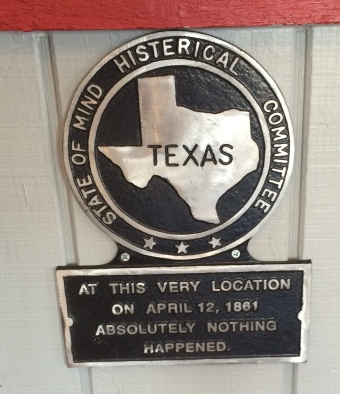
Had supper this evening, and noticed this very disturbing sign: 


2014-09-10 16.54.04

The idea that nothing happened in a given spot privileges “Great Men History” per se. In the particular spot where this sign was specifically and in the area more generally, hundreds and hundreds of enslaved individuals forcibly worked for abusive enslavers. Women cooked and cleaned. Etc. We have numerous records of these people and events in the particular spot in question.

This sign also privileges human life. In the particular spot in question, animals and plants and the broader environment also operated in a symbiotic relationship and lived and did things. 

So of course many, many things happen in e-v-e-r-y particular spot and happen all the time. Most of these become history and not History. But that does not make it permissible to ignore it. Recognition is the first step toward something becoming History. 

Additionally the date used–April 12, 1861–has significance as the date when slave-holding states in the South fired what is considered the first shot of the Civil War. Texas was very clearly and very deeply involved in the Civil War for the purpose of maintaining enslavement. So on this particular date, especially this particular date, a lot would have been happening in Texas directly and indirectly related to events far away with the official military beginning of the Civil War.

Rhetoric and History and history mater.