The Room (Poem)

The Room
With its spaciousness,
invites you.
With its tables and chairs,
talks to you.
With its storage spaces,
says, please stay.
With its location,
says, you are visible.
With its mix of different people,
inspires and encourages you.
The Room is a neat, different, weird place.
But,
you don’t know The Room.
The Room manipulates you.
And kills you.
And lies to you.
And steals from you, too.
The Room, despite or because of its nature,
kills dreams.
When you break free,
it forgets you.

Dr. Andrew Joseph Pegoda 

Film and Television – Things On My Mind Series, #8

I use the Things On My Mind series to share collections of working, not necessarily related, ideas that don’t (yet, anyway) warrant their own article or have another home.

Law and Order: Special Victims Unit receives its fair share of criticism, much of it warranted; however, here I want to mainly recognize some of Law and Order: SVU’s strengths. Writers of this ever-popular drama certainly make little effort to demonstrate (or allude to) the realities of the justice system and provide no articulation of the long-term struggles survivors and their loved ones face.

In contrast, Law and Order: Special Victims Unit creates a world where the pervasiveness and seriousness of rape are acknowledged; where no easy, one-fix solutions are suggested; where social problems ranging from homelessness and poverty, to sexism, to cycles of abuse are represented; where victims and perpetrators basically represent the ranges of ability, age, class, gender, and race; where police, investigators, doctors, courts, and juries take sexual violence seriously and don’t blame the victims; and where a White, unmarried heterosexual, able-bodied cisgender woman–Olivia Margaret Benson (Mariska Magdolna Hargitay)–is in an authority position.

Marking categories of privilege is important. Dr. Koritha Mitchell’s recent social media activity has emphasized the importance of “marking Whiteness.” I have been thinking about this and its connection to other identity categories — e.g., (dis)ability, age, class, gender, sex, religion. When experiences or identities go unnamed, we make them invisible. This contributes to the oppression of everyone. “Marking” Whiteness, for example, involves specifically stating assumptions, involves making the historically invisible, visible.

Thus, when describing Olivia’s character, I deliberately emphasize some of her identities, including her Whiteness.

Any identity explicitly marked for any person or group should, at the very least, be marked for all others within a given context. There are no “natural” or static categories of experiences. Moreover, the more categories that are marked, the more our understandings will increase and the unquestioned powers of identities will decrease. And, identities never exist within binaries but within spectrums.

Longing for friendly worlds. Ever since I watched Lars and the Real Girl (2007), I have been unable to stop thinking about it. In this movie, Lars (Ryan Gosling) is neurodivergent. He basically inhabits his own world and has trouble living and socializing as others do. Lars makes progress when he meets his girlfriend–Bianca–on the Internet. His girlfriend, however, is a life-size plastic doll. While sadly completely unrealistic in our world, every one accepts Lars and Bianca. No one teases him. No one tries to fix him. They don’t even really think he is crazy. They accept Lars. Bianca is greeted and served meals exactly the same as Lars and everyone else at social gatherings and at restaurants. Everyone attends Bianca’s funeral without any hint of sarcasm or meanness when she ‘dies’ an untimely death. Lars has unconditional support.

Lars and his personification of Bianca even generate a very real and new kind of loving bond between members of the community. I can’t think of any other film that shows such love.

What determines a text’s value? I sometimes think about why some blogs/movies/songs go viral and other do not. Which texts scholars study. Ignore. Which ones everyday society embraces and remembers. Only cherishes after-the-fact. Is it all chance and luck? Why is Lars and the Real Girl a film that will probably be forgotten and ignored? Why is Mildred Pierce (1945) theorized and studied but largely forgotten by the larger culture? Why is Gone with the Wind (1939) still popular among the public but basically always ignored by academics? Questions…

Dr. Andrew Joseph Pegoda 
No Room For Disabled People – Chick-fil-A at North Mopac and Parmer Lane

Disabled people are systemically abused, denied access, and misrepresented across the United States, and laws related to us are often ignored or are not enforced. While such problems of access and equity are often far worse in other countries, such is not an acceptable excuse.

Case in point:

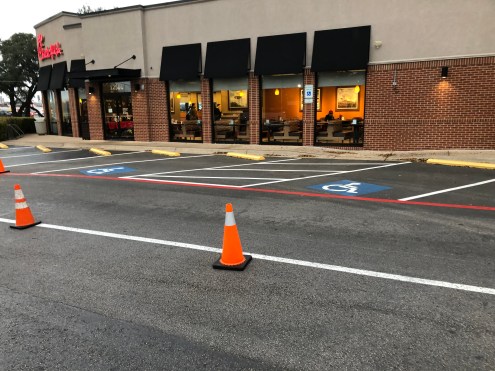
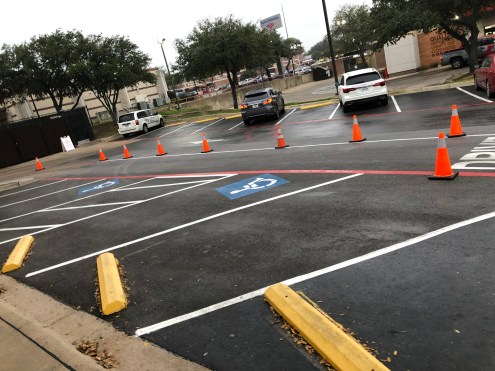
While visiting Austin, Texas, on February 7-10, 2019, I needed a Chick-fil-A fix. The closest Chick-fil-A was the North Mopac and Parmer Lane FSU location. The first thing I noticed was that they had both handicaped (I hate that word) disabled spaces completely blocked off. They have the spaces blocked off to allow more room for and to prioritize cars using the drive-thru. With both rows of cones, which began on the other side of the building, parking in (or getting out of) one of the disabled spaces would have been absolutely impossible. 

IMG_1754
Image of this Chick-fil-A’s parking lot. The image shows orange cones blocking the disabled spaces.
IMG_1755
Image of this Chick-fil-A’s parking lot. The image shows two rows of orange cones blocking the disabled spaces.

After researching Texas’s law (based on the Americans with Disabilities Act) on the issue, I learned that not only is this a violation, the location of its spaces is illegal: Disabled spaces are supposed to be the absolute closest spaces to a main entrance. As these photos clearly show, these two (inaccessible) spaces are almost furthest away from the door when considering the main row of blocked spaces.

After seeing this, I reached out by email and by social media to this Chick-fil-A and to corporate Chick-fil-A. Chick-fil-A at North Mopac and Parmer Lane never responded to my message. Chick-fil-A headquarters did, but only sent a very generic (what I call) “industrial strength customer service” reply saying the owner/operator, Mark Ortego, would be reaching out shortly. Ortego never replied. I wrote headquarters again saying they should take this issue seriously, that such violations could easily result in daily fines and that such violations discriminate against their customers. I never heard anything.

So, not only are disabled people faced with access issues, our voiced concerns and needs are ignored. The Imperialist White Supremacist Capitalist (Heteronormative Ableist Theistic) Patriarchy clearly does not care, and we should not expect this to change. 

(Coda: I am one of the lucky ones–currently anyway. I was able to personally park, enter, and exit this location without difficulty, at least on this occasion, but this location certainly lost business from people who desperately needed those spaces. I did see, upon circling the building to leave, one additional kind-of-hidden disabled space on the opposite side of the store. And this is only one example. I see such violations at all kinds of stores every. single. day. Often, stores do not have enough disabled parking spaces for their total number of spaces. Often, disabled spaces are blocked in some way or another.) 

Dr. Andrew Joseph Pegoda

Alex Trebek. Aunt Becky. Not Your Friends.

Parasocial relationships form easily. Carefully-scripted and highly-rehearsed, people see fictional characters people on their screens from the comfort of their homes and almost naturally come to believe they really know and very much like them. People are not able to internalize that this relationship is one-sided and is with a fictional character. 

Sometime during the past week, Alex Trebek announced his current struggle with pancreatic cancer. I saw countless posts reacting to Trebek’s news. Numerous people wrote that the news was “absolutely devastating.” This baffled me.

Of course, any kind of medical scare is serious and warrants sympathy. I especially relate to this because of my already long history with on-going medical scares. I do not, however, understand the reaction of “absolutely devastating.” Such a reaction would be appropriate for a loved friend or relative, but for a celebrity, a stranger? Trebek’s family could rightly find offensive at strangers effectively appropriating their feelings.

Of course, celebrities waive everyday privacy. Of course, Trebek’s scare could awaken fears in other people. “Absolutely devastating” might well be a coded reaction for fears that have not found a welcome place in the lexicon of the everyday.

The Imperialist White Supremacist Capitalist (Heteronormative Ableist Theistic) Patriarchy matters, too. (bell hooks never ceases to inspire me!) Society has trained people to absolutely accept and to unquestionably respect people like Trebek. People are supposed to see him as a “father” figure. And again, while “Alex Trebek” is his real name, his character/persona on Jeopardy! and on his other television/film projects is fictional. 

Dynamics of the IWSC(HAT)P apply to and are perpetuated by women, too.

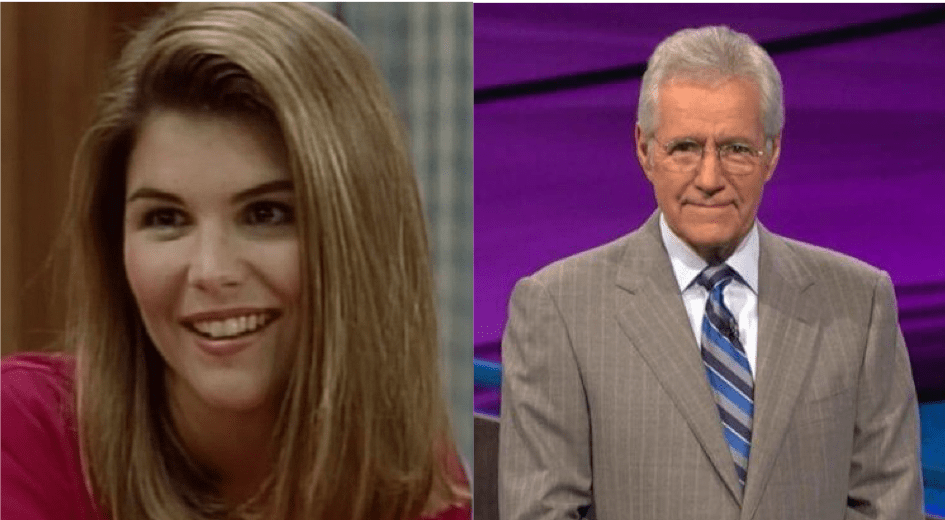
(Quick interlude: I am not suggesting any comparison between Trebek and Lori Loughlin beyond their celebrity status and the related concerns. Trebek’s cancer battle and Loughlin’s criminal record are in no way equivalents. I write about them together here, again, because of their celebrity status and because they are both in the news right now. I had been wanting to write about Trebek but lacked a framework until having the ideas in this article.)   

“Aunt Becky” (aka Lori Loughlin) is another household name. People believe they know and love her and believe she can do no wrong. She represents an ideal “motherly” figure who distills values and traditions. Her character does not challenge or even question prevailing mores. Maybe “Aunt Becky” can do no wrong–as she does not actually exist beyond the bubbles of Full House and Fuller House (which are admittedly kind of queer, as I have previously written about)–but Loughlin, as people across the United States learned yesterday, certain can.

As with Trebek, people are expressing devastation and dismay that “Aunt Becky” would face felony charges. In the case of Loughlin, I have seen a fair number of “we’re-not-surprised-a-celebrity-would-cheat-like-that” posts, but if not for everybody knowing “Aunt Becky,” she wouldn’t be receiving this kind of news coverage. 

Alex Trebek, despite Ken Jennings’s op-ed. Aunt Becky. They are not your friends. You do not know themThey do not know you. This does not mean anything positive or negative in and of itself. The public does not know. The public only knows their fictional selves, as created by other people.

I’m reminded of an interview I watched with Roma Downey of Touched by an Angel for a project I was working on. She recounted an event of being at a hospital to see a friend and having someone run up to her saying, “Monica! I was just praying for an angel. Thank you for coming.” Downey said that she tried to explain, to no avail, that she was not “Monica.” 

Dr. Andrew Joseph Pegoda 

Unemployment data is a distraction.

Despite rhetoric from businesses and governments, unemployment/employment statistics do not provide useful information. And worse, whether about the Great Depression or about today, they are a distraction. 

Unemployment data says nothing about:

  1. what work or employment mean
  2. what jobs pay
  3. available “benefits”
  4. how many jobs a person has
  5. how many hours a person works
  6. underemployment
  7. unofficial economies
  8. the kinds of labor people perform
  9. spending power
  10. economic inequality
  11. gender inequality
  12. race inequality
  13. planning for the future
  14. personal health and satisfaction
  15. forced dependency on welfare/aid from others 

Focusing on the percentage of people employed promotes a never-actually-historically-realized utopia idea that work–being employed–guarantees a certain level of economic security and advancement. Such data also says, without an acknowledgment of social constructions, that work is not just necessary but a positive good. 

Rhetoric about low unemployment data gives the employed permission to flee responsibility or thoughts of further concern. (But why is it economists say a healthy economy must have some level of unemployment – permission to flee responsibility?!)

The popular cliché–“He who does not work, neither shall he eat”–gets in wrong on both accounts. Not feeding someone–regardless–is immoral, especially in a world with plenty and with food thrown away en masse. And working does not guarantee someone can eat. Thousands of students and their teachers and professors go hungry everyday because the powers at be have determined that their own increased wealth is more important. Thousands of government workers are going hungry because of the POTUS’s support of White Supremacy. In addition this wisdom operates under the false assumption that work is automatically good and that people will be allowed to do said work. And even if those in charge of the economy allowed it to work, “work=eat” is a very low standard. 

Dr. Andrew Joseph Pegoda

Body, Country, and Betrayal: A Poem

Your body will betray you.
Without consent or reason,
Without preparation or solution,
Without fairness or predictability,
Pain and tumors will colonize.
Ideologies and histories colonize, too.
Suffering will reign in the body.
Your body will betray you,
Until an expiration date suddenly reveals,
“Life is over,”
And interrupts all.
Your body will betray you,
Always, betray you.

Without consent or reason,
Without preparation or solution,
Without fairness or predictability,
With lies and broken promises,
Your country will demand you.
And betray you:
you and your body.
Such demanding, victimizing religious patriotism,
Binds people and money and ideas,
Blinds and tortures.
With acknowledgment and dissatisfaction,
Your country and its conformists will betray you,
Always, betray you.

Epilogue:

Events surrounding Trumpism, generally, and Kavanaugh, specifically, inspired this poem, as well as Joseph Schreiber’s essay and my never-ending health problems. In addition, before today, I made several unsuccessful attempts to explore this theme of body, country, and betrayal in this medium. The poem is both personal and artistic. 

Finally, the following quotation is important: 

On the one hand, man is a body, in the same way that this may be said of every other animal organism. On the other hand, man has a body. That is, man experiences himself as an entity that is not identical with his body, but that, on the contrary, has that body at its disposal.

Dr. Andrew Joseph Pegoda

Ableism and Wheel of Fortune

Tonight, I watched Wheel of Fortune to do something different and to relax a bit after a busy week. And I got to thinking.

My students and I have been talking about privilege and its various manifestations.

This evening I got to wondering what they would do if a contestant required a wheelchair or a stool or had some kind of difference that might prevent them from being able to stand and turn the heavy wheel. What about contestants who can’t see or can’t hear? 

And it occurred to me that I’ve never seen or heard of a “disabled” contestant on the show. Admittedly, I have seen the show probably ten times in the last ten or fifteen years, if even that often. However, as a child, I watched it daily. (Wow. I am getting old.)

Anyway, I did some quick Google searches. Apparently, Wheel of Fortune had what is considered its first disabled contestant in 2014 (!!!). I can only find evidence of one wheelchair user who was a contestant but during a couples week in 2011 or so.

This is a problem. 

Wheel of Fortune should regularly have contestants with various kinds of non-normative bodies and non-normative senses. For those who can’t stand or turn the wheel, they could have someone else spin for them. For those who can’t see or hear, they could have an interpreter. 

As a disabled person myself and as someone who has all kinds of medical problems, I am disappointed that I didn’t “see” this sooner, but such is the nature of privilege and oppression. We’re so accustomed to both — sometimes we miss it. We assume that Wheel of Fortune “allows” regular people, that it perpetuates normativity, and we forget that the normative is socially constructed. 

Wheel of Fortune discriminates en masse against contestants–young and old–who are qualified in every possible way–except for their inability to stand and physically spin the wheel and/or the inability to see or hear in the “correct” way.

Dr. Andrew Joseph Pegoda 

Facebook, Birthdays, and Neoliberalism

Earlier this year and last year, Facebook started encouraging its users to garner charitable donations through its platform, especially for birthdays. 

In particular, on my birthday last month Facebook encouraged me to select a charity that friends could donate to as a way of giving a birthday present that would keep giving. Facebook even offered to chip in itself! 

With 539 Facebook Friends (as of 9-3-18), I have a friend with a birthday almost everyday and thus see requests for donations associated with these birthdays all the time.  

And I think we should reconsider this entire trend.

(Setting aside legitimate questions about how much of said money actual ends up with the specified charity.) 

At first, I thought it was a great idea. Then by only late January and early February of this year, it was getting too expensive! Giving even just a few dollars to each birthday fundraiser added up insanely quickly. 

Neoliberalism demands that we pay for research and aid once paid for by tax dollars and common decency, per se. Because of the GOP’s multi-decade-war on everyday people, charities have emerged en masse to help fill voids. No doubt there are absolutely worthy charitable organizations for every possible niche–including Reading Is Fundamental, the American Civil Liberties Union, the Freedom From Religion Foundation, and the Texas Neurofibromatosis Foundation–and they only typically survive with our money alone. 

Problems begin to emerge when there are more and more causes that urgently need our money: our money because Federal, State, and Local governments have not only withdrawn their support but have taken our money and given it to themselves and to the 1 percent in a form of “welfare for the ultra super rich.” In addition to income inequalities and price increases, such charitable responsibilities placed on everyday people only add to economic woes. 

Facebook’s seemingly generous gesture effectively contributions to the normalcy of poverty and privatization and therefore, governmental abuse, too. Facebook is, afterall, a neoliberalim platform, par excellence

I opted not to create a Facebook fundraiser for the above reasons and because I didn’t want my Facebook Friends to be visually assaulted all day with involuntary requests to make a(nother) donation. Money is tight for people. People look to Facebook for an escape from the inhumane domains of capitalism. 

(On this note, no one should be an unpaid volunteer or unpaid intern [how do you like those retronyms?!] in a capitalistic society. Society requires money. Time is money. Labor is money. All involve selling one’s body. Those with power and money should provide fair compensation for any and all labor.) 

Dr. Andrew Joseph Pegoda