A Look Inside My Introduction to Queer Studies Classes: Poetry and Identity

Today my wonderful students in both sections of Introduction to GLBT Studies (or Queer Studies) at the University of Houston explored various aspects of identity! 

We started off by listening to and discussing a variety of performance poems: “Until We Could,” “Lost Voices,” and “For Anyone Who’s Been Told it’s ‘Just a Phase’.”

Then we wrote a poem as a class. I started it by typing “Growing up it was always expected” and then let the students run with it. One of them in each class typed everything. The only rule was every thing said went into the poem! I “tricked” people a few times! Both classes did an excellent job! Lucky for you, they gave me permission to share these with you. They are below.

Then we listened to Lee Mokobe’s poem about being transgender.

Next, I gave students the following prompt (stolen from my friend and colleague Dr. Trevor Boffone – who is the other professor at the University of Houston who teaches sections of this class):

There are numerous ways to identify who we are. Who are you? How do you identify yourself to others? Who are you to your friends, to your family, to strangers? Who are you at school, work, or other locations such as church or the gym? What about race, class, gender, sexuality, religion, ableness? Are any of these categories important to how you view yourself? If so, which ones and why? If not, why not? Think about your identity. How would you describe yourself? What does this description say about you? What is the history of your identity? Have you changed? Have you always been the same? Answer one, all, or none of the above questions.

In response, some students wrote individual poems, some drew sketches and portraits, some made lists, some wrote beautiful essays – the results were all unique and wonderful. Students had an opportunity to read some of or all of what they wrote. They are all so supportive of each other!

Then we listened to and discussed Audre Lorde’s “There is No Hierarchy of Oppression” and looked at her self-care questionnaire.

Finally, we listened to “Son of a Preacher Man” while wrapping up the class.

During the last few minutes I asked students to write any final thoughts or questions about identity or the day and to turn something in for an assignment grade – for which they all got full credit!

And now I present the stream of consciousness poems to you written as an entire class.

The first one, as decided by the students, is titled, 2:30 Expectations 

Growing up it was always expected
To be a woman
What is a woman
Still figuring it out
Ooo fun
Behave
Oh my gosh
Fragile and sensitive
Pink not blue
Smart
Have to wear dresses
Reserved
Growing up it was expected
Play sports
To go to dance class
Don’t go outside the fence
To be a bad driver
To go to college
Never being good enough
Follow the curfew
Be home before the street lights come on
A right
But he’s a boy, he’ll be ok
As long as he marries a woman
Be independent
To know who I am before I know who I am
To do things as told
To be strong
Have grandkids
Do well in school
Stay close to your brother
Find a man with a good job
Don’t be too friendly
It’s your fault if anything happens
Be safe
Be careful
Never show your fears
Never let them see you sweat
Never try to be someone you’re not
Be a leader not a follower
Be perfect
What is perfect
No one is perfect
Don’t talk to strangers, but don’t be mean to strangers
Don’t let them see you cry else you’ll look weak
How can I be everything they expect me to be?
Give him a fake number so he’ll go away
Have faith that you’ll find your way
Too many demands
Believe in something
Hold on, it’ll get better
I forgot the original sentence
Follow your dreams
Be reasonable
Be successful
Be responsible
Be an adult
Grow the hell up
Pick a gender already
Get married already
I don’t wanna
When are you going to have kids?
Never
Do you think that will attract a man?
I am not trying to attract a man
Who needs a man?
No one needs a man
No offense
Full offense
I like this as an ending
Damn it
That’s good
Is the goal like three pages or something
Shhhhh
The end

The second class named their poem SHIT POST:

Growing up it was always expected
To be normal
To follow the rules
To be straight
To have goals
To go to school
Africans don’t play
No no no…..
Anything we say
Growing up it was always expected
To be like your siblings
To be better than your siblings
Who needs siblings?
They’re annoying
Yea yea yea
To make good grades
I don’t know
To be better than the rest
To be independent
To be outgoing
To fit in
To be the man
To not be weak
Be responsible
To have a boyfriend
Who needs men?
No
To be a doctor
What are we doing?
Okay
It’s alright
Huh?
Get a career then you can get pregnant
Social norms
To fix your brothers and dads plates
I’m sorry… I don’t know why I’m doing it
I have nothing
Whats the point of this ?
Reflecting on expectations
To dress like your friends
To have friends
To have nice things
Never give up
But don’t be a copy cat
To fit in
To be understood
Yea I said like four things
To eat healthy
Hmmmm…. No
To play sports
To give up your career for your family
To be a ballerina
To not be a football player
To be a football player
To be extremely wealthy
To not be shy
To be kind
Accepting of others
No to judge people
Love your family
To wanna kill your family
Had dark teenage years
Okay that’s going on the record… okay
To graduate high school
To be beautiful
To be handsome
To be able to immediately go into college
To be skinny
To be perfect
Does this person even exist?
Maybe with Photoshop
To be ashamed of my culture
To embrace your culture
The masculine man
The feminine woman
To shave your arm pits
Oh yea… you should do it
That’s sexist
That’s racist
That’s homophobic
What…
The End

It was a fun, full class! Teaching is the best!

Dr. Andrew Joseph Pegoda


Getting it (Mostly) Wrong: AJP’s Take on National Geographic’s January 2017 Special Issue on Gender

While I understand that capitalism pressures even the best media or educational outlets to satisfy its audiences, this does not excuse the distribution of misleading or inaccurate information.

One of the biggest problem with National Geographic‘s special issue on gender is that it is not really so much about gender as it is about sex (and sometimes case studies in sex/gender expectations). Consistently throughout its 150 pages, its authors inaccurately conflate gender and sex. For example, it has a world map titled “The Legality of Gender Change.” This should be “The Legality of Sex Change.” 

Some of my problems with this special issues would instantly disappear if it had been called “Special Issue SEX REVOLUTION” instead of “Special Issue GENDER REVOLUTION.” But, either way, I’m actually not sure what it means by “REVOLUTION.” There’s nothing that revolutionary about the issue or about the practices it describes. 

The differences between biological sex, gender identity, and gender behavior, for example, are extremely important to understand. Too many people think sex and gender are the same. It’s also important to understand they all involve multiple social constructions and all exist on spectrums–which are in sharp contrast to the binary-based, structuralist thinking during the Gilded Age  and Progressive Eras, eras during which our current conceptions of all things related to sex and gender first came about.

National Geographic provides readers with lots of information that is, no doubt, useful, but in addition to misinforming readers about the definition of “sex” and “gender,” it is entirely too normative in every way possible–it really needs to be queered up. There aren’t any people who appear as “men” in “women’s clothing.” (See an example of this gender bending here.) There aren’t any “shocking” illustrations of how unique and different all humans are when it comes to what we call sex and gender. “Shocking” examples are limited to pictures of three unclothed, teenaged male members of the Bukusu tribe in Kenya prior to their circumcision and to a discussion of female genital mutilation. These “shocking” examples are akin to a “poverty tour” and perpetuate the idea that such things only happen far away in poor countries. As this video about Intersex people introduces, similar barbaric practices happen right here.

Examples are focused more on males and masculinity. As some have put it, “the issue fails women.” In the catalogue of pictures, examples are focused on the “default” historical stand-in images when thinking about world History and diversity – the Native American, the Kenyan, the Muslim, the Chinese, the White dad with kids are represented.

In sum, then, editors missed an opportunity to really educate and “upset” people in much needed ways. Think how they could have shocked readers with a discussion of how a person’s sex constantly changes according to those around them and according to what they do, for example. (See Delusions of Gender.)

Dr. Andrew Joseph Pegoda

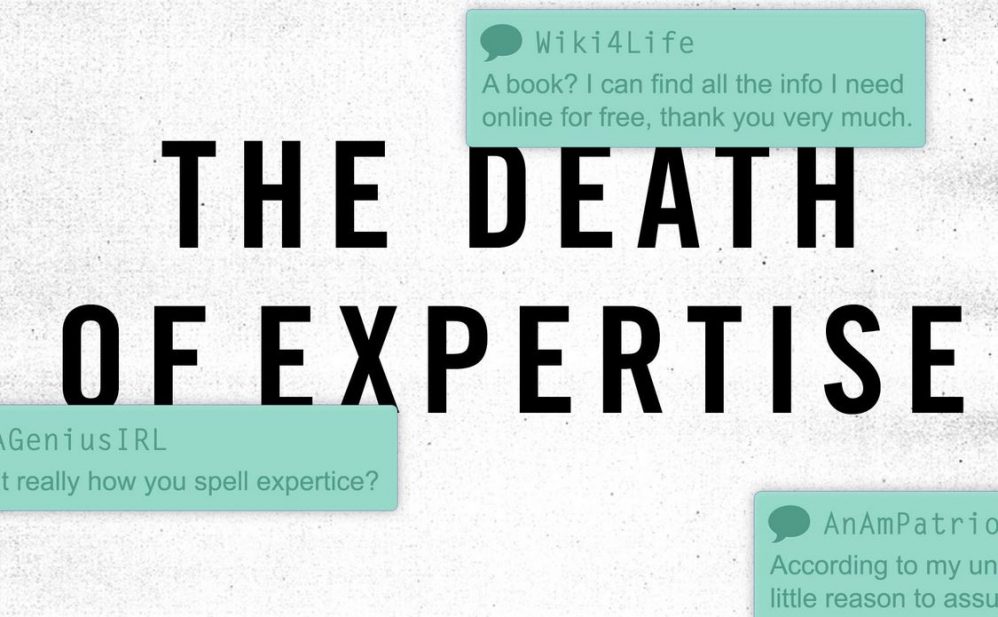
AJP’s take on Tom Nichols’s “The Death of Expertise: The Campaign against Established Knowledge and Why it Matters”

My copy of Tom Nichols’s The Death of Expertise: The Campaign against Established Knowledge and Why it Matters arrived earlier this week. I started the book late last night, and a few hours later, I finished and can say that The Death of Expertise is an extremely interesting, important, and timely book. The Death of Expertise is full of specific human examples.

According to George Lakoff’s The Political Mind, direct examples (in contrast to evidence for systemic causation) that can illustrate causation are much more effective for conservative readers, so hopefully this book will gain an audience among those more prone to perpetuate the death of experts. (I wonder if we should have predicted the death of experts after “the death of the author”? Although, this poststructuralist method for reading texts remains useful and one I use in my work on films.) 

Nichols, in short, provides a brief History, informed by psychology and political science, of what he argues is a new phenomenon whereby people in the United States are not just regularly wrong or ignorant but “proud of not knowing things” and are “aggressively wrong.” Such a “philosophy of life” has potentially deadly consequences, not to mention the stress and frustration this causes, and will cause the United States to fall more and more behind other countries. This History explores how the nature of information–it’s creation, publication, and delivery–matters and how it has changed overtime. 

Anyone who is an expert–a term Nichols fortunately does not tie to credentialization–will personally relate to the frustration of being an actual, real-life expert, being right, and yet having uninformed masses, guided by confirmation bias, unable and unwilling to see evidence scream how wrong you are. They will simply guess or perpetuate “fake news.” 

And Nichols is actually critical, saying that too many students go to college today and says that sometimes college graduates are the worst at thinking they know everything and have a right to disagree with experts.) 

Little frustrates me or makes me sad more than when people (especially voters) believe things that are simply wrong and easily known to be wrong and when people mistrust experts and the hard work it takes to become one. The Death of Expertise explores such dynamics by looking at what it means to be an expert vs. a citizen in a republic, what it means to just go to college vs. actually learning and being challenged, what it means to live in a society where Google houses answers to everything written by a society of journalists (professional and non-professional) who lack expertise in the topics they report about, what it means that people generally no longer do (or know how to do) true research, what it means when experts themselves are wrong, what it means to say “I don’t know,” and what it means that social media has made conversations much more difficult (or impossible). 

The Death of Expertise does what good books do as possible and provides some possible solutions. For example, he calls on society to use experts and respect experts and to allow them to be human, to know and expect that they will occasionally make tragic mistakes. He calls on academia, particularly public intellectuals, to communicate more effectively with the general public. He also calls for more careful, considerate use of the word “expert,” saying the word loses value when there are “yard care experts” and “carpet cleaning experts,” for example. Here I’m reminded of Michael C. C. Adams’s reservations about the overuse of the word “war” in his The Best War Ever: America and World War II but also Virginia Woolf’s warning that “when words are pinned down they fold their wings and die.”

Overall, I agree with the analysis and discussion in The Death of Expertise. Nichols’s chapter on colleges was the only one that I regularly found myself having ideas of disagreement. For example, I do not think that email and Facebook and other such technologies are “great equalizers.” If anything, being somewhat “equalized” in those ways is helpful for the learning process, especially when looking to adult learning theory. Technology has made more and better learning possible in countless ways that I have written about elsewhere. I also think that, provided the correct learning environment and freed from the pressures of capitalism, the more people with a college education, the better. Additionally, I do not fully accept the notion that some people simply don’t belong in college. Such a theory of knowledge goes against research–some people can change and improve their academic skills. However, I do agree with The Death of Expertise‘s statement that student evaluations are problematic and that “college is supposed to be uncomfortable.”  

On a more global scale, The Death of Expertise does not explore class, race, or sex (namely, patriarchy), for example. This concerns me, or it is at least something readers should be aware of. I am reminded of Koritha Mitchell’s research and public scholarship addressing the low, low standards for White people in the United States. I am reminded too of research from countless scholars and fields that looks at the role of patriarchy and the dangerous “father is always right” mentality. Media outlets and conservative politicians exploit people without access to money and resources to be more informed. If you can’t afford to see an expert because of capitalism and racism and sexism, we’re talking about a different problem concerning the death of expertise than if we’re talking about the changing nature of society aided by computers.

Of course, not every book can explore every topic. This 250-page book would have to be another few hundred pages to add more layers to the analysis! The Death of Expertise has potential to start more important conversations, to let people know they are not alone, and to let people know the nature of knowledge and learning is important and deserves on-going attention. You can find an excerpt from his book here.

Dr. Andrew Joseph Pegoda 

Why would Cruz and Abbott call for term limits?

At first I was excited when I saw word that Senator Ted Cruz (and thinking, “wow, we agree on something!?!”) and then Governor Greg Abbott were calling for Congressional term limits.

At first.

Until I remembered that Cruz and Abbott do not care about the people who elect them or anyone else but only care for themselves and the ultra, ultra rich White men. 

We are then left with the question: Why would Cruz and Abbott call for term limits? Why? Why would Cruz voluntarily limit the possible duration of his job? How would this, ultimately, help them and the power structure?

In some ways, I don’t know. Term limits would tend to give more power to the states. I don’t hear Cruz or Abbott calling for limitation of the Office of Governor in Texas that so concerned people when it seemed like Rick Perry might remain in office forever.

But it would also be expensive…it would greatly expand the number of people who received federal benefits for life. 

And, mostly I suspect, as I have seen a few others say, that this would result in a Congress at the national level that even more than already would never get anything done and couldn’t get anything done because no one would ever really know what they were doing. This, in turn, would cause the nation’s CEOs and others to become even more influential and richer.

Term limits would also make it even harder for “the people” to become acquainted with their representatives. It would tend to prevent representatives like Senator Elizabeth Warren from having an on-going national platform. It would be harder for the women and men in office to assume positions of necessary power and respect within their communities. 

In sum, a combination of wanting the federal government to get less powerful and in turn, people having less of a political voice, while making states and CEOs more powerful motivates their desires for term limits, I predict.

Just a few days ago I remember thinking about how term limits would be a good idea, but I’m not so sure any more. Maybe, term limits greatly expanded from Cruz’s and Abbott’s proposal.

And before we talk about term limits or any other political reform, we need to get big, big money (i.e., Koch brothers, for example) out of politics! Politicians should not be “owned” by a company.

Dr. Andrew Joseph Pegoda 

Neoliberalism and the Violence of Scholastic Scholarships

Neoliberalism, which has little to do with the political philosophy called (modern) liberalism in the present-day United States, has its roots in classical liberalism and in (modern) conservatism. Neoliberalism is also so powerful and pervasive that most people cannot see it and never really know what it is.

Neoliberalism has a variety of tenets and goals. These include:

  • removing the government as an entity responsible for its members (especially in terms of social services) and transferring responsibility to private businesses and organizations 
  • enhancing the role of money and costs of doing “business” – thereby, ensuring the inefficiency of everyday life and the perpetuity of capitalism  (e.g., it would save the government and its members billions, if not trillions, of dollars, if it provided “free” education and healthcare for all).
  • trusting private business over the government and not trusting any form of regulation or governmental power
  • believing that every person is ultimately responsible for him or herself and that nature and nurture are irrelevant and believing that private property is essential to creating moral citizens 
  • erasing (most) geopolitical boundaries between nations when it comes to economic opportunities  
  • emphasizing (unique, rare, exceptional) individual people and their stories as proof of how successful the social order is 
  • believing “that the world needs exceptional heroes and elite structures to rescue impoverished and oppressed people
  • outlawing unions and other such organizations that challenge the status quo
  • moving past any interest in the public good – everything is about the individual and his and her climb above others

For more information check this or this.

Of these, privatization and decreases in public funding have especially important consequences for education. (Have you noticed that essentially every college and university has a linked private foundation? Such foundations would not be necessary if our society provided full funding to its future and enrichment.) Institutions of higher education across the nation have received less and less funding for decades. Given the expensive of education, federal loans, student aid, and scholarships have come to play an essential role.

Here I want to articulate some thoughts that have been on my mind, namely that scholarships are violent. 

To begin, it’s worth stating that scholarships are a perfect example of neoliberalism in action. For example: an organization collects money from wealthy benefactors and in turn redistributes this money to select individuals in the form of a tuition scholarship. This is a process necessary only because of neoliberalism. This private-sector-function could and should be done by the government. The government could do this much more efficiently, cheaply, and equitably. Every one (notice that it is two words?) could be provided a “free” education. Governments outside of the United States do this and have done this. Moreover, governments outside of the United States even provide basic incomes to college students. 

Scholarships are violent, then, because not every one gets one. Scholarships take time that the people who need such assistant most might really not have. 

Violence also occurs when people say, “all you have to do is find them and apply,” “hundreds of scholarships go unclaimed.” From all that I have seen and heard, the belief that “scholarships go unclaimed” is on par with “fake news.” Maybe not many apply, but if anything, scholarships are far too hard to find and not available to meet full demand.

Violence occurs because scholarships generally do not cover the full costs of tuition and fees and books and computers and food and transportation and incidental fees and medications and so much more.

Violence occurs yet again when people say “work and go to school at the same time.” Any amount of working for the 98% is not enough to pay for college in the 2010s.

On the other side, even recipients of scholarships are victims of violence in that no one explains that scholarships are a manifestation of a specific ideology (i.e., neoliberalism) generally unique to the United States (when talking about so-called “First World Countries”). Additionally, recipients seldom understand that they are one of the “lucky ones” because of luck, privilege, and other factors.

And there is the added factor that neoliberalism greatly complicates the value of and rewards of receiving college degrees because of its violent reliance on “workers,” on workers who lack any kind of protection, who are aching and starving.

(Added 5-12-2020, as Dr. Sara Goldrich-Rab points out, scholarships also often require students to “perform their poverty.”)

Dr. Andrew Joseph Pegoda


Obamacare is Saving My Life. Will you let me live?

No one is born voluntarily. Even more, no one asks to be born with permanent disorders and diseases.

And because of capitalism and its inhumane nature, people like me “cost” millions of additional dollars over a lifetime in order to live. And this is largely due to being born in the United States. The United States is the only so-called “first world country” that doesn’t guarantee basic survival. Having “Medicaid for all” is the only true option. 

My entire life has been dependent on having very good insurance because in the United States one can only get good healthcare with very good insurance. Because part time professors generally do not get insurance (just like part time employees across the nation generally do not get insurance – even though we end up working the equivalent of several full time jobs), I have been on Obamacare insurance since January 2014. And starting in December 2016, I have been on insurance with the University of Houston because of how they calculate working hours and because of how they interpret and follow Obamacare rules.

My life depends on having quality insurance and quality healthcare. In the last month alone, I have had three MRIs (each one can easily cost $10,000+ before insurance), doctors visits with a half dozen or more specialists (including a surgeon), and have had a minor eye procedure. In the next month, I see another surgeon and the heart doctor. Because of how life is not valued in the United States and because of how selfish the insurance industry is, these visits are insanely expensive. I am on 13 medications now, too. 

But because I have Obamcare insurance, most of it is covered, and for what isn’t covered, I will be paying $30 a month for the rest of my life and will die one day indebted financially to M.D. Anderson Cancer Center – but they don’t need the money!  

During my time with insurance because of Obamacare, I have had easily $300,000++ in medical bills covered. 

Republicans in D.C. continue to show how little they actually care about the people they represent. By even advocating the repeal of Obamacare right now, they are seconds away from being murderers. It baffles me that anybody voted for them since they ran on something of one single issue–killing millions of fellow citizens.

Dr. Andrew Joseph Pegoda

15966075_1292023114187099_5146304837418264743_n


Teaching Texas History Backward – Update #1

Almost since I first head about the “new, radical” notion of teaching history backward, I have been intrigued. I first heard about it while overhearing a conversation–while presenting a paper at Rice University in March 2014–about how Dr. W. Caleb McDaniel was teaching his survey course backward, starting with the present and working backward. 

It took some time for the idea to fully soak in. While I have wanted to try it for sometime, I have hesitated for a number of reasons, but I am finally going to try it this semester in my Texas History class!

While the idea seems new and radical, it apparently dates back to at least the 1870s1890s, 1900s, and the 1970s! About 95%+ of those I have discussed this with in the past (including students), find it fascinating and different. The idea is, simply and partly, that learning occurs naturally and most productively when people start with the most familiar and work slowly toward the unfamilar.

Additionally, the hope is that by working backward, the focus shifts much more directly to “how” and “why” instead of “and then this happened.” When discussing each period, you ask “what do we need to understand about the previous era to understand this era.” 

Additionally, as I have written about before, history really is the study of the present (not the past). President Barack Obama influenced Dr. Martin Luther King, Jr., much more than the other way around.

And, as my syllabi say:

History is a tale told about the past in the present for present purposes.

The past is never dead. It’s not even the past.

This approach will help decenter typical trajectories and force all of us to think in different, new ways.

So, I am excited to see what happens. I am constantly trying new things in the classroom, and this is one of the latest ones! I’ll be blogging with updates regularly. 

For more information on recent approaches, see Dr. Rob MacDougall‘s “The Backward Survey,” Dr. Tim Lacy‘s “Off-Topic Methodology Bleg: Teaching History Backwards,” The History Education Network’s “Teaching History Backwards,” Dr. Kenneth W. Hermann’s “The Pedagogical Strengths of Teaching History Backwards,” and Dr. Annette Atkins‘s “A Teaching Strategy: Teaching U.S. History Backwards.”

Dr. Andrew Joseph Pegoda 

AJP’s take on Josh Katz’s “Speaking American” – An exploration of culture with maps and digital humanities.

Journalist Josh Katz has done some incredible work in the digital humanities (i.e., using computers to analyze information and then making that information visual). See his map about the new phenomenon of men not working in the United States. And this map about the popularity of various contemporary television shows.

pp127His book Speaking American: How Y’all, Youse, and You Guys Talk – A Visual Guide is very interesting. Don’t be deceived by the title “Speaking American” – this book is not at all saying there is any “one” or “correct” form of speaking. This book has over one hundred maps that illustrate how complex and different language is across the United States based on various surveys/quizzes. What words exist and don’t, as well as how they are pronounced differ in ways that match geography.

Have you heard of a “tag sale”??

If you want to borrow the book, let me know! We can mail it around to each other! 

This is not the kind of book I would recommend buying, necessarily, because there isn’t much to actually read, and it takes about 30 minutes to go through all 200 pages. It makes for a good “coffee table” book. Don’t get me wrong – there is plenty to think about. But once you look at it, the book has probably served its purpose. Unlike the articles linked above, the information in this book is not all that scientific. If you do buy a copy, buy a physical copy of this one! The kind of maps it has don’t work well on the Kindle.

Dr. Andrew Joseph Pegoda